
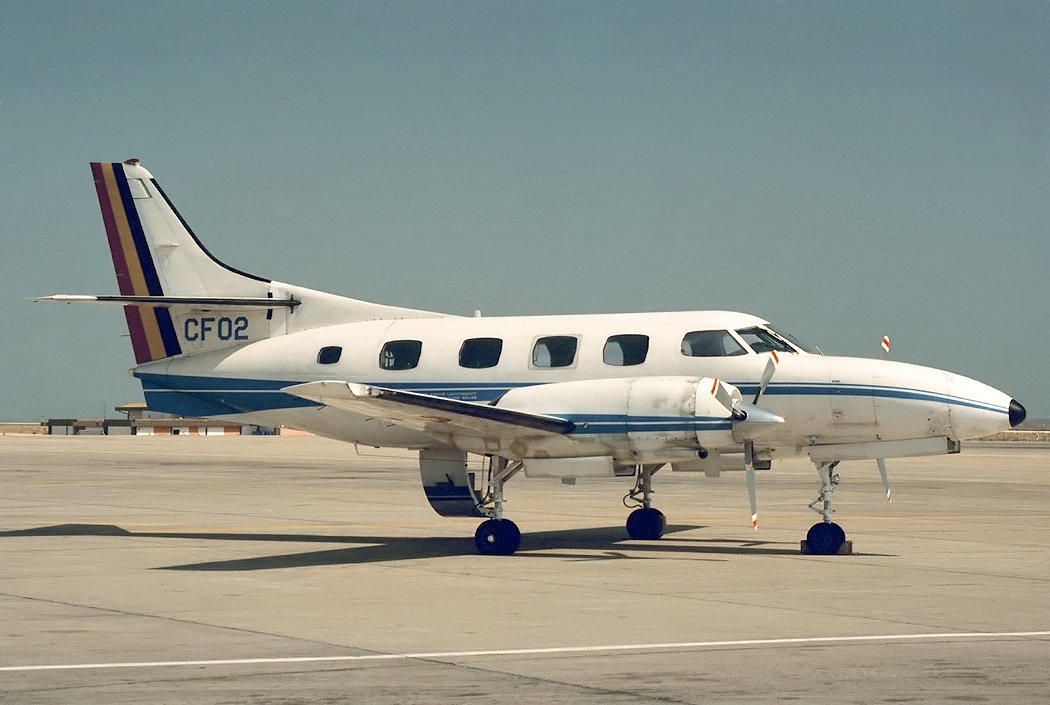
Belgian Air Force Merlin IIIA CF-02 on the ramp, around 1990. · Pedro Aragão, CC BY-SA 3.0, via Wikimedia Commons
Swearingen · Turboprop
Merlin III / IIIA (SA226-T)
The second generation of the short-body Merlin, built between the Merlin IIB and the more powerful IIIB.
The Merlin III and IIIA deliver King Air-class space and speed for a fraction of the price, but ownership hinges on engine times, wing spar and trim inspections, and finding shops that know the type. Buy the paperwork first and the airplane second.
Buy it if
You want a pressurized six-seat turboprop that cruises near 283 knots for well under $600,000, and you have a TPE331 engine shop and a mechanic who knows Merlins lined up before you buy.
Skip it if
You need an enclosed washroom, a quiet cockpit, easy resale or predictable maintenance bills. A King Air 200 or Conquest II costs more to buy but is easier to support, insure and sell.
Biggest compromise
Cheap to buy, potentially expensive to own. Two TPE331 engine overhauls can approach the value of the airplane, and a 50-year-old airframe carries repeating FAA-mandated inspections of the wing spar, wing attach fittings, pressure bulkhead and pitch trim actuator.
The numbers that matter
What it costs per year
$582K
at 300 hrs · one professional pilot
How far it flies
1,710 nm
1,445–1,450 nm with passengers
How fast
283 kt
high-speed cruise
Seats
6
6 typical, up to 9 by interior
Pilots needed
1
Flown by one pilot; no type rating needed at 12,500 lb, but workload is high.
Price
What one costs to buy
Typical asking price
$0
Other sites
Priced vs call
with a price / call for price
No Merlin III or IIIA is advertised right now; asking prices from 2023 to 2025 ran about $250,000 to $575,000.
Price vs its family and alternatives
Scroll to explore · select a jet for details
For sale now
None listed right now
Cost to own
What it costs per year to run
300hours / year
Per year
Per flight hour
Estimate — your operator will quote actual numbers.
Fuel, airframe and propeller maintenance, engine overhaul set-aside and trip fees and miscellaneous rise as you fly more. One professional pilot, recurrent training, hangar, insurance and databases and tracking stay the same however much you fly.
Where the money goes
- One professional pilot$145,00025%
- Recurrent training$14,0002%
- Hangar$30,0005%
- Insurance$20,0003%
- Databases and tracking$6,5001%
- Fuel$185,76032%
- Airframe and propeller maintenance$97,50017%
- Engine overhaul set-aside$64,50011%
- Trip fees and miscellaneous$18,5003%
Fuel is the biggest single cost at 32% of the total.
The JetGrade
66 out of 100 — Below its class average
Peer group: Beechcraft King Air 200, Cessna Conquest II (441), Mitsubishi MU-2 long body (G / J / L / N), Rockwell Commander 690 / 690A
Seven categories at a glance
- - - 70 = typical— This aircraft
Strongest on range & payload, weakest on reliability & support.
Grades are editorial opinions about the model, not any specific aircraft. Sponsors and affiliates have no input. Reviewed 2026-10-08.
Where it flies
Sample trips and reach
Typical trips on a map
Nonstop
Depends on weight or weather
Fuel stop likely
4 of 6 sample trips are comfortable nonstops.
Sample flight times
- 1.1 hr
Carlsbad → Las Vegas
205 nm · Short hop; lower cruise altitude
- 2.8 hr
Carlsbad → Aspen
625 nm · Hot-and-high; depends on weight and weather
- 3.2 hr
Santa Ana → San José del Cabo
765 nm
- 3.9 hr
Teterboro → West Palm Beach
900 nm
- 5.0 hr
Dallas → Teterboro
1,190 nm · Long leg; near practical range with four passengers
- 8.9 hr
Carlsbad → Teterboro
2,100 nm · Needs one stop, typically mid-continent
Lineage
What came before and after

1970–1978
Merlin III / IIIA
Metro-style wing, long nose and dual-wheel gear; IIIA added windows.

What changed from the Merlin IIA / IIB
- Longer fuselage and nose, with a baggage compartment ahead of the cockpit.
- New wing shared with the Metro commuter airliner.
- Garrett TPE331-3 engines of 840 shp in new nacelles with top-mounted inlets.
- Two wheels on every landing gear leg.
- Maximum takeoff weight rises from 10,000 lb to 12,500 lb.
- Horizontal tail moved up onto the fin, with a trimming stabilizer.
Size and cabin
How big it is, inside and out
Outside
Silhouette · scaled to length
Length
Wingspan
Height
Inside the cabin
Cabin length
Width
Height
Compare
How it stacks up
This aircraft
Merlin III / IIIA (SA226-T)
- JetGrade
- 66
- Cost per year
- $582K
- Range
- 1,710 nm
- Speed
- 283 kt
- Seats
- 6
- Cabin length
- 17′ 5″
- Pilots
- 1
- Years built
- 1970–1978
← Before
- JetGrade
- 58
- Cost per year
- $539K
- Range
- 1,550 nm
- Speed
- 256 kt
- Seats
- 6
- Cabin length
- 10′ 8″
- Pilots
- 1
- Years built
- 1966–1972
After →
- JetGrade
- 68
- Price
- $620K
- Cost per year
- $877K
- Range
- 2,425 nm
- Speed
- 290 kt
- Seats
- 6
- Cabin length
- 17′ 5″
- Pilots
- 1
- Years built
- 1979–1983
Alternative
- JetGrade
- 72
- Price
- $1.28M
- Cost per year
- $729K
- Range
- 1,490 nm
- Speed
- 289 kt
- Seats
- 6
- Cabin length
- 16′ 8″
- Pilots
- 1
- Years built
- 1974–1981
Alternative
- JetGrade
- 72
- Price
- $1.36M
- Cost per year
- $671K
- Range
- 2,000 nm
- Speed
- 314 kt
- Seats
- 7
- Cabin length
- 12′ 10″
- Pilots
- 1
- Years built
- 1977–1986
- Beechcraft King Air 200 instead: Similar speed and seating, an enclosed toilet and the deepest support network of any turboprop twin, at a much higher purchase price.
- Cessna Conquest II (441) instead: Faster and better supported on TPE331-8 engines with stronger resale, but recent asks run two to three times higher.
- Fairchild Merlin IIIB / IIIC instead: Same family with more powerful Dash 10 engines and four-blade propellers, with current asks around $575,000 to $770,000.
Gold marks the best figure in each row.
Owning one
What to know before you buy
Engines & inspections
2 × Garrett (Honeywell) TPE331-3U-303G · 840 shp each
No APUEngine hours until overhaul
- Rudder cable replacement · 800 hr
- Forward pressure bulkhead inspection · 1,000 hr
- Pitch trim actuator checks · 1,000 hr
- Hot section inspection · 1,800 hr
- Wing spar web inspection · 2,000 hr
- Propeller overhaul · 3,000 hr
- Engine overhaul · 5,400 hr
Honeywell's hourly MSP plans cover the TPE331 family; confirm each engine's enrollment, buy-in cost and transfer terms before purchase. Many airplanes now have Dash 10 engines.
Known issues
Wing spar and attach cracks
Repeat inspections of the spar web and wing-to-fuselage fittings; an unrepaired spar is a major cost risk.
Engine overhaul exposure
Two TPE331 overhauls can approach the airplane's value, so engine times drive price.
Pitch trim actuator
Long series of FAA directives; a 2026 proposal adds frequent checks after in-flight actuator failures.
Pre-buy checklist
0 of 9 checked
Ontic holds the type certificate and supplies factory parts, manuals and mechanic training; Honeywell lists about a dozen US TPE331 service centers for the engines.
Review
The full review
Strengths
- Wide 5.2 ft by 17.4 ft cabin with 314 cu ft, an airstair door and up to 900 lb of baggage.
- Cruises around 283 knots and climbs about 2,530 feet per minute on two 840 shp TPE331 engines.
- Recent asking prices of $250,000 to $575,000 make it one of the cheapest pressurized turboprop twins to buy.
Limitations
- With full fuel the payload is only about 158 lb, so long trips trade passengers for fuel.
- One cabin seat doubles as the toilet; there is no enclosed washroom in a typical interior.
- More than ten repeating FAA inspections cover the spar, attach fittings, bulkhead, cables and pitch trim system.
The Merlin III and IIIA, certified as the Swearingen SA226-T, are the middle chapter of the short-body Merlin line. About 90 were built in San Antonio between 1970 and 1978, after the Queen Air-based Merlin IIB and before the more powerful IIIB. The III took the wing, engine nacelles and dual-wheel landing gear of the Metro commuter airliner then in development, added a longer nose with a baggage compartment, and moved the horizontal tail up onto the fin. The IIIA, introduced in 1974, is the same airplane with extra cabin windows.
Pilot's take
On paper the Merlin III is a hot rod: 840 shp a side, a brisk climb and close to 283 knots. Pilot reports describe heavy, truck-like controls, a busy single-pilot workload and loud TPE331 engines that idle at high power on the ramp. Icing deserves respect; the fleet's flameout history is why automatic ignition and inlet anti-ice procedures are mandatory. Know the trim system, nose-wheel steering and engine limits cold, train with Metro-family differences in the simulator, and add a second pilot when the weather is serious.
Who this is for
An experienced turboprop pilot or small operator who wants pressurized speed and space on a tight purchase budget, already has TPE331 and Merlin or Metro maintenance support, and will pay for a thorough pre-buy and avionics work.

Ask about this aircraft
Answers come only from our research file on the Merlin III / IIIA.
Your earlier questionsOwners
Private to verified ownersOwn a Swearingen Merlin III / IIIA (SA226-T)? Verify with its FAA registration to join the owners' thread and the real-cost poll.