
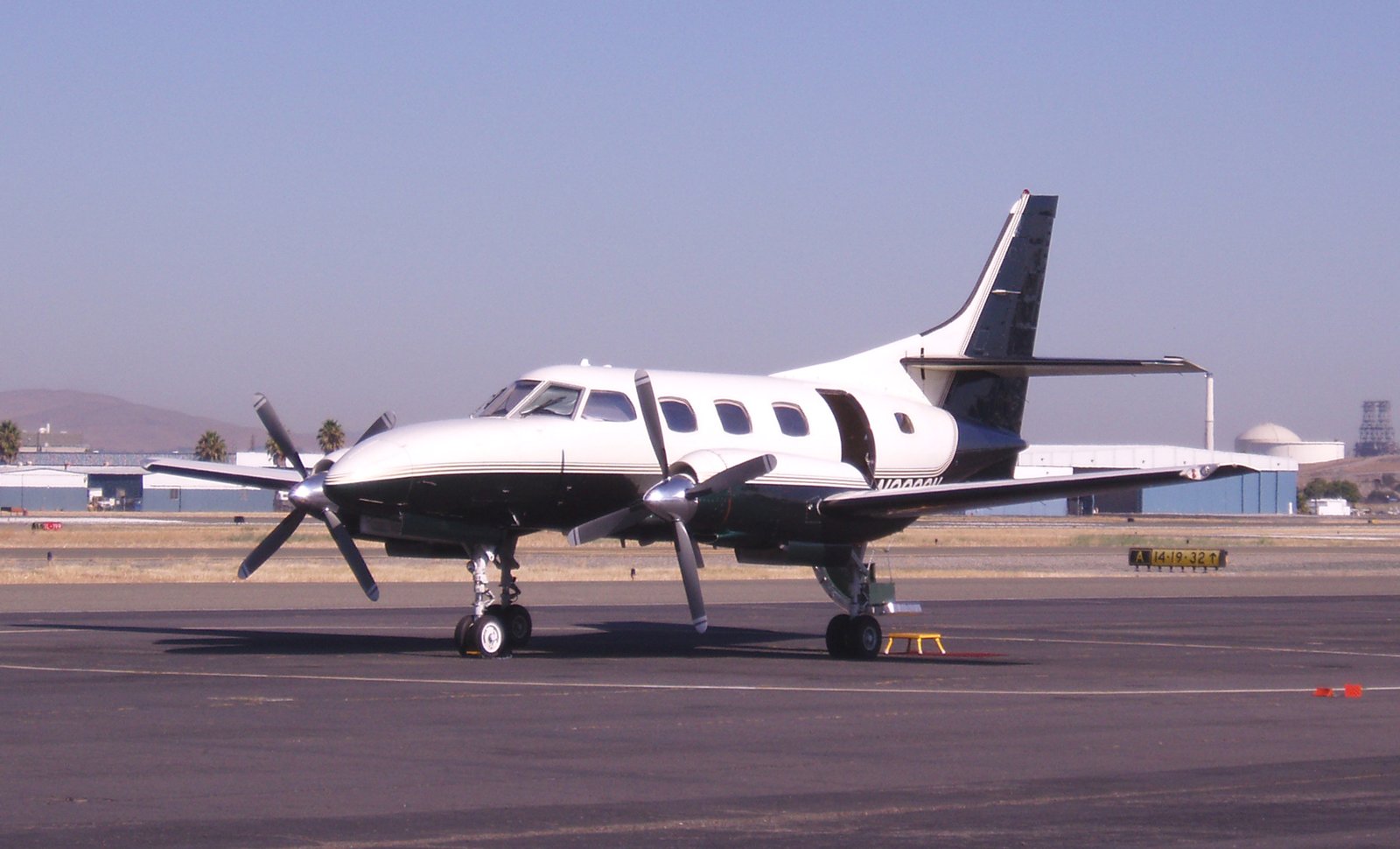
A Merlin IIIB on the ramp; four-blade propellers set it apart from earlier Merlin IIIs. · Bill Larkins, CC BY-SA 2.0, via Wikimedia Commons
Fairchild · Turboprop
Merlin IIIB / IIIC
The last short-body Merlin III models: the IIIB (1979–1981) and heavier IIIC (1981–1983), before the winglet-equipped Merlin 300.
The Merlin IIIB offers King Air 200 speed, a lower cabin altitude and big tanks for asking prices under $800,000. The trade-off is a demanding airplane, a long list of repeat inspections and a small support network.
Buy it if
You want King Air–class speed and cabin for well under $1 million, will fly with a second pilot or a well-trained professional, and have a shop that knows Garrett engines and Merlin airframes.
Skip it if
You plan to fly yourself without serious recurrent training, need to fill the seats and the tanks at the same time, or want a wide network of service centers and an easy resale later.
Biggest compromise
Weight. With the 648-gallon tanks full, a typical IIIB has room for only about 250 lb beyond the pilot, so every long trip is a fuel-versus-passengers decision.
The numbers that matter
Purchase price
$620K
typical asking · $495K–$770K
What it costs per year
$877K
at 300 hrs · one professional pilot
How far it flies
2,425 nm
1,350–1,550 nm with passengers
How fast
290 kt
high-speed cruise
Seats
6
6 typical (up to 9 by interior)
Pilots needed
1
Legal single-pilot, but reviewers strongly recommend two pilots. IIICs flown above 12,500 lb need a type rating.
Price
What one costs to buy
Typical asking price
$620,000
Where asking prices sit
Low
$495K
Typical
$620K
High
$770K
Most asking prices fall inside this band.
Other sites
Priced vs call
with a price / call for price
Four IIIBs show asks of $495,000–$770,000; no IIIC shows a price. Guides from JetAV and Aircraft Cost Calculator put IIIC values near $900,000–$1.1M.
Price vs its family and alternatives
Scroll to explore · select a jet for details
Merlin IIIB / IIIC · This aircraft
$620K
The least expensive here; next up is the MU-2 Marquise (MU-2B-60).
For sale now
None listed right now
Cost to own
What it costs per year to run
300hours / year
Per year
Per flight hour
Estimate — your operator will quote actual numbers.
Fuel, airframe and propeller maintenance, engine overhaul set-aside and trip costs rise as you fly more. One professional pilot, recurrent training, hangar, insurance and databases and tracking stay the same however much you fly.
Where the money goes
- One professional pilot$143,00016%
- Recurrent training$15,0002%
- Hangar$30,0003%
- Insurance$18,0002%
- Databases and tracking$8,7501%
- Fuel$219,73525%
- Airframe and propeller maintenance$267,00030%
- Engine overhaul set-aside$139,35016%
- Trip costs$35,7004%
Airframe and propeller maintenance is the biggest single cost at 30% of the total.
The JetGrade
68 out of 100 — Below its class average
Peer group: Beechcraft King Air 200, Cessna Conquest II, Piper Cheyenne III / IIIA, Mitsubishi MU-2 Marquise, Gulfstream Commander 1000
Seven categories at a glance
- - - 70 = typical— This aircraft
Strongest on range & payload, weakest on reliability & support.
Grades are editorial opinions about the model, not any specific aircraft. Sponsors and affiliates have no input. Reviewed 2026-10-08.
Where it flies
Sample trips and reach
Typical trips on a map
Nonstop
Depends on weight or weather
Fuel stop likely
Out of reach
4 of 8 sample trips are comfortable nonstops.
Sample flight times
- 1.2 hr
Carlsbad → Las Vegas
205 nm · Short hop with full seats and ample fuel
- 2.7 hr
Carlsbad → Aspen
625 nm · High-altitude airport; plan weight and weather carefully
- 3.3 hr
Santa Ana → San José del Cabo
765 nm · Comfortable nonstop with four passengers
- 3.8 hr
Teterboro → West Palm Beach
900 nm · Nonstop with four passengers and reserves
- 4.8 hr
Dallas → Teterboro
1,190 nm · Nonstop with four passengers and reserves
- 5.7 hr
Teterboro → San Juan
1,410 nm · Nonstop only at economy cruise; little fuel to spare
- 8.6 hr
Carlsbad → Teterboro
2,100 nm · One stop, typically mid-continent
Los Angeles → Honolulu
2,215 nm · Too far over water with any useful load
Lineage
What came before and after


1979–1983
Merlin IIIB / IIIC
900-shp engines and four-blade props; the IIIC added higher weights.
Mid-1980s
Merlin 300 (Fairchild 300)
A IIIC with winglets and refinements; about ten built.
What changed from the Merlin III / IIIA
- Garrett TPE331-10U engines rated 900 shp each, up from 840 shp.
- Four-blade propellers with synchrophasers replaced the earlier three-blade propellers.
- Landing weight rose 1,000 lb and zero-fuel weight 500 lb, adding usable payload.
- Revised interior and air conditioning system.
- IIIC: faster landing gear with doors that close after extension.
- IIIC: certified to tougher SFAR 41 rules for a 13,230-lb takeoff weight.
Size and cabin
How big it is, inside and out
Outside
Silhouette · scaled to length
Length
Wingspan
Height
Inside the cabin
Cabin length
Width
Height
Compare
How it stacks up
This aircraft
Merlin IIIB / IIIC
- JetGrade
- 68
- Price
- $620K
- Cost per year
- $877K
- Range
- 2,425 nm
- Speed
- 290 kt
- Seats
- 6
- Cabin length
- 17′ 5″
- Pilots
- 1
- Years built
- 1979–1983
← Before
- JetGrade
- 66
- Cost per year
- $582K
- Range
- 1,710 nm
- Speed
- 283 kt
- Seats
- 6
- Cabin length
- 17′ 5″
- Pilots
- 1
- Years built
- 1970–1978
After →
Merlin 300 (Fairchild 300)
Not yet graded
Alternative
- JetGrade
- 72
- Price
- $1.28M
- Cost per year
- $729K
- Range
- 1,490 nm
- Speed
- 289 kt
- Seats
- 6
- Cabin length
- 16′ 8″
- Pilots
- 1
- Years built
- 1974–1981
Alternative
- JetGrade
- 72
- Price
- $1.36M
- Cost per year
- $671K
- Range
- 2,000 nm
- Speed
- 314 kt
- Seats
- 7
- Cabin length
- 12′ 10″
- Pilots
- 1
- Years built
- 1977–1986
Alternative
- JetGrade
- 69
- Price
- $847K
- Cost per year
- $659K
- Range
- 1,113 nm
- Speed
- 300 kt
- Seats
- 6
- Cabin length
- 16′ 1″
- Pilots
- 1
- Years built
- 1979–1986
- Beechcraft King Air 200 instead: Similar speed and cabin with a far larger service network and easier resale, at roughly twice the typical asking price.
- Cessna Conquest II instead: The same Garrett engine family in a more mainstream airframe with wider Cessna service support.
- Mitsubishi MU-2 Marquise instead: Comparable speed and Garrett engines, with a well-established pilot training program and active owner community.
Gold marks the best figure in each row.
Owning one
What to know before you buy
Engines & inspections
2 × Honeywell (Garrett) TPE331-10U · 900 shp each
Engine hours until overhaul
- Windshield inner-ply inspection · 100 hr
- Front pressure bulkhead inspection · 1,000 hr
- Engine hot section inspection · 1,800 hr
- Wing spar web inspection · 2,000 hr
- Pitch trim fitting inspection · 5,000 hr
- Wing attach fitting inspection · 5,300 hr
- Engine overhaul · 5,400 hr
- Letter-check inspection program every 12 months
Honeywell offers hourly engine plans for the TPE331, but rates are quoted per airplane; at least one listed Merlin is not enrolled, so check before buying.
Known issues
Wing spar web cracking
An FAA directive requires spar inspections from 6,500 hours and every 2,000 hours after; the FAA estimates repair near $26,400.
Pressure bulkhead fatigue cracks
Once past 11,000 hours the front pressure bulkhead needs inspection every 1,000 hours; the FAA puts a crack repair near $42,000.
Pitch trim actuator upkeep
Trim actuators need repeat checks and overhauls; a 2026 FAA proposal adds travel tests, with replacement near $20,425.
Pre-buy checklist
0 of 10 checked
Ontic, which now holds the type certificate, supplies factory parts, manuals and technical support, with parts orders handled around the clock through AAR. The Garrett engines have wide shop support; Merlin-experienced airframe shops are fewer.
Review
The full review
Strengths
- Cruises about 280–290 knots on two 900-shp Garrett engines, matching a King Air 200 for speed.
- Holds a sea-level cabin to 16,800 ft and about 7,400 ft at the IIIB's 31,000-ft ceiling.
- Asks of $495,000–$770,000 buy a pressurized 290-knot twin with 648 gallons of fuel.
Limitations
- Full tanks leave only about 250 lb for passengers, so range and seats trade off sharply.
- Repeat airframe inspections every 1,000–2,000 hours on the wing spar, pressure bulkhead and controls add cost.
- Demanding to fly: heavy controls, a 48-lb stick pusher and touchy nosewheel steering.
The Merlin IIIB and IIIC are the final short-fuselage versions of Swearingen's Merlin executive turboprop, built between 1979 and 1983 after Swearingen became part of Fairchild. They follow the Merlin II and the Merlin III/IIIA and sit beside the stretched Merlin IV, whose fuselage also became the Metro commuter airliner. The IIIB brought 900-shp Garrett TPE331-10U engines and four-blade propellers. The IIIC, from 1981, was certified to the tougher SFAR 41 standard so it could take off at 13,230 lb, and added faster landing gear, new engine cowlings and Dowty propellers. AOPA Pilot counted 71 IIIBs and 26 IIICs, followed by ten winglet-equipped Merlin 300s.
Pilot's take
The Merlin IIIB rewards a disciplined crew. The Garretts give strong acceleration and a brisk climb, and once level the airplane is stable and quick, settling near 280 knots in the low twenties. The workload is the catch: roll forces are heavy, the stick pusher is assertive, and an engine failure at low speed calls for full rudder and prompt feathering rather than reliance on the automatic negative-torque system. Nosewheel steering deserves attention on crosswind landings. Flown by a current, simulator-trained pilot, ideally with a second qualified pilot, it is an efficient long-legged traveler; flown casually, it is unforgiving.
Who this is for
Experienced turboprop pilots and small companies who want a fast six-seat cabin on a modest purchase budget, can fund older-airplane maintenance, and fly trips of 300–1,200 nm with four or five people aboard.

Ask about this aircraft
Answers come only from our research file on the Merlin IIIB / IIIC.
Your earlier questionsOwners
Private to verified ownersOwn a Fairchild Merlin IIIB / IIIC? Verify with its FAA registration to join the owners' thread and the real-cost poll.