
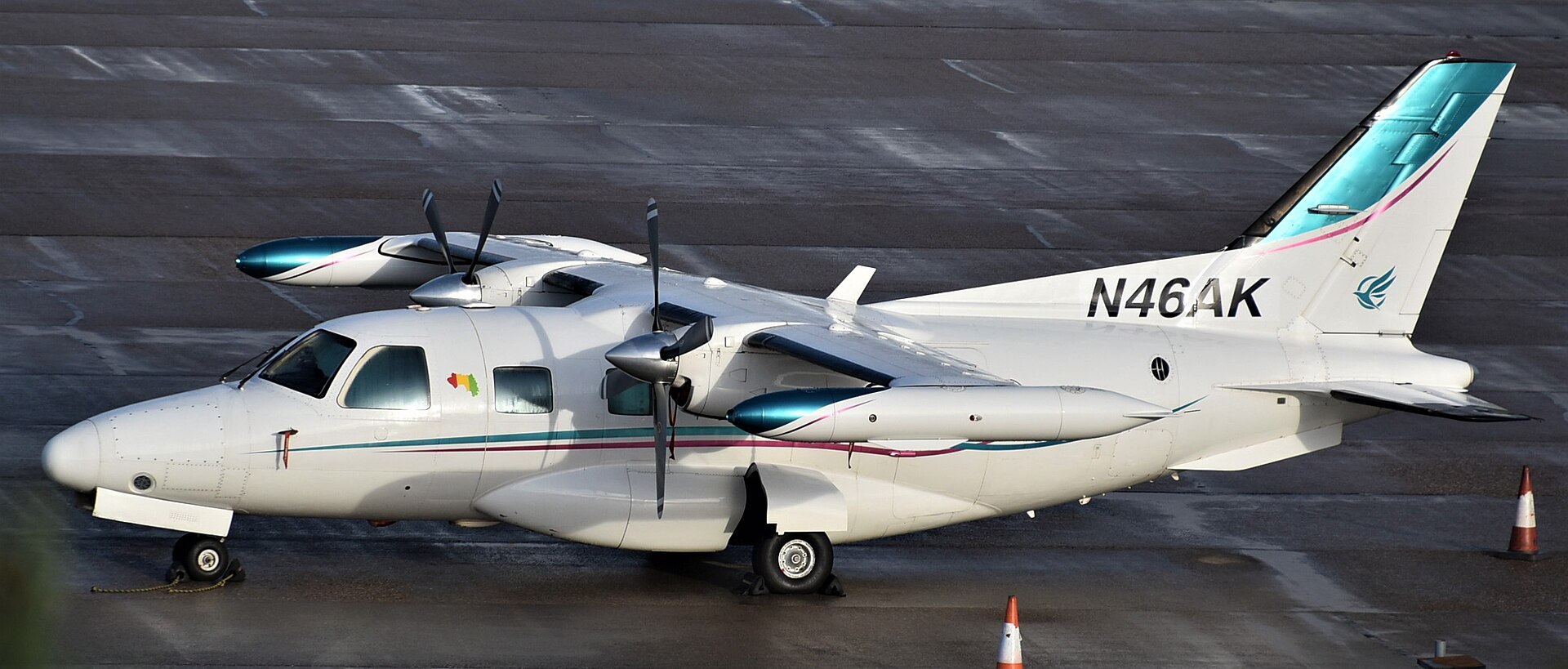
MU-2 Marquise N46AK, photographed in 2022. · Photo: Alec Wilson via Wikimedia Commons, CC BY-SA 2.0
Mitsubishi · Turboprop
MU-2 Marquise (MU-2B-60)
The fifth and final long-body MU-2, built alongside the short-body Solitaire until production ended in 1986.
One of the fastest and most economical used twin turboprops for the money, with strong factory support. The trade-offs are a low cabin, roughly 900–1,100 nm of range with four aboard, and mandatory MU-2 training for every pilot.
Buy it if
You want close to 290-knot cruise for well under $1 million, you or your pilot will commit to annual MU-2 training, and most trips are under about 900 nm with four or fewer passengers.
Skip it if
Your passengers expect a roomier cabin and a private lavatory, you need to fly six people more than about 700 nm, or you want an airplane that forgives an infrequent pilot.
Biggest compromise
The MU-2 has its own federal training rule: every pilot needs 100 hours of multi-engine command time, MU-2-specific initial and annual training, and a working autopilot to fly single-pilot. Before training became mandatory in 2009, accident rates ran about double comparable turboprops; in 2010–2014 they were about 20% higher.
The numbers that matter
Purchase price
$847K
typical asking · $575K–$1.2M
What it costs per year
$659K
at 300 hrs · one professional pilot
How far it flies
1,113 nm
784–1,000 nm with passengers
How fast
300 kt
high-speed cruise
Seats
6
6 typical, up to 9
Pilots needed
1
Single-pilot certified; pilots need 100 hours multi-engine command time plus MU-2-specific initial and annual training.
Price
What one costs to buy
Typical asking price
$847,000
Where asking prices sit
Low
$575K
Typical
$847K
High
$1.2M
Most asking prices fall inside this band.
Other sites
Priced vs call
with a price / call for price
Asks run $575,000 to $1.2 million, and four of six have been listed over a year. Valuation sites estimate roughly $710,000–$860,000.
Price vs its family and alternatives
Scroll to explore · select a jet for details
MU-2 Marquise (MU-2B-60) · This aircraft
$847K
Sits between the MU-2 Solitaire (MU-2B-40) and the King Air 200.
For sale now
None listed right now
Cost to own
What it costs per year to run
300hours / year
Per year
Per flight hour
Estimate — your operator will quote actual numbers.
Fuel, maintenance, engine reserves and other trip costs rise as you fly more. One professional pilot, annual mu-2 recurrent training, hangar and insurance stay the same however much you fly.
Where the money goes
- One professional pilot$115,00017%
- Annual MU-2 recurrent training$10,0002%
- Hangar$27,0004%
- Insurance$15,0002%
- Fuel$231,30035%
- Maintenance$135,00020%
- Engine reserves$89,25014%
- Other trip costs$36,6006%
Fuel is the biggest single cost at 35% of the total.
The JetGrade
69 out of 100 — Below its class average
Peer group: Beechcraft King Air 200, Cessna Conquest II (441), Piper Cheyenne IIIA (PA-42-720)
Seven categories at a glance
- - - 70 = typical— This aircraft
Strongest on airport access, weakest on range & payload.
Grades are editorial opinions about the model, not any specific aircraft. Sponsors and affiliates have no input. Reviewed 2026-10-08.
Where it flies
Sample trips and reach
Typical trips on a map
Nonstop
Depends on weight or weather
Fuel stop likely
2 of 6 sample trips are comfortable nonstops.
Sample flight times
- 1.1 hr
Carlsbad → Las Vegas
205 nm · Short hop, well within range
- 2.6 hr
Carlsbad → Aspen
625 nm · Mountain airport; summer loads depend on weather
- 3.1 hr
Santa Ana → San José del Cabo
765 nm · Nonstop with four aboard
- 3.7 hr
Teterboro → West Palm Beach
900 nm · Near the limit with four; headwinds force a stop
- 5.1 hr
Dallas → Teterboro
1,190 nm · Needs one stop with four aboard
- 8.7 hr
Carlsbad → Teterboro
2,100 nm · Two stops with four aboard
Lineage
What came before and after


1979–1986
MU-2 Marquise
Final long body with TPE331-10 engines and more fuel.
What changed from the MU-2 long body (G / J / L / N)
- TPE331-10 engines flat-rated to 715 shp replace the earlier TPE331-5 engines.
- Fuel capacity rose to 403 gallons with two added outer wing cells.
- A single red-line engine temperature system simplifies engine monitoring.
- Later aircraft received the Sperry SPZ-500 autopilot and flight director from the factory.
Size and cabin
How big it is, inside and out
Outside
Silhouette · scaled to length
Length
Wingspan
Height
Inside the cabin
Cabin length
Width
Height
Compare
How it stacks up
This aircraft
MU-2 Marquise (MU-2B-60)
- JetGrade
- 69
- Price
- $847K
- Cost per year
- $659K
- Range
- 1,113 nm
- Speed
- 300 kt
- Seats
- 6
- Cabin length
- 16′ 1″
- Pilots
- 1
- Years built
- 1979–1986
← Before
MU-2 Long Body (G / J / L / N)
- JetGrade
- 70
- Price
- $392K–$583K guide
- Cost per year
- $568K
- Range
- 1,348 nm
- Speed
- 300 kt
- Seats
- 7
- Cabin length
- 16′ 0″
- Pilots
- 1
- Years built
- 1969–1978
Alternative
- JetGrade
- 72
- Price
- $1.28M
- Cost per year
- $729K
- Range
- 1,490 nm
- Speed
- 289 kt
- Seats
- 6
- Cabin length
- 16′ 8″
- Pilots
- 1
- Years built
- 1974–1981
Alternative
- JetGrade
- 72
- Price
- $1.36M
- Cost per year
- $671K
- Range
- 2,000 nm
- Speed
- 314 kt
- Seats
- 7
- Cabin length
- 12′ 10″
- Pilots
- 1
- Years built
- 1977–1986
Alternative
- JetGrade
- 66
- Price
- $690K–$980K guide
- Cost per year
- $577K
- Range
- 1,600 nm
- Speed
- 318 kt
- Seats
- 5
- Cabin length
- 8′ 0″
- Pilots
- 1
- Years built
- 1979–1985
- Beechcraft King Air 200 instead: A taller, larger cabin and a vast support network, at the cost of more fuel, slower cruise, longer runways and a higher price.
- Cessna Conquest II (441) instead: Similar speed from Garrett engines, longer range and no type-specific training rule, but asking prices typically run $1M to $1.7M.
- Mitsubishi MU-2 Solitaire instead: The same family and TPE331-10 engines in a shorter fuselage with fewer seats, for owners who rarely fill the cabin; same training rule.
Gold marks the best figure in each row.
Owning one
What to know before you buy
Engines & inspections
2 × Honeywell TPE331-10-501M / -511M · 715 shp each
No APUEngine hours until overhaul
- 100-hour periodic inspection · 100 hr
- 600-hour or 3-year inspection · 600 hr
- Main gear fitting ultrasound · 600 hr
- Fuselage frame crack inspection · 2,400 hr
- Engine hot section inspection · 2,500 hr
- Propeller hub inspection · 3,000 hr
- Engine overhaul · 5,000 hr
- Wing spacer plate check · 7,500 hr
We found no pay-per-hour engine plan for this engine on the MU-2; owners usually fund overhauls themselves or use exchange engines.
Known issues
Training-sensitive handling
An FAA review found accident rates about twice comparable turboprops; after mandatory training began in 2009, rates were about 20% higher.
Main gear fitting cracks
A March 2026 Mitsubishi notice reports cracked main gear fittings on long-body MU-2s and calls for inspection before further flight.
Rising engine overhaul costs
One engine shop reports average TPE331-10 overhauls rising from about $294,000 in 2018 to $487,000 in 2025, per engine.
Pre-buy checklist
0 of 9 checked
Mitsubishi Heavy Industries America still supports the MU-2 from Texas with round-the-clock technical help, stocked parts and authorized service centers, and won AIN's turboprop support survey 14 times in 15 years through 2017.
Review
The full review
Strengths
- Cruises around 285–300 knots, faster than a King Air 200's roughly 272-knot normal cruise.
- Operator reports suggest about 85 gallons an hour on a typical trip, roughly a quarter less than a King Air 200.
- Broker data lists a balanced field length near 3,400 ft, against about 5,300 ft for a King Air 200.
Limitations
- The cabin is only about 4 ft 3 in tall, and the aft toilet doubles as a passenger seat.
- About 780 nm with six passengers; full tanks leave only about 775–825 lb for people and bags.
- One engine shop puts 2025 overhauls near $487,000 per engine, and every pilot needs annual MU-2 training.
The Marquise is the final version of the Mitsubishi MU-2, a high-wing twin turboprop designed in Japan and assembled in San Angelo, Texas. Built from 1979 to 1986, it is the stretched long-body model, and 139 were produced. It followed four earlier long-body versions and was built alongside the shorter Solitaire, so it represents the most developed form of the airframe.
Pilot's take
Pilots who fly the Marquise regularly describe a fast, capable airplane that rewards discipline and punishes improvisation. Training feels closer to a type rating than a checkout, and the FAA's standardized checklist, icing training and autopilot rules exist because loss of control in emergencies and icing once dominated the accident record. Expect real cruise speeds around 285 knots, a loud ramp and a snug cabin. Plan on time to get comfortable: one experienced operator wrote that it took about 100 hours to feel at ease and about 250 to feel fully at home. Factory support is a consistent bright spot.
Who this is for
Owner-pilots and small companies who fly two to four people on regional trips of 300–1,000 nm, value speed and fuel economy over cabin size, and will invest in proper training and an MU-2 specialist shop.

Ask about this aircraft
Answers come only from our research file on the MU-2 Marquise (long body).
Your earlier questionsOwners
Private to verified ownersOwn a Mitsubishi MU-2 Marquise (MU-2B-60)? Verify with its FAA registration to join the owners' thread and the real-cost poll.