
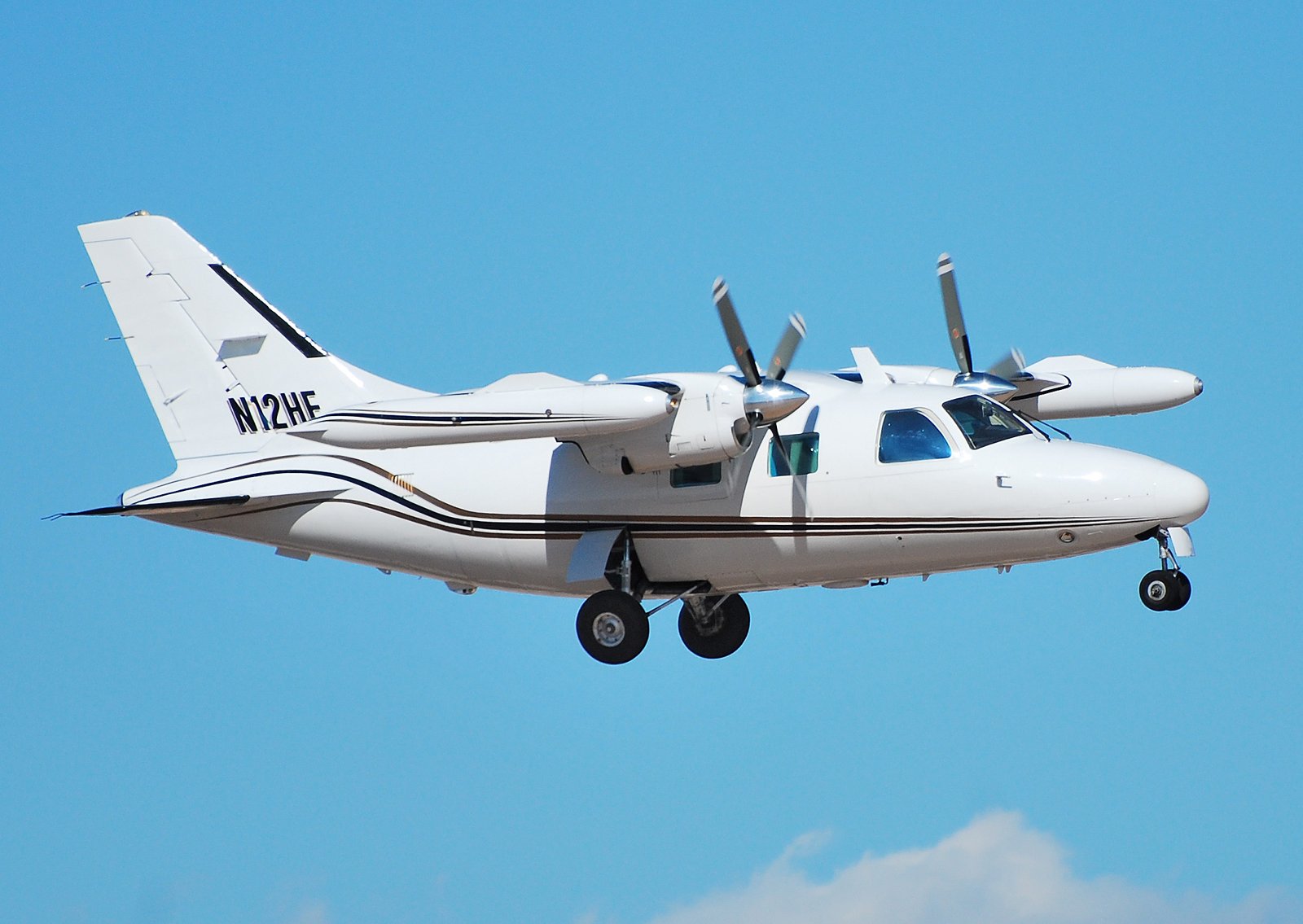
Solitaire N12HF, built in 1980, in flight at North Las Vegas, Nevada, in February 2011. · Photo: Tomás Del Coro, CC BY-SA 2.0, via Wikimedia Commons
Mitsubishi · Turboprop
MU-2 Solitaire (MU-2B-40)
Final short-body MU-2, built alongside the stretched Marquise; no later short-body model followed.
The Solitaire delivers 310-plus knots and short-runway ability for well under $1M, among the most speed per dollar of any twin turboprop of its era. You pay for it with a tight cabin, mandatory yearly MU-2 training and engine overhauls approaching $500,000 each.
Buy it if
You fly it yourself or employ one dedicated pilot, want 300-knot trips of 300–900 nm with up to four passengers, value short-runway ability, and will budget for yearly MU-2 training and large engine events.
Skip it if
Your passengers expect to stand up or use a private lavatory, you want a modern autopilot without compromise, or you are not ready to fund two engine overhauls that can approach $1M together.
Biggest compromise
The cabin is only 4 ft 3 in tall and 8 ft long behind the cockpit, closer to a large piston twin than a business turboprop. Add mandatory yearly MU-2 training, an autopilot that must work for single-pilot instrument flying, and fast-rising engine overhaul prices, and the low purchase price hides a demanding ownership.
The numbers that matter
Purchase price
$690K–$980K
guide value (PlanePhD and Aircraft Cost Calculator)
What it costs per year
$577K
at 300 hrs · one professional pilot
How far it flies
1,600 nm
840–1,050 nm with passengers
How fast
318 kt
high-speed cruise
Seats
5
5–6 typical, up to 7
Pilots needed
1
Flown by one pilot, who must complete FAA-required MU-2 training every year.
Price
What one costs to buy
Guide value
$690K–$980K
Other sites
Priced vs call
with a price / call for price
Only one Solitaire is listed, asking $795,000; published guide values run $690,000–$980,000, and refurbished examples have recently asked up to $1.65M.
Price vs its family and alternatives
Scroll to explore · select a jet for details
MU-2 Solitaire (MU-2B-40) · This aircraft
$690K–$980K guide
Guide value, not a listed asking price.
Sits between the King Air C90 and the MU-2 Marquise (MU-2B-60).
For sale now
None listed right now
Cost to own
What it costs per year to run
300hours / year
Per year
Per flight hour
Estimate — your operator will quote actual numbers.
Fuel, airframe maintenance, engine overhaul reserve and propeller reserve and trip costs rise as you fly more. One professional pilot, recurrent mu-2 training, hangar, insurance and subscriptions and databases stay the same however much you fly.
Where the money goes
- One professional pilot$97,75017%
- Recurrent MU-2 training$12,0002%
- Hangar$23,2504%
- Insurance$19,0003%
- Subscriptions and databases$8,0001%
- Fuel$200,64035%
- Airframe maintenance$135,00023%
- Engine overhaul reserve$67,50012%
- Propeller reserve and trip costs$14,0002%
Fuel is the biggest single cost at 35% of the total.
The JetGrade
66 out of 100 — Below its class average
Peer group: Cessna Conquest I (425), Piper Cheyenne II (PA-31T), Piper Cheyenne IIXL (PA-31T2), Gulfstream Commander 980, Beechcraft King Air C90
Seven categories at a glance
- - - 70 = typical— This aircraft
Strongest on speed & trip time, weakest on cabin & passenger comfort.
Grades are editorial opinions about the model, not any specific aircraft. Sponsors and affiliates have no input. Reviewed 2026-10-08.
Where it flies
Sample trips and reach
Typical trips on a map
Nonstop
Depends on weight or weather
Fuel stop likely
3 of 6 sample trips are comfortable nonstops.
Sample flight times
- 1.1 hr
Carlsbad → Las Vegas
205 nm
- 2.6 hr
Carlsbad → Aspen
625 nm · Hot-and-high; depends on weight and weather
- 3.1 hr
Santa Ana → San José del Cabo
765 nm
- 3.5 hr
Teterboro → West Palm Beach
900 nm · Near the limit with four passengers aboard
- 4.8 hr
Dallas → Teterboro
1,190 nm · One fuel stop with four aboard, mid-route
- 8.6 hr
Carlsbad → Teterboro
2,100 nm · Two fuel stops with four passengers aboard
Lineage
What came before and after


1979–1985
MU-2 Solitaire
TPE331-10 engines, 403 gallons of fuel and about 313-knot normal cruise.
What changed from the MU-2 short body (B / D / F / K / M / P)
- TPE331-10 engines held to 665 shp keep their power to much higher altitudes.
- Usable fuel rises from 364 to 403 gallons; maximum range from 1,461 to 1,600 nm.
- Normal cruise climbs from about 283 to 313 knots.
- A 9,700 lb maximum zero-fuel weight is added; takeoff weight stays 10,470 lb.
Size and cabin
How big it is, inside and out
Outside
Silhouette · scaled to length
Length
Wingspan
Height
Inside the cabin
Cabin length
Width
Height
Compare
How it stacks up
This aircraft
MU-2 Solitaire (MU-2B-40)
- JetGrade
- 66
- Price
- $690K–$980K guide
- Cost per year
- $577K
- Range
- 1,600 nm
- Speed
- 318 kt
- Seats
- 5
- Cabin length
- 8′ 0″
- Pilots
- 1
- Years built
- 1979–1985
← Before
MU-2 short body (B, D, F, K, M, P)
- JetGrade
- 70
- Price
- $575K
- Cost per year
- $461K
- Range
- 1,461 nm
- Speed
- 317 kt
- Seats
- 6
- Cabin length
- 8′ 0″
- Pilots
- 1
- Years built
- 1966–1978
Alternative
- JetGrade
- 69
- Price
- $847K
- Cost per year
- $659K
- Range
- 1,113 nm
- Speed
- 300 kt
- Seats
- 6
- Cabin length
- 16′ 1″
- Pilots
- 1
- Years built
- 1979–1986
Alternative
- JetGrade
- 69
- Price
- $775K
- Cost per year
- $609K
- Range
- 900 nm
- Speed
- 223 kt
- Seats
- 5
- Cabin length
- 12′ 5″
- Pilots
- 1
- Years built
- 1971–1983
Alternative
- JetGrade
- 67
- Price
- $1.23M
- Cost per year
- $531K
- Range
- 1,240 nm
- Speed
- 262 kt
- Seats
- 5
- Cabin length
- 10′ 7″
- Pilots
- 1
- Years built
- 1980–1986
- Mitsubishi MU-2 Marquise (long body) instead: Same engines and handling with a cabin about 6 ft longer, more seats and space for a lavatory, at a small speed penalty.
- Beechcraft King Air C90 instead: Roomier, gentler to fly and far more widely supported, with a much bigger pool of buyers and mechanics, but noticeably slower.
- Cessna Conquest I (425) instead: A same-era cabin twin with more conventional handling and no type-specific training rule, giving up some speed for comfort.
Gold marks the best figure in each row.
Owning one
What to know before you buy
Engines & inspections
2 × Honeywell TPE331-10-501M · 665 shp each
No APUEngine hours until overhaul
- 100-hour and annual inspection · 100 hr
- Propeller linkage repetitive check · 100 hr
- Hot section inspection · 2,500 hr
- Propeller overhaul · 4,000 hr
- Engine overhaul · 5,400 hr
Hourly program rates are quoted per aircraft; ask whether the engines are enrolled and what any buy-in would cost.
Known issues
Engine overhaul costs climbing fast
One engine shop reports average TPE331-10 overhauls rose from $294,000 in 2018 to $487,000 in 2025, some above $700,000.
Autopilot must work
Single-pilot night or instrument flying requires a working autopilot, and no modern Garmin autopilot is approved for the MU-2.
Mandatory MU-2 pilot training
FAA rules require MU-2-specific initial training and yearly recurrent training for every pilot, plus 100 hours multi-engine command time.
Pre-buy checklist
0 of 10 checked
Mitsubishi still supports the MU-2 from Dallas, with parts shipped from Coppell, Texas, and authorized service centers in South Carolina, Oklahoma and Wisconsin. The MU-2 Flyers owner group runs safety seminars.
Review
The full review
Strengths
- Cruises at about 313–318 knots, quicker than most twin turboprops built in the same years.
- Clears a 50 ft obstacle in about 1,800 ft on takeoff and lands in about 1,950 ft at maximum weight.
- Carries 403 gallons for up to 1,600 nm, and about 840 nm with every seat filled.
Limitations
- Tight cabin: 4 ft 3 in tall, 4 ft 11 in wide and 8 ft long behind the cockpit.
- Engine overhauls averaged about $487,000 each in 2025, up from $294,000 in 2018; hot sections now top $100,000.
- Only about 520 lb of payload remains with full tanks, so long legs mean fewer passengers.
The Solitaire is the final short-body version of the Mitsubishi MU-2, built in San Angelo, Texas, from 1979 to 1985. Fifty-seven were made, and about 35 remain on the US register today. It followed a long line of short-body MU-2s that began in 1965 and was sold alongside the stretched Marquise, which shares its wing, engines and systems. What set the Solitaire apart from the earlier MU-2P was the Honeywell (then Garrett) TPE331-10 engine, a 1,000 shp design held to 665 shp, plus more fuel and a higher cruise speed.
Pilot's take
The Solitaire rewards precise, disciplined flying. Roll control comes from spoilers, so the controls feel heavier and more direct than a conventional twin, and the airplane is happiest when flown by the numbers on speed. The direct-drive TPE331s respond instantly, but an engine failure demands quick, correct action, which is why the mandatory MU-2 training spends so much time on it. Expect real speed: 300-knot cruise at mid-altitudes is normal. Keep the autopilot healthy, because single-pilot night and instrument flying depend on it. Treat short runways as a strength, not a dare.
Who this is for
An experienced owner-pilot, or an owner with one dedicated pilot, who values speed over cabin size, flies one to four people on 300–900 nm trips, and has the budget and discipline for MU-2 training and specialist maintenance.

Ask about this aircraft
Answers come only from our research file on the MU-2 Solitaire (short body).
Your earlier questionsOwners
Private to verified ownersOwn a Mitsubishi MU-2 Solitaire (MU-2B-40)? Verify with its FAA registration to join the owners' thread and the real-cost poll.