
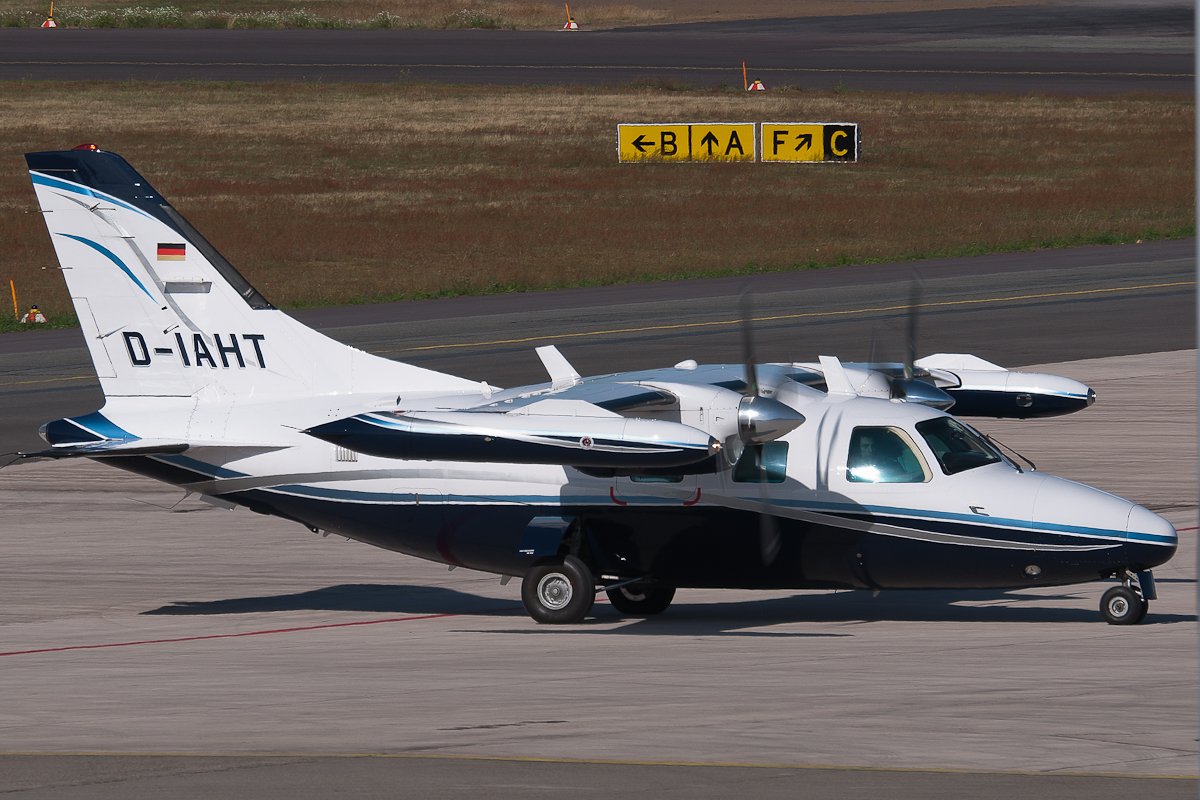
A late short-body MU-2P (MU-2B-26A) taxiing at Braunschweig, Germany. · "D-IAHT Mitsubishi MU-2" by Jens (Flickr 49412349@N05), CC BY 2.0, via Wikimedia Commons
Mitsubishi · Turboprop
MU-2 short body (B, D, F, K, M, P)
The original short-fuselage MU-2 line, built in six civil versions before the Solitaire replaced it in 1979.
One of the fastest pressurized twin turboprops you can buy for under $800,000, with about 1,460 nm of range and 1,700 ft takeoffs. The price is a tight cabin with no toilet, mandatory yearly MU-2 training and costly engines.
Buy it if
You are an experienced multi-engine pilot who wants close to 300 knots, strong short-field performance and good factory support for $260,000–$800,000, and you will commit to the required MU-2 training every year.
Skip it if
You want a stand-up cabin or a toilet, regularly carry more than four people on long legs, or want an aircraft that forgives rusty technique. Pilots with little multi-engine time should expect higher insurance quotes.
Biggest compromise
It flies like a small jet and punishes sloppy flying. Spoilers replace ailerons, an engine failure needs quick and precise handling, and US rules require MU-2-specific training every year plus a working autopilot for single-pilot instrument flights.
The numbers that matter
Purchase price
$575K
typical asking · $259K–$795K
What it costs per year
$461K
at 300 hrs · one professional pilot
How far it flies
1,461 nm
550–1,150 nm with passengers
How fast
317 kt
high-speed cruise
Seats
6
6 typical; up to 7
Pilots needed
1
Single-pilot; US rules require MU-2-specific training every year and a working autopilot.
Price
What one costs to buy
Typical asking price
$575,000
Where asking prices sit
Low
$259K
Typical
$575K
High
$795K
Most asking prices fall inside this band.
Other sites
Priced vs call
with a price / call for price
Dash 10-converted aircraft ask $575,000–$795,000; known original-engine aircraft ask $415,000 or less. Engine time drives price more than year.
Price vs its family and alternatives
Scroll to explore · select a jet for details
MU-2 short body (B, D, F, K, M, P) · This aircraft
$575K
Sits between the MU-2 Long Body (G / J / L / N) and the King Air C90.
For sale now
None listed right now
Cost to own
What it costs per year to run
300hours / year
Per year
Per flight hour
Estimate — your operator will quote actual numbers.
Fuel and engine overhaul and hot-section reserve rise as you fly more. One professional pilot, required mu-2 training, hangar and insurance stay the same however much you fly.
Where the money goes
Partial estimate- One professional pilot$110,00024%
- Required MU-2 training$20,0004%
- Hangar$45,00010%
- Insurance$12,5003%
- Fuel$188,21141%
- Engine overhaul and hot-section reserve$84,94218%
Fuel is the biggest single cost at 41% of the total.
The JetGrade
70 out of 100 — Typical for its class
Peer group: King Air C90, King Air E90, Piper Cheyenne II, Cessna Conquest I, Rockwell Commander 690 / 690A, Swearingen Merlin IIA / IIB
Seven categories at a glance
- - - 70 = typical— This aircraft
Strongest on speed & trip time, weakest on cabin & passenger comfort.
Grades are editorial opinions about the model, not any specific aircraft. Sponsors and affiliates have no input. Reviewed 2026-10-08.
Where it flies
Sample trips and reach
Typical trips on a map
Nonstop
Depends on weight or weather
Fuel stop likely
3 of 6 sample trips are comfortable nonstops.
Sample flight times
- 1.1 hr
Carlsbad → Las Vegas
205 nm · Short hop, well within range
- 2.7 hr
Carlsbad → Aspen
625 nm · Mountain airport; depends on weight and weather
- 3.2 hr
Santa Ana → San José del Cabo
765 nm · Comfortably nonstop with four aboard
- 3.7 hr
Teterboro → West Palm Beach
900 nm · Nonstop with four; strong headwinds may force a stop
- 5.0 hr
Dallas → Teterboro
1,190 nm · Needs one stop with four aboard
- 8.3 hr
Carlsbad → Teterboro
2,100 nm · One stop in calm air; westbound often needs two
Lineage
What came before and after
1963–1965
MU-2A prototypes
French Astazou-powered prototypes; never sold to customers.

1966–1978
MU-2 short body (B, D, F, K, M, P)
Original short fuselage with Garrett TPE331 engines.


What changed
- The D replaced rubber fuel bladders with a sealed wet wing; the F added two outer wing tanks.
- Engines grew from the original TPE331-25 to the TPE331-1 on the F and TPE331-6 on the K.
- Maximum takeoff weight rose from 9,350 lb (D) to 9,920 lb (F, K) and 10,470 lb (M, P).
- The M and P raised cabin pressure from 5.0 to 6.0 psi, for a lower cabin altitude.
- The P switched to slower-turning engines and four-blade propellers, cutting cabin noise by about 10 decibels.
- The K added the long body's engines and systems to the short fuselage in 1972.
Size and cabin
How big it is, inside and out
Outside
Silhouette · scaled to length
Length
Wingspan
Height
Inside the cabin
Cabin length
Width
Height
Compare
How it stacks up
This aircraft
MU-2 short body (B, D, F, K, M, P)
- JetGrade
- 70
- Price
- $575K
- Cost per year
- $461K
- Range
- 1,461 nm
- Speed
- 317 kt
- Seats
- 6
- Cabin length
- 8′ 0″
- Pilots
- 1
- Years built
- 1966–1978
After →
- JetGrade
- 66
- Price
- $690K–$980K guide
- Cost per year
- $577K
- Range
- 1,600 nm
- Speed
- 318 kt
- Seats
- 5
- Cabin length
- 8′ 0″
- Pilots
- 1
- Years built
- 1979–1985
Alternative
MU-2 Long Body (G / J / L / N)
- JetGrade
- 70
- Price
- $392K–$583K guide
- Cost per year
- $568K
- Range
- 1,348 nm
- Speed
- 300 kt
- Seats
- 7
- Cabin length
- 16′ 0″
- Pilots
- 1
- Years built
- 1969–1978
Alternative
- JetGrade
- 69
- Price
- $775K
- Cost per year
- $609K
- Range
- 900 nm
- Speed
- 223 kt
- Seats
- 5
- Cabin length
- 12′ 5″
- Pilots
- 1
- Years built
- 1971–1983
- MU-2 Solitaire instead: The last short body, built 1979–1985, with factory Dash 10 engines, more fuel and a quieter cabin, usually at a higher price.
- MU-2 long body (G, J, L, N) instead: Same wing and engine family with a cabin about 6 ft 3 in longer and a toilet, for buyers who regularly fill the seats.
- King Air C90 instead: Slower, but a taller cabin, gentler handling, a very large service network and no type-specific training rule.
Gold marks the best figure in each row.
Owning one
What to know before you buy
Engines & inspections
2 × Garrett (now Honeywell) TPE331-6-251M · 665 shp each
No APUEngine hours until overhaul
- Propeller control linkage check · 100 hr
- Engine hot section inspection · 1,800 hr
- Reduction gearbox inspection · 3,600 hr
- Engine overhaul · 5,400 hr
The K's original engines reach 5,400 hours with a mid-life gearbox inspection. Many owners have converted to the Dash 10, with 2,500-hour hot-section intervals.
Known issues
Training-dependent handling
Spoilers, sensitive trim and fast roll after an engine failure demand precise flying; mandatory yearly training addresses this.
Engine overhaul costs rising
Dash 10 overhauls averaged $487,000 in 2025, up from $294,000 in 2018; hot sections now exceed $100,000.
Flap and engine rigging
Small flap asymmetry or engine rigging errors can cause dangerous roll, so use shops that know the type.
Pre-buy checklist
0 of 10 checked
Mitsubishi Heavy Industries America offers 24-hour technical support, stocks parts in Coppell, Texas, and lists five authorized service centers, three of them in the United States.
Review
The full review
Strengths
- Published maximum cruise of about 317 knots and roughly 1,460 nm of range put it ahead of most 1970s twin turboprops.
- Clears a 50 ft obstacle in about 1,700 ft at maximum weight and lands in about 1,800 ft.
- Mitsubishi still stocks parts in Texas, lists five authorized service centers and runs free pilot safety seminars every two years.
Limitations
- The cabin is 4 ft 3 in tall and 4 ft 11 in wide, and no short-body model has a toilet.
- US rules require MU-2 training every year: at least 8 hours of ground school and 4–6 hours of flight.
- Dash 10 engine overhauls averaged about $487,000 each in 2025, close to many short bodies' asking prices.
The short-body Mitsubishi MU-2 is a twin-engine, pressurized turboprop designed in Japan and assembled for American buyers in San Angelo, Texas. The first prototype flew in September 1963, and six civil short-body versions followed between 1966 and 1978: the B, D, F, K, M and P. A stretched long-body line was built alongside it, and the Solitaire replaced the short body in 1979. Today the K is the most common short body on the US register, with the later M and P close behind.
Pilot's take
The MU-2 rewards precision and punishes improvisation. It feels more like a small jet than a typical twin: spoilers give crisp roll control, the full-span flaps change pitch and drag dramatically, and the propellers at flight idle act like speed brakes, so steep, fast descents are normal. An engine failure at low speed calls for immediate, practiced inputs, which is why the yearly training rule exists and why pilots who fly it stay current. Use the required checklist every time, keep the autopilot healthy, and the short body is a fast, honest traveling machine.
Who this is for
Experienced owner-pilots and small operators who fly one to four people 300–1,000 nm, value speed and short-runway ability over cabin comfort, and will train every year and keep the aircraft with an MU-2 specialist.

Ask about this aircraft
Answers come only from our research file on the MU-2 short body (B / D / F / K / M / P).
Your earlier questionsOwners
Private to verified ownersOwn a Mitsubishi MU-2 short body (B, D, F, K, M, P)? Verify with its FAA registration to join the owners' thread and the real-cost poll.