
Silhouette traced from a photo by Mark Wagner · CC BY 3.0
Daher · Turboprop
Kodiak 100 Series II
Second of three Kodiak 100 versions, built 2018–2020 between the Series I and Series III.
The Series II is the Kodiak 100 with Garmin's G1000 NXi cockpit. It lifts off in about 930 ft, works from grass or, on floats, water, and carries about 3,500 lb of useful load. The price is a 174-kt cruise in an unpressurized cabin.
Buy it if
You fly into short, unpaved or high-elevation strips, carry bulky gear, dogs or freight, keep most trips under 500 nm, and want a rugged single that one pilot can fly, including owners after proper training.
Skip it if
Your trips regularly run over 600 nm, your passengers expect a pressurized cabin or would rather not use oxygen on higher flights, or speed matters: a light jet covers the same distance in about half the time.
Biggest compromise
Speed and comfort on longer trips. Cruise is about 174 kt at 12,000 ft, and without pressurization the cabin sits at whatever altitude you fly, so crossing mountains or climbing over weather means oxygen for everyone.
The numbers that matter
What it costs per year
$337K
at 300 hrs · one professional pilot
How far it flies
1,132 nm
About 1,000 nm at normal cruise with four passengers and full fuel
How fast
174 kt
high-speed cruise
Seats
6
6 typical, up to 9
Pilots needed
1
Certified for one pilot; many are flown by their owners after simulator training.
Price
What one costs to buy
Typical asking price
$0
Other sites
Priced vs call
with a price / call for price
All three listed Series II aircraft ask buyers to call; one marketplace shows $2.695M for a 2020 aircraft. New Series III aircraft ask about $3.76M.
Price vs its family and alternatives
Scroll to explore · select a jet for details
For sale now
None listed right now
Cost to own
What it costs per year to run
300hours / year
Per year
Per flight hour
Estimate — your operator will quote actual numbers.
Fuel, airframe maintenance and engine program or reserve rise as you fly more. One professional pilot, recurrent training, hangar and insurance stay the same however much you fly.
Where the money goes
Partial estimate- One professional pilot$85,00025%
- Recurrent training$6,0002%
- Hangar$12,6004%
- Insurance$18,7506%
- Fuel$107,73032%
- Airframe maintenance$50,00115%
- Engine program or reserve$57,00017%
Fuel is the biggest single cost at 32% of the total.
The JetGrade
73 out of 100 — Slightly above its class
Peer group: Cessna Caravan 208, Cessna Grand Caravan EX, Pilatus PC-6 Porter, Daher Kodiak 100 Series I
Seven categories at a glance
- - - 70 = typical— This aircraft
Strongest on airport access, weakest on cabin & passenger comfort.
Grades are editorial opinions about the model, not any specific aircraft. Sponsors and affiliates have no input. Reviewed 2026-09-30.
Where it flies
Sample trips and reach
Typical trips on a map
Nonstop
Depends on weight or weather
Fuel stop likely
2 of 6 sample trips are comfortable nonstops.
Sample flight times
- 1.6 hr
Carlsbad → Las Vegas
205 nm · Short hop, well within range
- 4.1 hr
Carlsbad → Aspen
625 nm · Mountain route; oxygen, weather and icing dependent
- 5.0 hr
Santa Ana → San José del Cabo
765 nm
- 5.7 hr
Teterboro → West Palm Beach
900 nm · Near the limit with reserves; headwinds force a stop
- 7.5 hr
Dallas → Teterboro
1,190 nm · Needs one stop, typically mid-route
- 13.2 hr
Carlsbad → Teterboro
2,100 nm · Needs two stops; a full travel day
Lineage
What came before and after
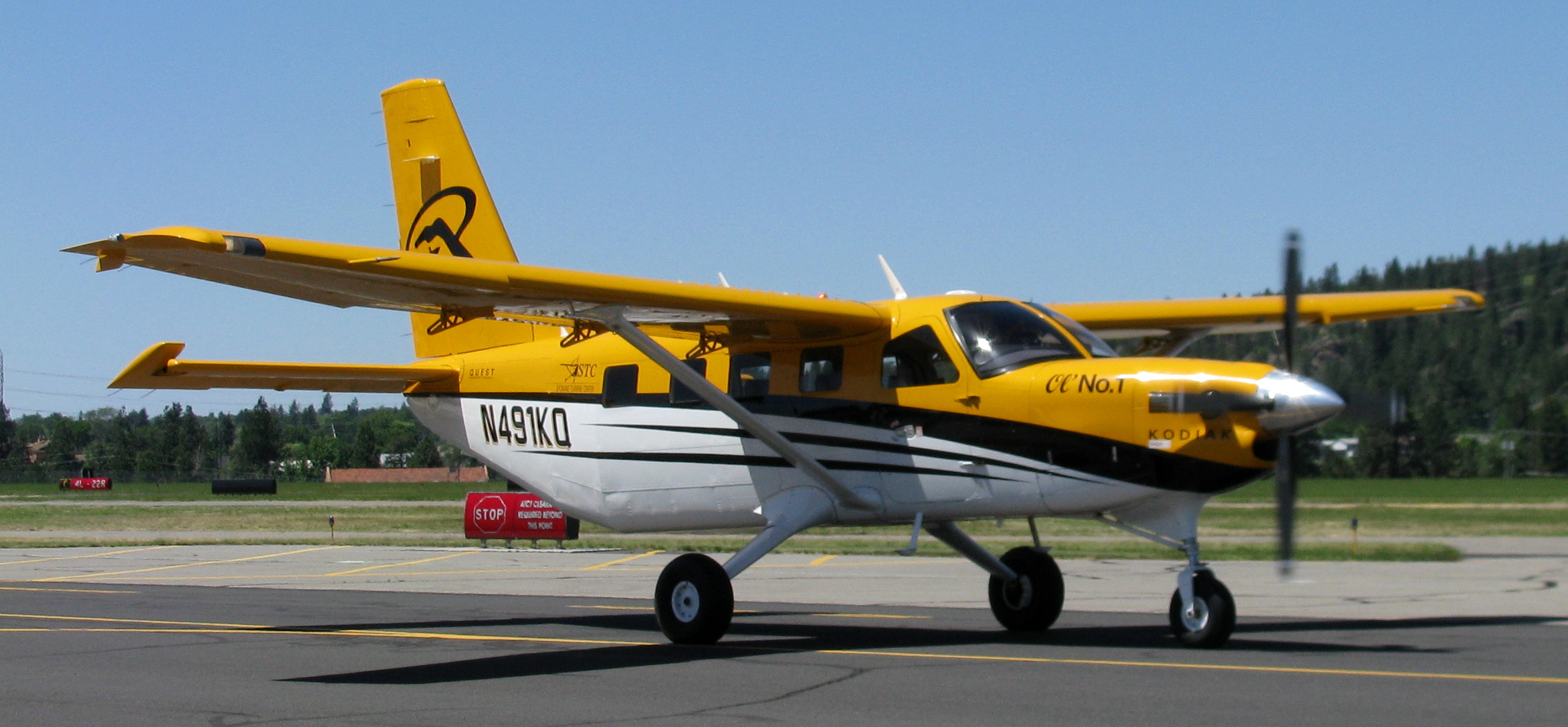
2018–2020
Kodiak 100 Series II
G1000 NXi cockpit, new interiors and better cabin sealing.

What changed from the Kodiak 100 Series I
- Garmin G1000 NXi replaces the original G1000, with a wireless link to tablets.
- Angle-of-attack indexer and a digital standby instrument become standard.
- ADS-B In and Out standard; radar, SurfaceWatch and flight recorders offered as options.
- New Summit, Timberline and Tundra interiors, cockpit gloveboxes and plug-in Bose headsets.
- Better fuselage and wing-root seals for a quieter cabin, plus a lighter cargo-door step.
- Optional single-point underwing refueling and 18 new paint schemes.
Size and cabin
How big it is, inside and out
Outside
Silhouette · scaled to length
Length
Wingspan
Height
Inside the cabin
Cabin length
Width
Height
Compare
How it stacks up
This aircraft
Kodiak 100 Series II
- JetGrade
- 73
- Cost per year
- $337K
- Range
- 1,132 nm
- Speed
- 174 kt
- Seats
- 6
- Cabin length
- 15′ 10″
- Pilots
- 1
- Years built
- 2018–2020
← Before
- JetGrade
- 73
- Cost per year
- $427K
- Range
- 1,132 nm
- Speed
- 174 kt
- Seats
- 8
- Cabin length
- 15′ 10″
- Pilots
- 1
- Years built
- 2007–2018
After →
- JetGrade
- 70
- Cost per year
- $185K
- Range
- 1,132 nm
- Speed
- 174 kt
- Seats
- 6
- Cabin length
- 15′ 10″
- Pilots
- 1
- Years built
- 2021–now
Alternative
- JetGrade
- 77
- Cost per year
- $467K
- Range
- 912 nm
- Speed
- 185 kt
- Seats
- 8
- Cabin length
- 16′ 9″
- Pilots
- 1
- Years built
- 2013–now
Alternative
- JetGrade
- 79
- Cost per year
- $524K
- Range
- 1,830 nm
- Speed
- 280 kt
- Seats
- 6
- Cabin length
- 16′ 11″
- Pilots
- 1
- Years built
- 2008–2020
- Daher Kodiak 100 Series III instead: The newer version, with a higher standard landing weight, larger tires, an optional eight-seat club cabin and longer factory care, at new prices near $3.76M.
- Cessna Grand Caravan EX instead: A larger cabin and a bigger worldwide support network for hauling heavier loads, with less emphasis on very short or rough strips.
- Pilatus PC-12 NG instead: Pressurized, about 100 kt faster and with an enclosed lavatory, for longer trips and more comfort, at asks of roughly $3M to $5.1M.
Gold marks the best figure in each row.
Owning one
What to know before you buy
Engines & inspections
1 × Pratt & Whitney Canada PT6A-34 · 750 shp each
No APUEngine hours until overhaul
- Nose gear fork checks · 200 hr
- Engine hot section inspection · 1,800 hr
- Engine overhaul · 4,000 hr
- Annual inspection every 12 months
Pratt & Whitney Canada's pay-per-hour Eagle Service Plan covers the PT6A-34, has no minimum hours and transfers to a new owner.
Known issues
Engine overhaul exposure
The PT6A-34 overhauls at 4,000 hours for roughly $240,000 to $387,000; most Series II aircraft are still far from it.
Nose gear fork inspections
A 2020 directive requires repeat crack checks every 200 hours on one fork type; a new fork costs about $7,300.
Flap actuator service bulletin
A 2026 mandatory Daher bulletin on flap actuators has been reported; confirm whether it applies and is done.
Pre-buy checklist
0 of 10 checked
Daher supports the Kodiak through about 70 authorized service centers worldwide and a factory parts and around-the-clock grounded-aircraft line; Pratt & Whitney Canada supports the PT6A-34.
Review
The full review
Strengths
- Takeoff ground roll of about 930 ft and landing roll of about 765 ft, with approval for grass, gravel and floats.
- About 3,535 lb of useful load and a 49 by 49 in cargo door with a built-in airstair.
- Garmin G1000 NXi with synthetic vision, autopilot envelope protection and an angle-of-attack indexer comes standard.
Limitations
- Cruise of about 174 kt at 12,000 ft, and about 183 kt at best, so long trips take most of a day.
- The unpressurized cabin is 4 ft 9 in tall, so higher flights need oxygen and passengers stoop.
- Only a few dozen Series II were built; just three were listed for sale in September 2026.
The Kodiak 100 Series II is the second version of the Kodiak, the single-engine utility turboprop designed by Quest Aircraft in Sandpoint, Idaho, and owned by Daher since 2019. Quest unveiled it in May 2018 and built it until the Series III arrived in March 2021, a short run of a few dozen aircraft. The airframe, the 750 shp Pratt & Whitney Canada PT6A-34 engine and the four-blade reversing propeller carried over from the original. What changed was the cockpit and the finish: Garmin's G1000 NXi replaced the original G1000, an angle-of-attack indexer and a digital standby instrument became standard, and new Summit, Timberline and Tundra interiors, better door and wing-root seals and a lighter cargo-door step made the cabin quieter and easier to use.
Pilot's take
Pilots describe the Kodiak as honest and easy to fly, with docile low-speed handling that makes short, rough-field work routine. The G1000 NXi and GFC 700 autopilot add envelope protection and synthetic vision that lighten the workload in cloud. The PT6A-34 has no digital engine control, so torque and temperature limits are the pilot's job, and the reversing propeller shortens landings but needs care on loose gravel. Weight and balance deserve attention because the big door invites heavy, aft loads that must be tied down. Unpressurized flying means planning altitudes around oxygen, terrain and icing, and the ice-protection fluid supply sets how long you can stay in ice.
Who this is for
Owner-pilots, outfitters, and mission and utility operators who fly families, gear or freight 100 to 500 nm into short, rough or remote strips, want a proven PT6 engine and modern Garmin cockpit, and care more about access than speed.

Ask about this aircraft
Answers come only from our research file on the Kodiak 100 Series II.
Your earlier questionsOwners
Private to verified ownersOwn a Daher Kodiak 100 Series II? Verify with its FAA registration to join the owners' thread and the real-cost poll.