
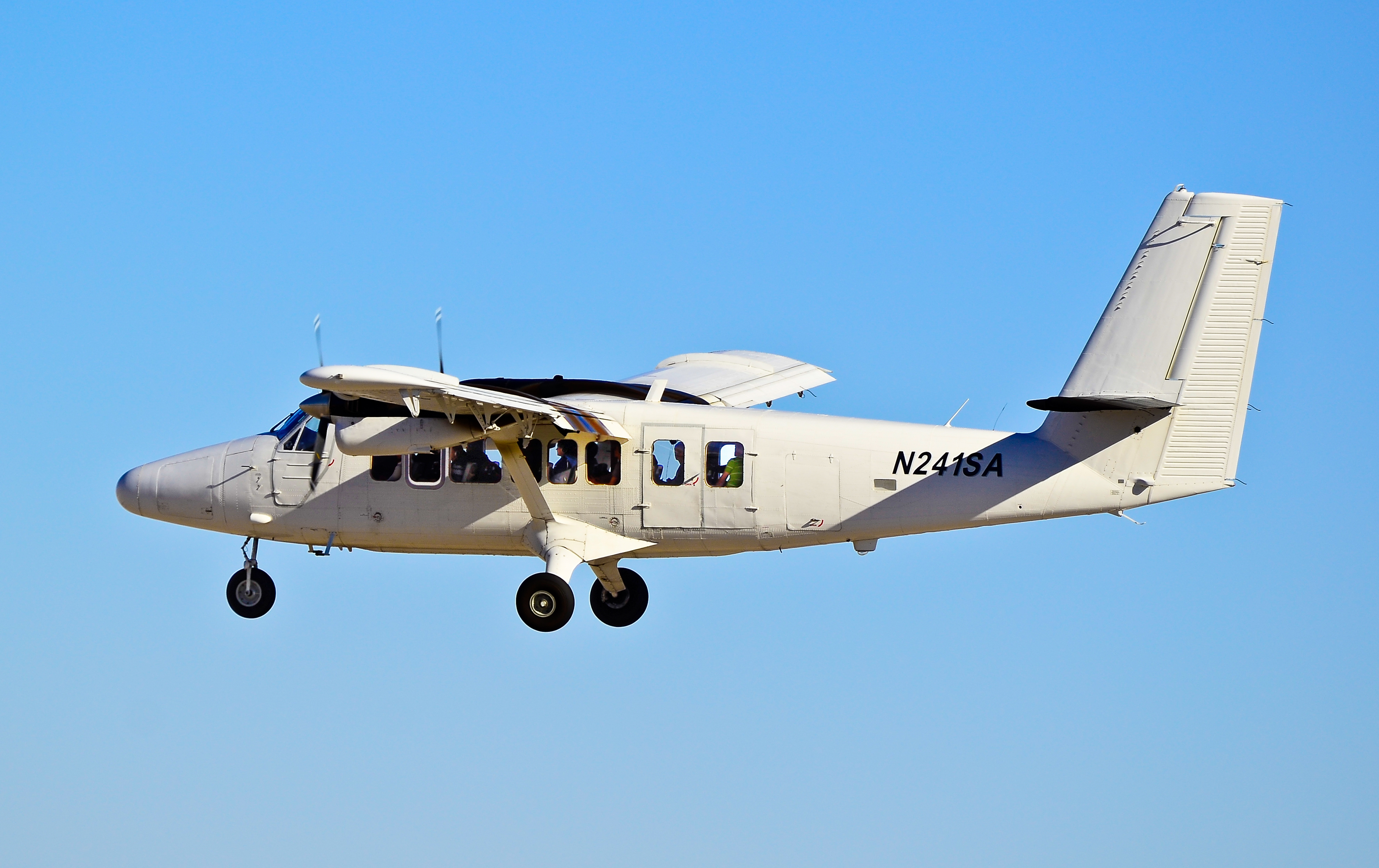
A 1977 DHC-6-300 Twin Otter, N241SA, in flight near Las Vegas. · Tomás Del Coro, CC BY-SA 2.0, via Wikimedia Commons
de Havilland Canada · Turboprop
DHC-6 Twin Otter Series 100, 200 and 300
The original 1965–1988 Twin Otters; the Series 300 is the final and most common version.
Few aircraft can carry 19 passengers into short strips, onto lakes or onto snow as dependably. But it is slow, unpressurized and old, and well-kept or rebuilt examples cost far more than their age suggests.
Buy it if
You need to move up to 19 people or about 2,500 lb of cargo into short, rough, wet or snowy places, and you value two engines and continuing factory parts support.
Skip it if
You mainly want a fast, comfortable cabin for business trips over 500 nm. A pressurized turboprop or a light jet covers the same distance much faster, above most weather.
Biggest compromise
Speed and comfort. At about 160 to 182 kt in an unpressurized cabin under 5 ft tall, a 600 nm trip takes about four to five hours, often with oxygen or a fuel stop, and most cabins hold 19 commuter seats, typically with no lavatory or galley.
The numbers that matter
Purchase price
$1.42M–$1.42M
guide value (PlanePhD)
What it costs per year
$772K
at 300 hrs · two professional pilots
How far it flies
700 nm
About 500 nm with four passengers
How fast
182 kt
high-speed cruise
Seats
19
19–20 commuter seats; about 11 VIP
Pilots needed
1
Certified for one pilot; charter flights with 10 or more passenger seats need two.
Price
What one costs to buy
Guide value
$1.42M–$1.42M
Other sites
Priced vs call
with a price / call for price
Two of 15 listings show prices: $2.5M (Series 200) and $3.2M (status uncertain). PlanePhD estimates a typical Series 300 at about $1.42M.
Price vs its family and alternatives
Scroll to explore · select a jet for details
DHC-6 Twin Otter Series 100, 200 and 300 · This aircraft
$1.42M–$1.42M guide
Guide value, not a listed asking price.
The least expensive here; next up is the Grand Caravan 208B.
For sale now
None listed right now
Cost to own
What it costs per year to run
300hours / year
Per year
Per flight hour
Estimate — your operator will quote actual numbers.
Fuel, airframe maintenance, engine overhaul and hot section reserve and propeller overhauls and miscellaneous rise as you fly more. Two professional pilots, recurrent training, hangar, insurance and subscriptions and databases stay the same however much you fly.
Where the money goes
- Two professional pilots$235,00030%
- Recurrent training$25,0003%
- Hangar$52,5007%
- Insurance$42,5006%
- Subscriptions and databases$8,5001%
- Fuel$197,37026%
- Airframe maintenance$105,00014%
- Engine overhaul and hot section reserve$96,00012%
- Propeller overhauls and miscellaneous$10,5001%
Two professional pilots is the biggest single cost at 30% of the total.
The JetGrade
66 out of 100 — Below its class average
Peer group: Beechcraft 1900C, Dornier 228-100 / -200, Cessna SkyCourier 408, Cessna Grand Caravan 208B, Basler BT-67
Seven categories at a glance
- - - 70 = typical— This aircraft
Strongest on airport access, weakest on speed & trip time.
Grades are editorial opinions about the model, not any specific aircraft. Sponsors and affiliates have no input. Reviewed 2026-10-08.
Where it flies
Sample trips and reach
Typical trips on a map
Nonstop
Fuel stop likely
Out of reach
1 of 6 sample trips are comfortable nonstops.
Sample flight times
- 1.7 hr
Carlsbad → Las Vegas
205 nm · Easy nonstop with four passengers
- 4.7 hr
Carlsbad → Aspen
625 nm · One stop likely; oxygen needed over the Rockies
- 5.6 hr
Santa Ana → San José del Cabo
765 nm · One fuel stop in Baja California
- 6.5 hr
Teterboro → West Palm Beach
900 nm · One fuel stop, typically in the Carolinas
- 8.7 hr
Dallas → Teterboro
1,190 nm · Two fuel stops; a full day of flying
Carlsbad → Teterboro
2,100 nm · Four or more stops; not a practical trip
Lineage
What came before and after
1951–1967
DHC-3 Otter
Single-engine bush aircraft whose role the Twin Otter took over and expanded.

1965–1988
DHC-6 Twin Otter Series 100 / 200 / 300
844 built; Series 300 with 620 shp PT6A-27s is the most common.

Launched 2023
DHC-6 Twin Otter Classic 300-G
New-build version with a Garmin G1000 NXi cockpit.
What changed from the DHC-3 Otter
- Two PT6 turboprops replaced the single engine of the earlier DHC-3 Otter.
- Series 200 added a longer nose and a bigger rear baggage area.
- Series 300 moved to 620 shp PT6A-27 engines from the 550 shp PT6A-20.
- Series 300 maximum takeoff weight rose to 12,500 lb from 11,579 lb.
- Series 300 added two forward exits and seating for 20 passengers.
Size and cabin
How big it is, inside and out
Outside
Silhouette · scaled to length
Length
Wingspan
Height
Inside the cabin
Cabin length
Width
Height
Compare
How it stacks up
This aircraft
DHC-6 Twin Otter Series 100, 200 and 300
- JetGrade
- 66
- Price
- $1.42M–$1.42M guide
- Cost per year
- $772K
- Range
- 700 nm
- Speed
- 182 kt
- Seats
- 19
- Cabin length
- 18′ 5″
- Pilots
- 1
- Years built
- 1965–1988
← Before
DHC-3 Otter
Not yet graded
After →
- JetGrade
- 70
- Price
- $4.5M–$4.5M guide
- Cost per year
- $802K
- Range
- 763 nm
- Speed
- 182 kt
- Seats
- 19
- Cabin length
- 18′ 5″
- Pilots
- 1
- Years built
- 2010–2020
Alternative
- JetGrade
- 76
- Price
- $1.99M
- Cost per year
- $442K
- Range
- 1,163 nm
- Speed
- 184 kt
- Seats
- 9
- Cabin length
- 16′ 9″
- Pilots
- 1
- Years built
- 1986–2012
Alternative
- JetGrade
- 66
- Cost per year
- $938K
- Range
- 1,425 nm
- Speed
- 275 kt
- Seats
- 19
- Cabin length
- 25′ 3″
- Pilots
- 1
- Years built
- 1984–1991
- Cessna Grand Caravan 208B instead: Single engine and fewer seats, but flown by one pilot, typically cheaper to run and very widely supported.
- Viking DHC-6 Twin Otter 400 instead: The modern Twin Otter: the same proven airframe built new from 2010, with PT6A-34 engines and a glass cockpit.
- Beechcraft 1900C instead: A pressurized 19-seat twin that cruises far faster and flies much farther, but needs longer, better runways.
Gold marks the best figure in each row.
Owning one
What to know before you buy
Engines & inspections
2 × PT6A-27 (Series 300); PT6A-20 (Series 100 and 200) · 620 shp each
No APUEngine hours until overhaul
- Elevator quadrant check · 400 hr
- Aileron cable inspection · 500 hr
- Horizontal stabilizer fittings check · 800 hr
- Wing spar adapter check · 1,200 hr
- Engine hot section inspection · 1,800 hr
- Propeller overhaul · 3,000 hr
- Engine overhaul · 3,600 hr
- Airframe structural life limit · 66,000 hr
Pratt & Whitney Canada lists a 2026 flat-rate PT6A-27 overhaul at $372,000 per engine; the older PT6A-20 is not on that list.
Known issues
Control cable wear
Elevator, rudder and aileron cables are life-limited and covered by several directives; one cable failure caused an accident.
Structural life limit
Airframes are limited to 66,000 hours or 132,000 cycles; high-time aircraft need major Re-Life structural work.
Wing spar adapter cracking
Stress-corrosion cracking requires checks every 1,200 hours or 12 months until the improved part is fitted.
Pre-buy checklist
0 of 10 checked
De Havilland Canada still supports the type with parts, factory-endorsed service centers and new Re-Life structural kits, and independent PT6 shops worldwide handle the engines.
Review
The full review
Strengths
- Series 300 clears a 50 ft obstacle in about 1,200 ft with short-field technique and lands over one in 1,050 ft.
- Seats 19 to 20 passengers, or carries about 2,500 lb over 700 nm, loaded through a large double cargo door.
- Approved on wheels, tundra tires, skis, floats and amphibious floats, and De Havilland Canada still sells parts and life-extension kits.
Limitations
- Cruises at about 160 to 182 kt, so a 600 nm trip takes about four to five hours.
- Unpressurized cabin only 4 ft 11 in tall; higher cruising altitudes require supplemental oxygen.
- Built between 1965 and 1988, with life-limited structure, several cable and corrosion directives, and few published prices.
The de Havilland Canada DHC-6 Twin Otter is a high-wing, twin-turboprop utility aircraft that first flew in May 1965. This page covers the original production run of 844 aircraft built until December 1988: the Series 100, the Series 200 with its longer nose and bigger baggage areas, and the Series 300, which makes up most of the fleet. Viking Air restarted production in 2010 with the Series 400, and the type certificate now sits with De Havilland Aircraft of Canada, which delivered the 1,000th Twin Otter in March 2026.
Pilot's take
This is an aircraft that rewards technique more than speed. On a short strip, full flaps, careful speed control and reverse thrust bring it to a stop in remarkably little room, and two PT6s give a second engine over water or forest. Systems are simple and the landing gear is fixed. Icing deserves respect: the flight manual requires early boot use and leaving severe icing promptly. Expect to plan around oxygen, fuel stops and weather rather than over it.
Who this is for
Island, bush, float and polar operators, skydive centers, survey and government fleets, and owners of remote lodges who need a rugged twin that carries a crowd almost anywhere and accept slow, simple travel.

Ask about this aircraft
Answers come only from our research file on the DHC-6 Twin Otter 100 / 200 / 300.
Your earlier questionsOwners
Private to verified ownersOwn a de Havilland Canada DHC-6 Twin Otter Series 100, 200 and 300? Verify with its FAA registration to join the owners' thread and the real-cost poll.