
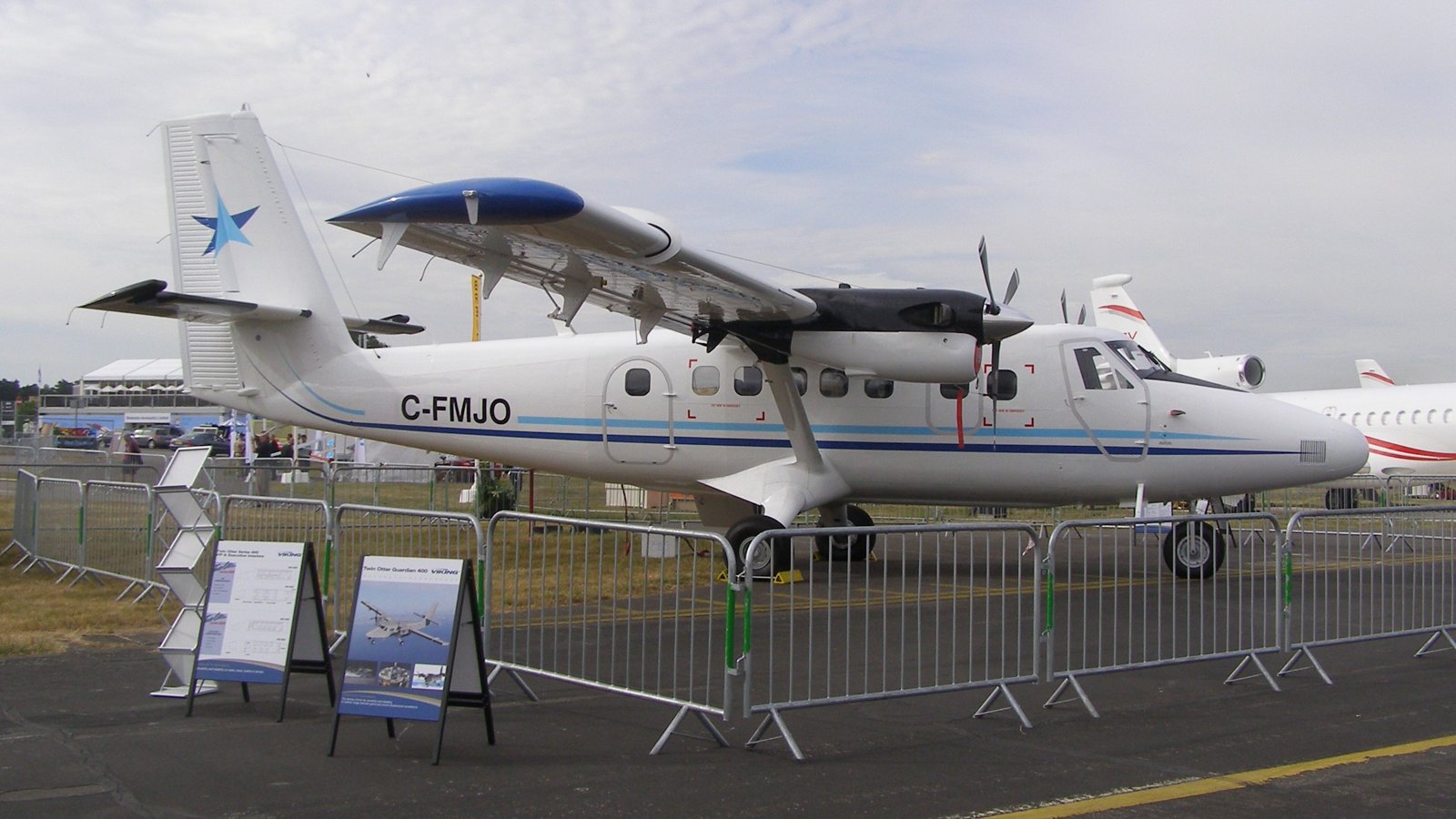
One of the first Twin Otter Series 400s, shown at the 2010 Farnborough Airshow. · MilborneOne, CC BY-SA 3.0, via Wikimedia Commons
Viking · Turboprop
DHC-6 Twin Otter Series 400
Fourth production series of the Twin Otter, built new in Canada from 2010 to 2020.
The Series 400 is still the benchmark for carrying up to 19 people into short, rough or watery strips, now with glass avionics and newer engines. It is slow, loud and unpressurized, and used examples rarely come up for sale.
Buy it if
You run island, lodge, survey, skydive or remote-site operations and need 19 seats or about 4,300 lb of payload from strips around 1,500 ft long, on wheels, skis or floats.
Skip it if
You mainly fly family or clients between paved airports. A pressurized King Air or Pilatus PC-12 is faster, quieter and far more comfortable on trips over 300 nm.
Biggest compromise
Speed and comfort. Top cruise is about 182 kt at 10,000 ft, the cabin is unpressurized and noisy, and longer flights above 12,500 ft need oxygen.
The numbers that matter
Purchase price
$4.5M–$4.5M
guide value (Aircraft Cost Calculator)
What it costs per year
$802K
at 300 hrs · two professional pilots
How far it flies
763 nm
108–550 nm with passengers
How fast
182 kt
high-speed cruise
Seats
19
19 standard; 8–12 in executive layouts
Pilots needed
1
Certified for one pilot; most operators fly two, and US charter with 10 or more seats requires two.
Price
What one costs to buy
Guide value
$4.5M–$4.5M
Other sites
Priced vs call
with a price / call for price
Neither advertised Series 400 shows a price. Aircraft Cost Calculator's average used value is about $4.5M; new aircraft were quoted around $5.9M to $7.25M.
Price vs its family and alternatives
Scroll to explore · select a jet for details
DHC-6 Twin Otter Series 400 · This aircraft
$4.5M–$4.5M guide
Guide value, not a listed asking price.
The most expensive here; the DHC-6 Twin Otter Series 100, 200 and 300 is the next step down.
For sale now
None listed right now
Cost to own
What it costs per year to run
300hours / year
Per year
Per flight hour
Estimate — your operator will quote actual numbers.
Fuel, airframe, propeller and gear maintenance, engine program or overhaul reserve and landing fees, cleaning, supplies and miscellaneous rise as you fly more. Two professional pilots, recurrent training, hangar, insurance and subscriptions and databases stay the same however much you fly.
Where the money goes
- Two professional pilots$250,00031%
- Recurrent training$30,0004%
- Hangar$48,0006%
- Insurance$67,5008%
- Subscriptions and databases$9,0001%
- Fuel$206,14226%
- Airframe, propeller and gear maintenance$82,50010%
- Engine program or overhaul reserve$91,50011%
- Landing fees, cleaning, supplies and miscellaneous$17,5002%
Two professional pilots is the biggest single cost at 31% of the total.
The JetGrade
70 out of 100 — Typical for its class
Peer group: DHC-6 Twin Otter 100 / 200 / 300, Dornier 228NG, Cessna SkyCourier 408, Let L 410 NG
Seven categories at a glance
- - - 70 = typical— This aircraft
Strongest on airport access, weakest on speed & trip time.
Grades are editorial opinions about the model, not any specific aircraft. Sponsors and affiliates have no input. Reviewed 2026-10-08.
Where it flies
Sample trips and reach
Typical trips on a map
Nonstop
Fuel stop likely
Out of reach
1 of 6 sample trips are comfortable nonstops.
Sample flight times
- 1.6 hr
Carlsbad → Las Vegas
205 nm · Easy nonstop with fuel to spare
- 4.4 hr
Carlsbad → Aspen
625 nm · Usually one stop; oxygen needed over the Rockies
- 5.3 hr
Santa Ana → San José del Cabo
765 nm · One fuel stop, typically in Baja California
- 6.1 hr
Teterboro → West Palm Beach
900 nm · One fuel stop, typically in the Carolinas
- 8.0 hr
Dallas → Teterboro
1,190 nm · Two fuel stops with four passengers
Carlsbad → Teterboro
2,100 nm · Three or more fuel stops; a two-day trip
Lineage
What came before and after
1951–1967
DHC-3 Otter
Single-engine bush plane whose rugged formula the Twin Otter scaled up.


2010–2020
DHC-6 Twin Otter Series 400
New-build Twin Otter with PT6A-34 engines and Honeywell glass cockpit.
2026–present
DHC-6 Twin Otter Classic 300-G
Same certified model with Garmin G1000 NXi and a lighter, new interior.
What changed from the DHC-6 Twin Otter 100 / 200 / 300
- PT6A-34 engines replace the -27s, still limited to 620 shp, so field performance is unchanged.
- Honeywell Primus Apex glass cockpit with terrain warning, traffic alert and flight management system as standard.
- New DC electrical system with modern starter-generators, plus LED and xenon lighting.
- Composite non-structural parts such as the nose baggage section; primary structure and dimensions unchanged.
- About 800 smaller modifications in total versus the Series 300.
Size and cabin
How big it is, inside and out
Outside
Silhouette · scaled to length
Length
Wingspan
Height
Inside the cabin
Photo · this model
Cabin length
Width
Height
Compare
How it stacks up
This aircraft
DHC-6 Twin Otter Series 400
- JetGrade
- 70
- Cost per year
- $802K
- Range
- 763 nm
- Speed
- 182 kt
- Seats
- 19
- Cabin length
- 18′ 5″
- Pilots
- 1
- Years built
- 2010–2020
← Before
DHC-6 Twin Otter Series 100, 200 and 300
- JetGrade
- 66
- Cost per year
- $772K
- Range
- 700 nm
- Speed
- 182 kt
- Seats
- 19
- Cabin length
- 18′ 5″
- Pilots
- 1
- Years built
- 1965–1988
After →
DHC-6 Twin Otter Classic 300-G
Not yet graded
Alternative
- JetGrade
- 70
- Cost per year
- $945K
- Range
- 920 nm
- Speed
- 210 kt
- Seats
- 19
- Cabin length
- 23′ 4″
- Pilots
- 1
- Years built
- 2022–now
Alternative
- JetGrade
- 66
- Cost per year
- $869K
- Range
- 1,276 nm
- Speed
- 223 kt
- Seats
- 19
- Cabin length
- 23′ 3″
- Pilots
- 1
- Years built
- 2010–2021
- DHC-6 Twin Otter 100 / 200 / 300 instead: The same airframe and short-field ability for far less money, but with older engines, analog cockpits and usually very high airframe hours.
- Cessna SkyCourier 408 instead: A brand-new twin with a bigger, squarer cabin and Textron's large service network, but it needs longer, better-prepared runways.
- Dornier 228NG instead: Faster and longer-legged with 19 seats and a modern glass cockpit, but rare in the US and less suited to the roughest strips.
Gold marks the best figure in each row.
Owning one
What to know before you buy
Engines & inspections
2 × Pratt & Whitney Canada PT6A-34 · 620 shp each
No APUEngine hours until overhaul
- 125-hour A check · 125 hr
- Float fuel gallery inspection · 125 hr
- 500-hour C check · 500 hr
- Engine hot section inspection · 2,000 hr
- Propeller overhaul · 3,000 hr
- Engine overhaul · 4,000 hr
- 6,000-hour D check · 6,000 hr
- Main landing gear leg overhaul every 60 months
Pratt & Whitney Canada's pay-per-hour Eagle Service Plan is offered for this engine. One aircraft for sale in 2026 was not enrolled, so check each engine.
Known issues
Nosewheel steering veer-offs
French investigators reviewed 54 Twin Otter runway veer-offs; the nosewheel does not self-centre, so a steering lock check matters.
Fuel gallery corrosion on floats
Aircraft flown on floats need fuel gallery checks every 125 hours and modifications costing up to about $44,000.
Rare Honeywell avionics
Primus Apex is used on few aircraft types and new production switched to Garmin; confirm software, spares and upgrade plans.
Pre-buy checklist
0 of 10 checked
De Havilland Canada supports the type from Calgary and Victoria with 24/7 technical help, field representatives and a cost-per-hour parts plan. The PT6A-34 engines are supported worldwide.
Review
The full review
Strengths
- Clears a 50 ft obstacle in about 1,490 ft at full weight, or 1,200 ft where short-field approvals apply.
- Carries up to 19 passengers or about 4,300 lb, and can switch between wheels, skis and floats.
- Two PT6A-34 engines limited to 620 shp keep full takeoff power up to 42°C at sea level.
Limitations
- Top cruise of about 182 kt at 10,000 ft is slow next to a King Air or Dornier 228.
- Unpressurized, with a 4 ft 11 in tall cabin and no toilet in the standard 19-seat layout.
- Only about 153 were built, and just two were advertised in October 2026, both priced on request.
The DHC-6 Twin Otter Series 400 is the new-build version of one of aviation's best-known bush aircraft. De Havilland Canada built 844 Twin Otters between 1965 and 1988. Viking Air, which bought the type certificate in 2006, restarted production in Calgary and Victoria and delivered the first Series 400 in July 2010. About 153 were built before production paused in March 2020. The design now continues as the Classic 300-G, which swaps the Honeywell cockpit for Garmin avionics and began deliveries in 2026.
Pilot's take
From the left seat, the Series 400 feels like the Twin Otter pilots already know, with a much better panel. The big flaps, reversing propellers and slow approach speeds make short, steep arrivals routine, and the 620 shp limit leaves plenty of margin on hot days. The Honeywell glass cockpit adds terrain and traffic warnings that older Twin Otters lacked. In cruise it is honest but slow, and the cabin is loud. We would pay close attention to nosewheel steering technique on the ground, because runway veer-offs are a known Twin Otter weakness.
Who this is for
Island and lodge operators, survey and government fleets, skydive and expedition outfits, and owners of remote properties who need a twin-engine aircraft that can carry a crowd into strips most other twins cannot use.

Ask about this aircraft
Answers come only from our research file on the DHC-6 Twin Otter 400.
Your earlier questionsOwners
Private to verified ownersOwn a Viking DHC-6 Twin Otter Series 400? Verify with its FAA registration to join the owners' thread and the real-cost poll.