
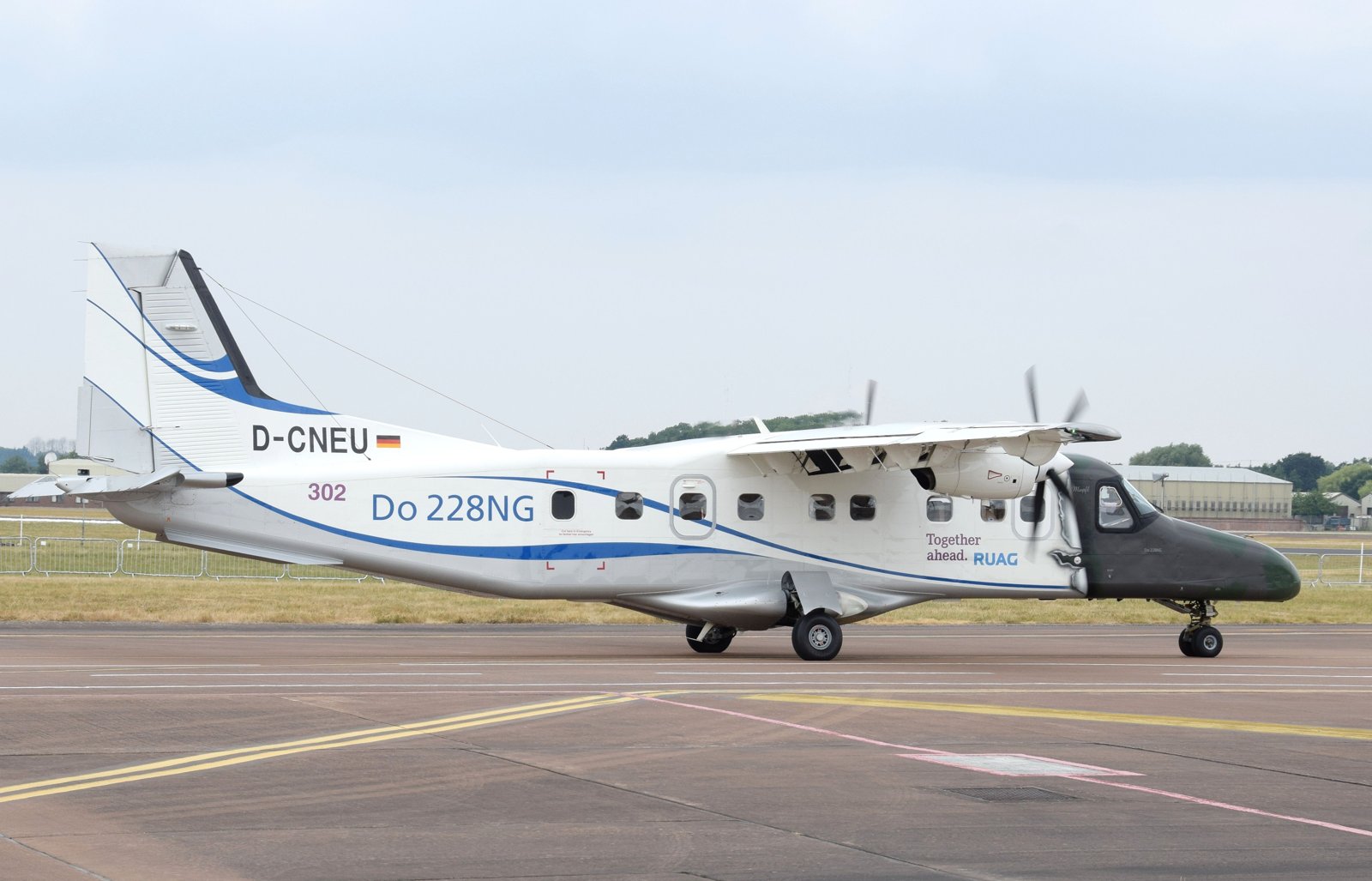
RUAG's Dornier 228NG demonstrator D-CNEU at RIAT, Fairford, July 2018. · Adrian Pingstone, public domain, via Wikimedia Commons
Dornier · Turboprop
Dornier 228NG
The modernized third generation of the Dornier 228, built 2010–2021 and succeeded by the Do228 NXT.
The 228NG carries more people and cargo farther and faster than most rough-field twins, with a modern glass cockpit. But it is unpressurized, has no toilet in airline layout, and very few exist, so support and resale lean heavily on one German factory.
Buy it if
You need to move up to 19 people or about 4,500 lb of cargo through short or unpaved runways, fly mostly legs under 500 nm, and are comfortable relying on factory support from Germany.
Skip it if
You want a private cabin with a toilet, stand-up headroom or pressurization to fly above the weather, or you need easy resale and a deep US service network. A King Air 350 or Beech 1900D fits better.
Biggest compromise
It is a working airplane, not a jet substitute. The unpressurized 5 ft 1 in cabin keeps most flights at 8,000 to 12,000 ft, in the bumps, and much higher requires oxygen.
The numbers that matter
What it costs per year
$869K
at 300 hrs · two professional pilots
How far it flies
1,276 nm
380–1,040 nm with passengers
How fast
223 kt
high-speed cruise
Seats
19
19 single seats, each by a window
Pilots needed
1
Certified for one pilot; US commercial flights with 10 or more seats need two.
Price
What one costs to buy
Typical asking price
$0
Other sites
Priced vs call
with a price / call for price
Neither aircraft for sale shows a price. New, the NG was quoted at about €5.2 million in 2010; no published value guide covers it.
Price vs its family and alternatives
Scroll to explore · select a jet for details
Dornier 228-100 / -200
$1.2M–$1.88M guide
Guide value, not a listed asking price.
See the Dornier 228-100 / -200For sale now
None listed right now
Cost to own
What it costs per year to run
300hours / year
Per year
Per flight hour
Estimate — your operator will quote actual numbers.
Fuel, airframe and propeller maintenance, engine program or overhaul reserve and landing fees, cleaning and miscellaneous rise as you fly more. Two professional pilots, recurrent training, hangar, insurance and subscriptions and databases stay the same however much you fly.
Where the money goes
- Two professional pilots$260,00030%
- Recurrent training$45,0005%
- Hangar$48,0006%
- Insurance$60,0007%
- Subscriptions and databases$18,0002%
- Fuel$224,10026%
- Airframe and propeller maintenance$120,00014%
- Engine program or overhaul reserve$79,1589%
- Landing fees, cleaning and miscellaneous$15,0002%
Two professional pilots is the biggest single cost at 30% of the total.
The JetGrade
66 out of 100 — Below its class average
Peer group: Viking DHC-6 Twin Otter Series 400, Cessna SkyCourier 408, Beechcraft 1900D, Let L-410 NG
Seven categories at a glance
- - - 70 = typical— This aircraft
Strongest on airport access, weakest on value & resale.
Grades are editorial opinions about the model, not any specific aircraft. Sponsors and affiliates have no input. Reviewed 2026-10-08.
Where it flies
Sample trips and reach
Typical trips on a map
Nonstop
Depends on weight or weather
Fuel stop likely
2 of 6 sample trips are comfortable nonstops.
Sample flight times
- 1.4 hr
Carlsbad → Las Vegas
205 nm · Short hop at high-speed cruise
- 3.7 hr
Carlsbad → Aspen
625 nm · Oxygen over mountains; hot-and-high arrival limits load
- 4.4 hr
Santa Ana → San José del Cabo
765 nm · Comfortable range with four passengers
- 5.1 hr
Teterboro → West Palm Beach
900 nm · Near range limit; headwinds may force a stop
- 7.1 hr
Dallas → Teterboro
1,190 nm · Needs one stop, typically mid-route
- 12.3 hr
Carlsbad → Teterboro
2,100 nm · Two stops; slow, unpressurized trip across country
Lineage
What came before and after
1985–present
Hindustan 228
Licence-built in India by HAL under a separate approval.

2010–2021
Dornier 228NG
Restarted German line with glass cockpit and five-blade propellers.
2026–present
Do228 NXT
General Atomics' updated build of the same type.
What changed from the Dornier 228-100 / -200 / -212
- Universal glass cockpit and flight management system replace analog dials; certified for one-pilot instrument flying.
- Honeywell TPE331-10 engines flat-rated to 776 shp, with longer intervals between overhauls.
- Five-blade composite propellers, 2.5 m across, cut vibration and noise and add ground clearance.
- More than 350 design changes while keeping the proven wing and fuselage structure.
- Optional takeoff weight increase to 14,500 lb from the standard 14,110 lb.
Size and cabin
How big it is, inside and out
Outside
Silhouette · scaled to length
Length
Wingspan
Height
Inside the cabin
Cabin length
Width
Height
Compare
How it stacks up
This aircraft
Dornier 228NG
- JetGrade
- 66
- Cost per year
- $869K
- Range
- 1,276 nm
- Speed
- 223 kt
- Seats
- 19
- Cabin length
- 23′ 3″
- Pilots
- 1
- Years built
- 2010–2021
← Before
- JetGrade
- 66
- Cost per year
- $834K
- Range
- 1,200 nm
- Speed
- 232 kt
- Seats
- 19
- Cabin length
- 23′ 3″
- Pilots
- 1
- Years built
- 1982–1998
After →
Do228 NXT
Not yet graded
Alternative
- JetGrade
- 70
- Cost per year
- $802K
- Range
- 763 nm
- Speed
- 182 kt
- Seats
- 19
- Cabin length
- 18′ 5″
- Pilots
- 1
- Years built
- 2010–2020
Alternative
- JetGrade
- 70
- Cost per year
- $945K
- Range
- 920 nm
- Speed
- 210 kt
- Seats
- 19
- Cabin length
- 23′ 4″
- Pilots
- 1
- Years built
- 2022–now
Alternative
- JetGrade
- 66
- Cost per year
- $1.24M
- Range
- 1,279 nm
- Speed
- 280 kt
- Seats
- 19
- Cabin length
- 25′ 3″
- Pilots
- 1
- Years built
- 1991–2002
- Viking DHC-6 Twin Otter Series 400 instead: Slower with a smaller cabin, but floats, skis, a large worldwide fleet and North American support make ownership and resale far easier.
- Cessna SkyCourier 408 instead: A new 19-seat twin with US factory support, a bigger cargo door and a nationwide service network; less proven on rough strips.
- Beechcraft 1900D instead: Pressurized stand-up cabin and roughly 280 knots for longer airline legs, but it needs longer paved runways.
Gold marks the best figure in each row.
Owning one
What to know before you buy
Engines & inspections
2 × Honeywell TPE331-10GP-511D / -10GT-511D · 776 shp each
No APUEngine hours until overhaul
- Carbon brake inspection · 50 hr
- Overhead panel wiring check · 600 hr
- Propeller overhaul · 4,500 hr
- Heavy structural check · 4,800 hr
- Throttle box pin inspection · 4,800 hr
- Engine overhaul · 5,000 hr
- Fuselage frame crack inspection every 72 months
Honeywell's engine plan and factory hourly contracts exist, but rates are by quote; most owners set aside about $130 per engine-hour or more.
Known issues
Costly engine overhauls
TPE331-10 overhauls averaged about $487,000 each in 2025, some over $700,000; check time remaining on both engines.
Hydraulic pump motor fix
A 2025 European directive requires a new hydraulic pump motor to remove a fire risk; about $9,000 per aircraft.
Fuselage frame fatigue
Repeat crack inspections on a fuselage frame; heavy short-field use speeds fatigue and may require reinforcement.
Pre-buy checklist
0 of 9 checked
Factory support, parts and type training come from General Atomics in Oberpfaffenhofen, Germany, with a 24-hour help line. Honeywell TPE331 engine shops are common across the US.
Review
The full review
Strengths
- Carries up to about 4,500 lb or 19 passengers, and can take full fuel with about 1,350 lb aboard.
- Takes off in 2,600 ft at full weight and lands in about 1,480 ft, including on gravel and grass.
- Cruises around 223 knots, up to 50 knots faster than rival short-field twins, with a glass cockpit certified for one pilot.
Limitations
- Unpressurized cabin just 5 ft 1 in tall, so flights stay low, typically 8,000 to 12,000 ft, in turbulence.
- No toilet in the standard 19-seat layout; the optional aft lavatory costs a seat.
- Fewer than two dozen factory-built NGs exist, so parts, training and resale depend on one German factory.
The Dornier 228NG is the modernized version of a German 19-seat utility turboprop that first flew in the early 1980s. RUAG restarted production at Oberpfaffenhofen, near Munich, and delivered the first NG in 2010. General Atomics bought the line in 2021 and now builds the same aircraft as the Do228 NXT. The airframe and its distinctive straight high wing carry over from the 228-212 of 1989. What changed is nearly everything the crew touches: a Universal glass cockpit with a flight management system, five-blade composite propellers, and Honeywell TPE331-10 engines flat-rated to 776 shp each.
Pilot's take
From the cockpit, the 228NG feels like a utility airplane that went to finishing school. The TPE331s respond instantly, the supercritical wing and Fowler flaps make short, steep approaches routine, and the Universal glass panel with its flight management system makes one-pilot instrument flying manageable. The trade-off is the working environment: no pressurization, a cabin that is quieter than older 228s but still built for work, and a 223-knot cruise that pays off mainly on short legs. It rewards crews who fly into tight, rough or remote strips and disappoints anyone expecting business-aircraft refinement.
Who this is for
Island and remote-strip airlines, charter and freight operators, government and survey users, and companies moving crews into short or rough runways, who value payload and speed over cabin comfort and can work with factory support from Germany.

Ask about this aircraft
Answers come only from our research file on the Dornier 228NG.
Your earlier questionsOwners
Private to verified ownersOwn a Dornier Dornier 228NG? Verify with its FAA registration to join the owners' thread and the real-cost poll.