
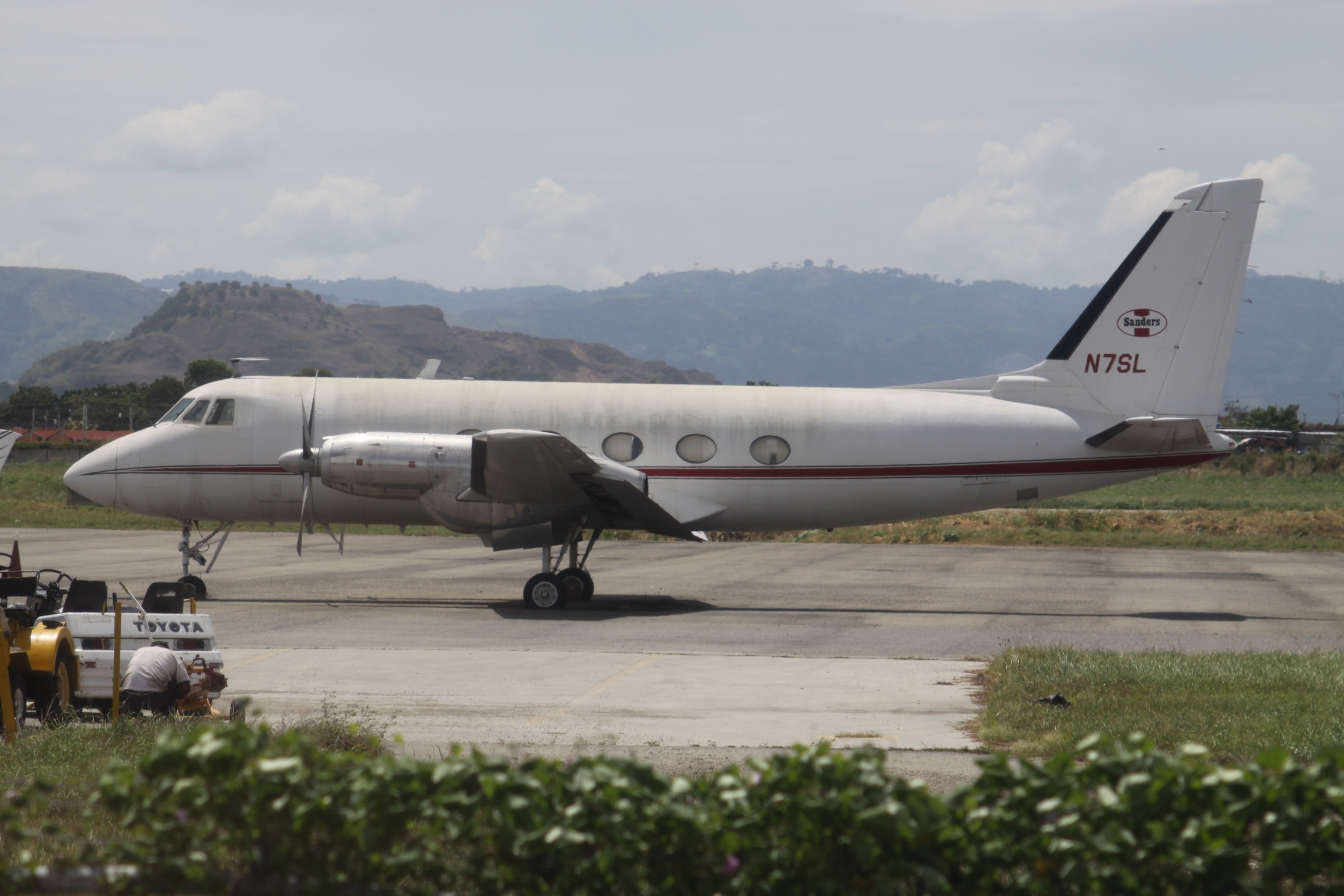
A Gulfstream I, registration N7SL, photographed in 2012. · Photo: Aeroprints.com, CC BY-SA 3.0, via Wikimedia Commons
Grumman · Turboprop
Gulfstream I (G-159)
The first Gulfstream: the turboprop that started the line leading to today's Gulfstream jets.
A landmark design whose cabin still beats most turboprops, but with no factory support, out-of-production engines and repeat wing corrosion inspections, it suits collectors and specialist operators rather than buyers who need dependable business transport.
Buy it if
You are an operator, museum or collector with your own maintenance shop, access to Rolls-Royce Dart engine expertise, and a heritage or special-mission reason to fly the original Gulfstream.
Skip it if
You need dependable trips, predictable costs, easy resale or charter income. A King Air 350, Beechcraft 1900D or Dornier 328 does similar work with engines and parts that are still supported.
Biggest compromise
Support. Gulfstream no longer supports the aircraft beyond parts shared with later models, Rolls-Royce stopped building Dart engines in 1987, and the wing needs detailed corrosion inspections every 9 to 18 months.
The numbers that matter
What it costs per year
$779K
at 300 hrs · two professional pilots
How far it flies
2,210 nm
1,545–1,580 nm with passengers
How fast
302 kt
high-speed cruise
Seats
12
10–12 typical, up to 24
Pilots needed
2
Flown by two pilots, each holding a type rating for this large aircraft.
For sale now
None listed right now
Cost to own
What it costs per year to run
300hours / year
Per year
Per flight hour
Estimate — your operator will quote actual numbers.
Fuel and wing corrosion inspections rise as you fly more. Two professional pilots stays the same however much you fly.
Where the money goes
Partial estimate- Two professional pilots$250,69032%
- Fuel$508,27565%
- Wing corrosion inspections$20,0003%
Fuel is the biggest single cost at 65% of the total.
The JetGrade
54 out of 100 — Well below its class
Peer group: Beechcraft King Air 350, Beechcraft 1900D, Dornier 328-100 (corporate), Swearingen Merlin IV / IVA / IVC
Seven categories at a glance
- - - 70 = typical— This aircraft
Strongest on range & payload, weakest on reliability & support.
Grades are editorial opinions about the model, not any specific aircraft. Sponsors and affiliates have no input. Reviewed 2026-10-04.
Where it flies
Sample trips and reach
Typical trips on a map
Nonstop
Depends on weight or weather
Fuel stop likely
Out of reach
5 of 8 sample trips are comfortable nonstops.
Sample flight times
- 1.2 hr
Carlsbad → Las Vegas
205 nm · Short hop, well within range
- 2.7 hr
Carlsbad → Aspen
625 nm · Hot-and-high; depends on weight and weather
- 3.2 hr
Santa Ana → San José del Cabo
765 nm · Comfortable nonstop with four aboard
- 3.7 hr
Teterboro → West Palm Beach
900 nm · Comfortable nonstop with four aboard
- 4.7 hr
Dallas → Teterboro
1,190 nm · Nonstop with four aboard in normal winds
- 5.5 hr
Teterboro → San Juan
1,410 nm · Long overwater leg; tight in strong headwinds
- 8.2 hr
Carlsbad → Teterboro
2,100 nm · Needs one stop, typically mid-continent
Los Angeles → Honolulu
2,215 nm · Beyond safe range; no fuel stop en route
Lineage
What came before and after

1959–1969
Gulfstream I (G-159)
Twin-turboprop original that launched the Gulfstream name
Size and cabin
How big it is, inside and out
Outside
Silhouette · scaled to length
Length
Wingspan
Height
Inside the cabin
Cabin length
Width
Height
Compare
How it stacks up
This aircraft
Gulfstream I (G-159)
- JetGrade
- 54
- Cost per year
- $779K
- Range
- 2,210 nm
- Speed
- 302 kt
- Seats
- 12
- Cabin length
- 32′ 6″
- Pilots
- 2
- Years built
- 1959–1969
After →
Gulfstream GII / GII-SP (hushkit)
- JetGrade
- Not yet graded
- Range
- 3,300 nm
- Speed
- 460 kt
- Seats
- 12
- Years built
- 1967–1977
Alternative
- JetGrade
- 76
- Cost per year
- $1.13M
- Range
- 1,806 nm
- Speed
- 312 kt
- Seats
- 8
- Cabin length
- 19′ 6″
- Pilots
- 1
- Years built
- 1990–2009
Alternative
- JetGrade
- 68
- Cost per year
- $1.79M
- Range
- 1,750 nm
- Speed
- 335 kt
- Seats
- 30
- Cabin length
- 33′ 9″
- Pilots
- 2
- Years built
- 1993–2000
Alternative
- JetGrade
- 66
- Cost per year
- $1.24M
- Range
- 1,279 nm
- Speed
- 280 kt
- Seats
- 19
- Cabin length
- 25′ 3″
- Pilots
- 1
- Years built
- 1991–2002
- Beechcraft King Air 350 instead: Smaller cabin, but about 1,800 nm of range and roughly 310 kt cruise, with wide service support and an active resale market.
- Dornier 328-100 (corporate) instead: The closest newer match for a large stand-up turboprop cabin, with roughly 335 kt cruise and Pratt & Whitney Canada engines.
- Beechcraft 1900D instead: Stand-up cabin turboprop with common PT6 engines, often fitted with executive interiors for 8 to 10 passengers.
Gold marks the best figure in each row.
Owning one
What to know before you buy
Engines & inspections
2 × Rolls-Royce Dart Mk 529
Engine hours until overhaul
- Engine fuel burner check · 1,000 hr
- Engine mount chafe guards · 2,500 hr
- Propeller pitch-link inspection · 3,300 hr
- Turbine blade platform inspection · 7,400 hr
- Wing corrosion inspection every 18 months
Engine overhauls are arranged with one of a few remaining Dart specialist shops, such as Fields Airmotive in South Africa.
Known issues
Wing and skin corrosion
Repeat inspections of lower wing planks and spot-welded skins; severe findings ground the aircraft until repaired.
Shrinking engine parts pool
Dart production ended in 1987; parts are shared with the last Viscount, F27 and 748 airliners.
No factory support
Gulfstream no longer supports the aircraft beyond parts shared with later models.
Pre-buy checklist
0 of 8 checked
Gulfstream no longer supports the Gulfstream I beyond parts shared with later models. Engine work relies on a handful of Dart specialists worldwide, and the remaining aircraft are maintained largely by their own operators.
Review
The full review
Strengths
- Stand-up cabin about 7 ft 4 in wide and 6 ft 1 in tall, seating 10 to 12 in executive layouts.
- About 2,210 nm on full tanks, and an estimated 1,580 nm with four passengers and standard fuel reserves.
- Built-in airstair and a tail-mounted auxiliary power unit let it operate at airports with few services.
Limitations
- Burns about 1,300 to 1,400 lb of fuel an hour in cruise, roughly 200 gallons, according to a longtime operator.
- Wing corrosion inspections every 9 to 18 months; the FAA estimated $24,000 to $36,000 per round in 2006.
- About a half-dozen remained in service worldwide in 2022, so parts, mechanics and buyers are scarce.
The Gulfstream I is where the Gulfstream name began. Grumman flew the first one in August 1958 and built 200 between 1959 and 1969, selling them to companies such as Ford and Walt Disney as one of the first aircraft designed from the start for business travel. Two Rolls-Royce Dart turboprop engines, a stand-up cabin and a built-in airstair set the pattern that the Gulfstream II jet followed in 1967, and the line runs through every Gulfstream since. Five were later stretched into 37-seat G-159C commuter airliners, a separate version not covered here.
Pilot's take
From the flight deck, the Gulfstream I is a big, honest 1950s transport. The controls are manual, without hydraulic boost, water-methanol injection adds power for hot-day takeoffs, and it needs two pilots with a type rating. Operators describe cruising at 270 to 280 kt in the mid-20s, still brisk for a turboprop. The pressing concerns are upkeep rather than handling: icing procedures written into the flight manual by directive, recurring wing corrosion inspections, and engines that only a few shops in the world still overhaul. It suits crews and mechanics who treat it as the classic it is.
Who this is for
Aviation museums, heritage collectors and specialist operators with in-house maintenance and Dart engine know-how. It is not a practical choice for a first-time owner or a company that needs everyday business transport.

Ask about this aircraft
Answers come only from our research file on the Gulfstream I (G-159).
Your earlier questionsOwners
Private to verified ownersOwn a Grumman Gulfstream I (G-159)? Verify with its FAA registration to join the owners' thread and the real-cost poll.