
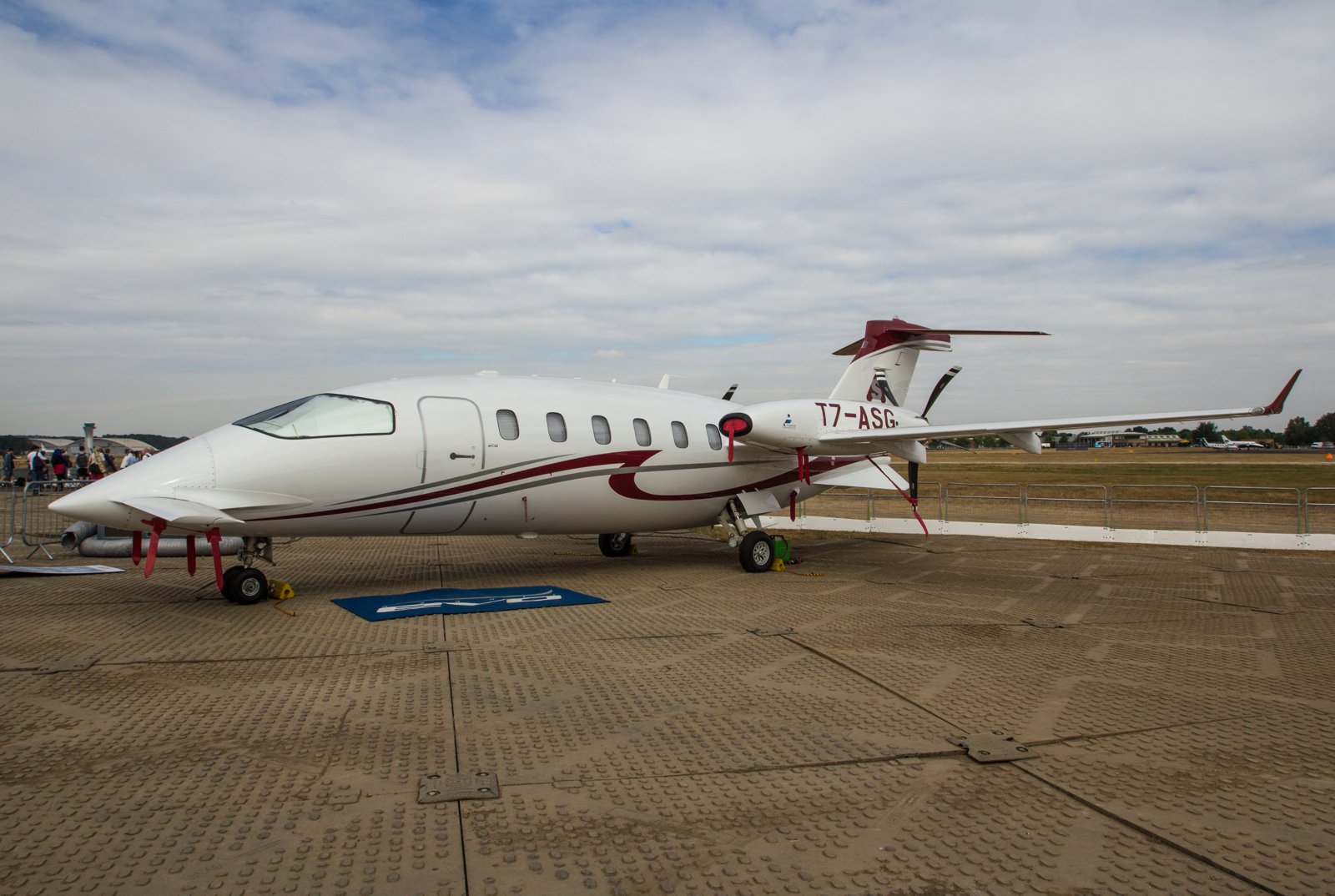
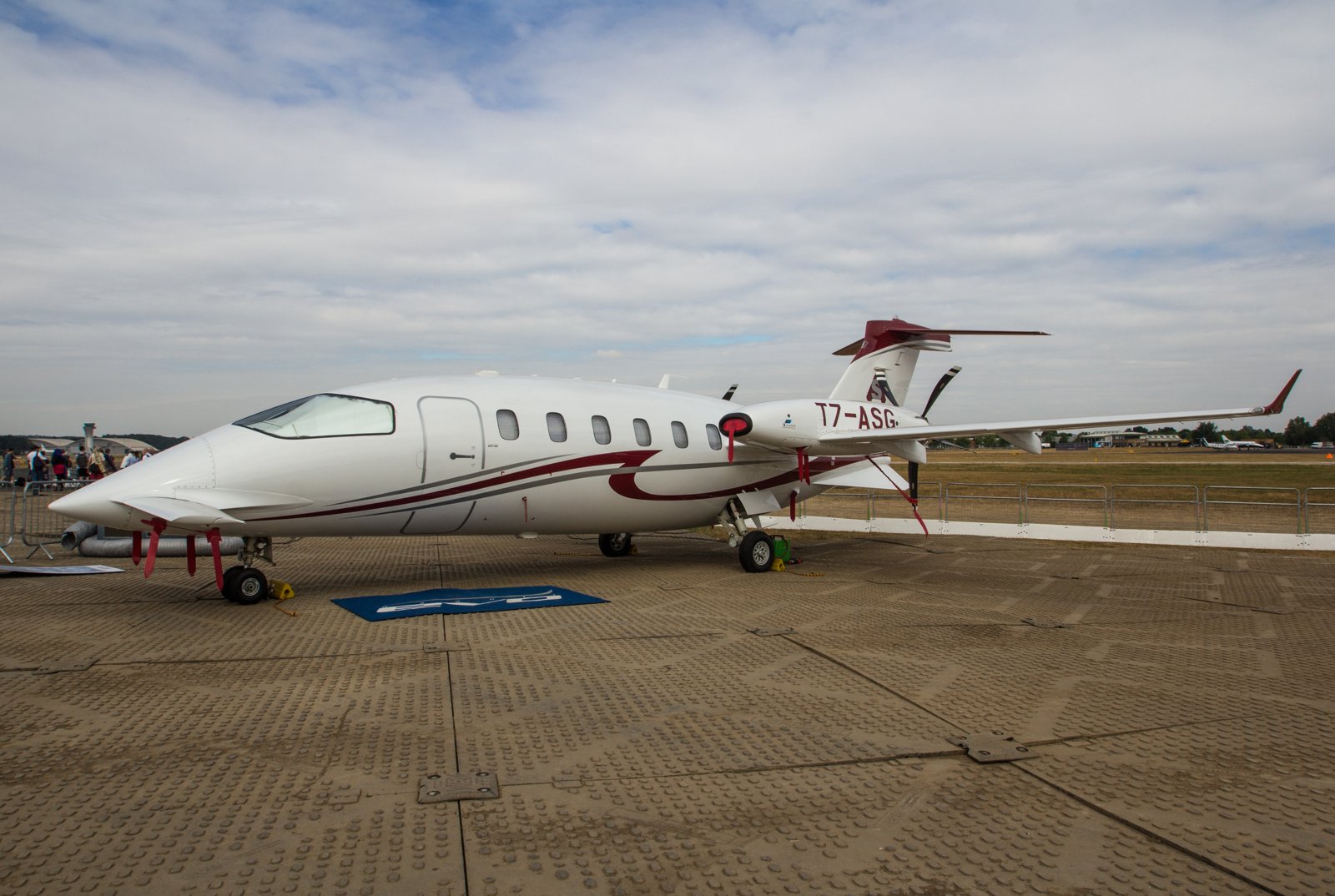
A Piaggio P.180 Avanti EVO on display at Farnborough, England, in July 2018. · Steve Lynes, CC BY 2.0, via Wikimedia Commons
Piaggio · Turboprop
P.180 Avanti EVO
Third version of the P.180 Avanti and the current production model; the Avanti NX successor was announced in 2026.
The fastest business turboprop on sale, with a cabin wider and taller than any King Air's. You pay for it in support: a small fleet, a factory only recently out of administration, and maintenance bills closer to a light jet's.
Buy it if
You fly two to six people on 300 to 1,200 nm trips, want light-jet trip times on turboprop fuel burn, value a quiet cabin with an enclosed lavatory, and can base the aircraft near an experienced Avanti shop.
Skip it if
You need gravel or grass strips, want the deepest service network and quickest resale, or plan to fly it yourself without an insurer-approved experience level. A King Air or PC-12 is simpler to own.
Biggest compromise
Support depth. About 220 Avantis fly worldwide and only a few dozen are EVOs.
The numbers that matter
Purchase price
$5.88M–$5.88M
guide value (Aircraft Cost Calculator average pre-owned price)
What it costs per year
$1.2M
at 300 hrs · two professional pilots
How far it flies
1,770 nm
1,050–1,500 nm with passengers
How fast
402 kt
high-speed cruise
Seats
6
6 typical (up to 8)
Pilots needed
1
Certified for one pilot; most owners and insurers use two professional pilots.
Price
What one costs to buy
Guide value
$5.88M–$5.88M
Other sites
Priced vs call
with a price / call for price
Only one EVO is publicly priced: a 2018 aircraft at $6.0M. Aircraft Cost Calculator puts the average pre-owned EVO at $5.88M; new list was about $7.7M.
Price vs its family and alternatives
Scroll to explore · select a jet for details
P.180 Avanti EVO · This aircraft
$5.88M–$5.88M guide
Guide value, not a listed asking price.
Sits between the P.180 Avanti II and the PC-12 NGX.
For sale now
None listed right now
Cost to own
What it costs per year to run
300hours / year
Per year
Per flight hour
Estimate — your operator will quote actual numbers.
Fuel, airframe maintenance, engine and propeller reserve and trip costs rise as you fly more. Two professional pilots, annual recurrent training, hangar, insurance and avionics data and subscriptions stay the same however much you fly.
Where the money goes
- Two professional pilots$329,27927%
- Annual recurrent training$50,0004%
- Hangar$35,0003%
- Insurance$47,5004%
- Avionics data and subscriptions$11,2501%
- Fuel$253,09821%
- Airframe maintenance$268,80022%
- Engine and propeller reserve$153,90013%
- Trip costs$55,2005%
Two professional pilots is the biggest single cost at 27% of the total.
The JetGrade
68 out of 100 — Below its class average
Peer group: Beechcraft King Air 260, Beechcraft King Air 360, Pilatus PC-12 NGX, Cessna Citation M2 Gen2
Seven categories at a glance
- - - 70 = typical— This aircraft
Strongest on speed & trip time, weakest on reliability & support.
Grades are editorial opinions about the model, not any specific aircraft. Sponsors and affiliates have no input. Reviewed 2026-10-08.
Where it flies
Sample trips and reach
Typical trips on a map
Nonstop
Depends on weight or weather
Fuel stop likely
4 of 6 sample trips are comfortable nonstops.
Sample flight times
- 1.0 hr
Carlsbad → Las Vegas
205 nm
- 2.3 hr
Carlsbad → Aspen
625 nm · High-altitude airport; depends on weight and weather
- 2.8 hr
Santa Ana → San José del Cabo
765 nm
- 3.2 hr
Teterboro → West Palm Beach
900 nm
- 4.0 hr
Dallas → Teterboro
1,190 nm · Nonstop with four passengers; strong headwinds cut margin
- 7.1 hr
Carlsbad → Teterboro
2,100 nm · Needs one stop, typically mid-continent
Lineage
What came before and after


2014–present
P.180 Avanti EVO
Winglets, quieter five-blade swept propellers, new exhausts and cabin upgrades.
Announced 2026
P.180 Avanti NX
New flight deck, interior and connectivity; first order April 2026.
What changed from the P.180 Avanti II
- Winglets on the main wing and reshaped forward-wing tips cut drag and improve climb.
- Five-blade swept Hartzell propellers and new exhaust stacks make it quieter outside and inside.
- Optional extra fuel tank raises published range to 1,770 nm.
- New low-maintenance landing gear with anti-skid carbon brakes and digital steering.
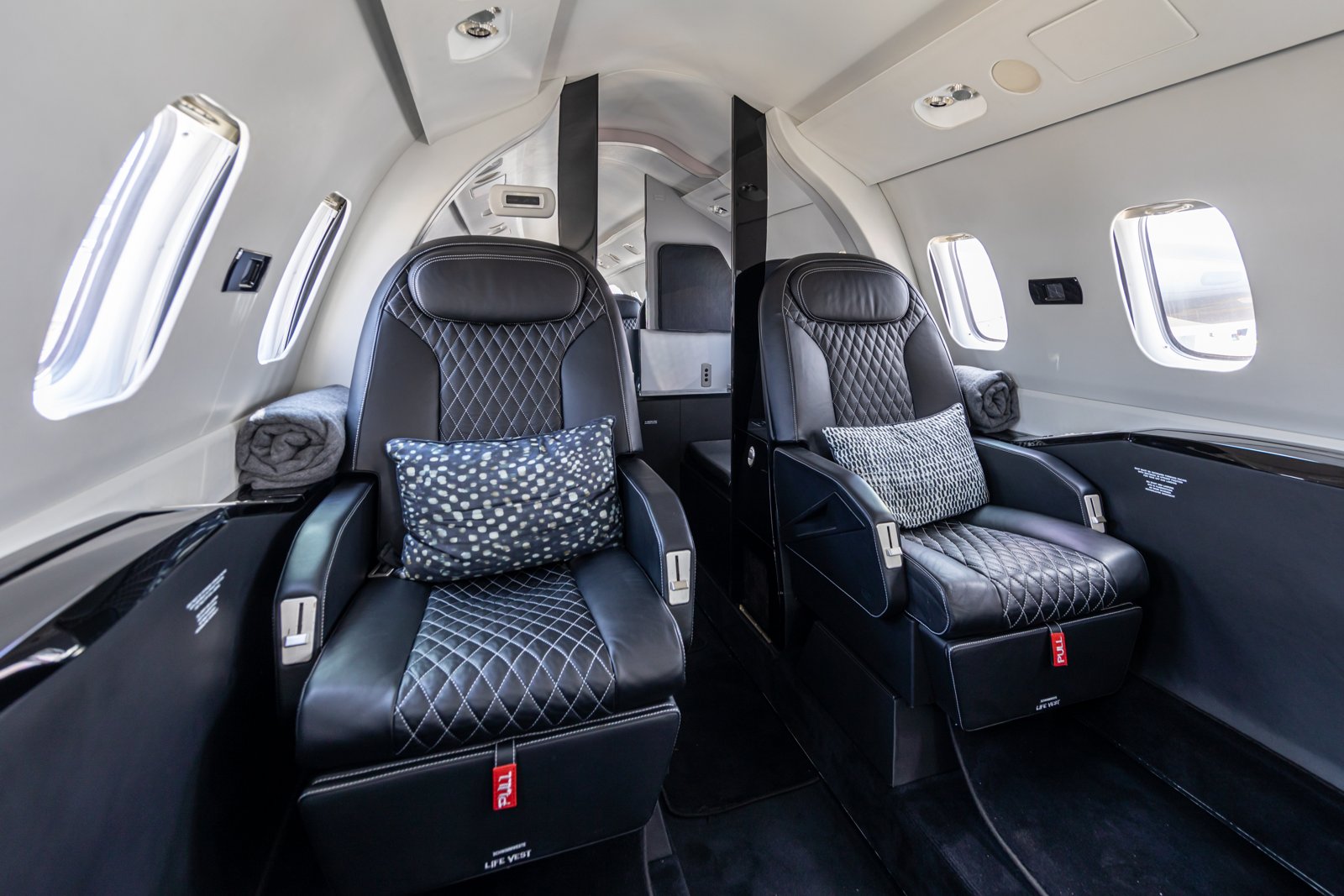
- New seats, LED lighting and a digital two-zone climate system.
- Collins Pro Line 21 cockpit carried over; enhanced vision became an option in 2025.
Size and cabin
How big it is, inside and out
Outside
Silhouette · scaled to length
Length
Wingspan
Height
Inside the cabin
Photo · this model
Cabin length
Width
Height
Compare
How it stacks up
This aircraft
P.180 Avanti EVO
- JetGrade
- 68
- Price
- $5.88M–$5.88M guide
- Cost per year
- $1.2M
- Range
- 1,770 nm
- Speed
- 402 kt
- Seats
- 6
- Cabin length
- 14′ 11″
- Pilots
- 1
- Years built
- 2014–now
← Before
- JetGrade
- 70
- Price
- $1.7M–$3.65M guide
- Cost per year
- $1.01M
- Range
- 1,470 nm
- Speed
- 400 kt
- Seats
- 7
- Cabin length
- 14′ 11″
- Pilots
- 1
- Years built
- 2005–2014
After →
P.180 Avanti NX
Not yet graded
Alternative
Beechcraft King Air 360 / 360ER
- JetGrade
- Not yet graded
- Range
- 1,806 nm
- Speed
- 312 kt
- Seats
- 8
- Years built
- 2020
Alternative
- JetGrade
- 80
- Price
- $7.39M
- Cost per year
- $608K
- Range
- 1,889 nm
- Speed
- 290 kt
- Seats
- 6
- Cabin length
- 16′ 11″
- Pilots
- 1
- Years built
- 2020–2025
Alternative
- JetGrade
- 70
- Cost per year
- $1.09M
- Range
- 2,040 nm
- Speed
- 416 kt
- Seats
- 7
- Cabin length
- 15′ 8″
- Pilots
- 1
- Years built
- 2026–now
- Beechcraft King Air 360 instead: Roughly 90 knots slower, but the best-supported twin turboprop, with easier resale and a far larger service network.
- Pilatus PC-12 NGX instead: One engine, slower and narrower, but cheaper to run, happy on gravel or grass, and quick to resell.
- Cessna Citation CJ3 Gen2 instead: A light jet with similar trip times, more range and Cessna's service network, at higher fuel burn and price.
Gold marks the best figure in each row.
Owning one
What to know before you buy
Engines & inspections
2 × Pratt & Whitney Canada PT6A-66B · 850 shp each
No APUEngine hours until overhaul
- A check · 200 hr
- Vertical tail corrosion check · 660 hr
- C check · 1,800 hr
- D check · 3,600 hr
- Engine overhaul · 3,600 hr
- Propeller overhaul · 3,600 hr
- Landing gear overhaul every 180 months
Ask whether both engines are on a pay-per-hour plan, what it covers and what transfer costs. Uncovered overhauls are major bills.
Known issues
Horizontal tail corrosion
Directive requires central-box inspections on most EVOs; a replacement stabilizer is estimated near $150,000.
Thin factory support network
Few US shops know the type and parts come from Italy; downtime waiting for parts is a real risk.
Vertical tail corrosion and cracks
Repeat inspections every 660 hours or 26 months until a fix is installed.
Pre-buy checklist
0 of 10 checked
Piaggio Aerospace has been owned by Turkey's Baykar since mid-2025. It runs 24/7 parts support, named a Florida parts warehouse in October 2026, and has few US service centers.
Review
The full review
Strengths
- Cruises at up to 402 knots, close to light jets such as the Citation M2 on most trips.
- Cabin is 1.85 m (6 ft 1 in) wide and 1.75 m (5 ft 9 in) tall, roomier than any King Air.
- Burns about 100–118 gallons an hour, less fuel than light jets of similar speed.
Limitations
- About $1.2M a year to run at 300 hours with two pilots, more than a King Air 350i.
- Baggage hold takes about 35 cu ft and 350 lb, tight for six people on a long weekend.
- Small fleet of about 220 Avantis means fewer shops, slower parts and a thin resale market.
The Piaggio P.180 Avanti EVO is the third and current version of one of the strangest-looking business aircraft ever certified. A small forward wing sits on the nose, the main wing is mounted behind the cabin, and two Pratt & Whitney Canada PT6A-66B turboprops face backwards, pushing the aircraft with five-blade, swept propellers. The original Avanti flew in 1986 and entered service in 1990, the Avanti II added more powerful engines and a Collins Pro Line 21 cockpit in 2005, and the EVO arrived in late 2014 with winglets, quieter propellers and new engine exhausts. A successor called the Avanti NX was announced in 2026.
Pilot's take
From the cockpit the EVO feels more like a light jet than a turboprop. Climb is brisk, the Pro Line 21 displays are familiar to anyone from a Citation or King Air, and the pusher layout keeps propeller noise behind the cabin. The forward wing and laminar main wing reward precise speed control on approach. Most operators fly it with two pilots even though one is legal. The real workload is on the ground: finding a technician who knows the type and planning around parts lead times.
Who this is for
Owners and companies flying 250–400 hours a year on 300–1,200 nm trips with four to six passengers, who want light-jet door-to-door times and a big cabin, and will pay for a professional crew and a specialist shop.

Ask about this aircraft
Answers come only from our research file on the Piaggio P.180 Avanti EVO.
Your earlier questionsOwners
Private to verified ownersOwn a Piaggio P.180 Avanti EVO? Verify with its FAA registration to join the owners' thread and the real-cost poll.