
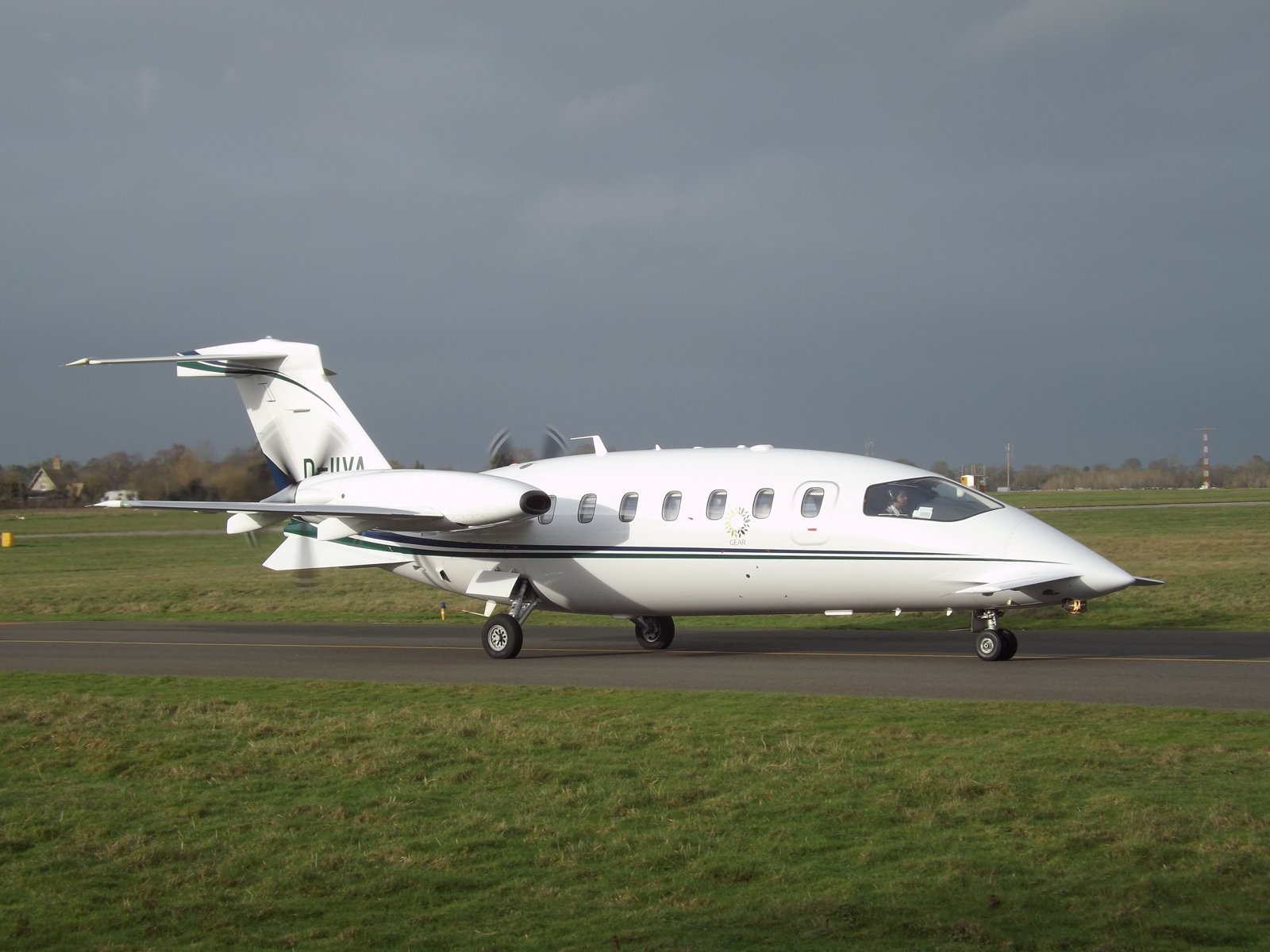
Avanti II D-IIVA at Oxford, showing the small forward wing and rear pusher propellers. · James from Cheltenham, CC BY-SA 2.0, via Wikimedia Commons
Piaggio · Turboprop
P.180 Avanti II
Second of three production versions of Piaggio's P.180, between the original Avanti and the Avanti EVO.
The Avanti II gives light-jet speed and a roomy, quiet cabin for twin-turboprop fuel bills. Range shrinks quickly as seats fill, and years of factory insolvency left parts and service thinner than at Textron. Buy the best-documented example you can find.
Buy it if
You fly two to four people on trips under about 1,200 nm, value a 400 kt cruise and a cabin you can nearly stand in, and will budget for specialist maintenance and a careful pre-purchase inspection.
Skip it if
You regularly fill the seats, need more than about 750 nm with a full cabin, want a dense service network nearby, or plan to sell quickly in a thin market.
Biggest compromise
Payload and support. With full tanks and two pilots, about 848 lb is left for people and bags, so full-cabin trips mean stopping for fuel.
The numbers that matter
Purchase price
$1.7M–$3.65M
guide value (Aircraft Bluebook)
What it costs per year
$1.01M
at 300 hrs · two professional pilots
How far it flies
1,470 nm
752–1,364 nm with passengers
How fast
400 kt
high-speed cruise
Seats
7
7 typical (6–9 by interior)
Pilots needed
1
Certified for one pilot; insurers typically expect type-specific simulator training.
Price
What one costs to buy
Guide value
$1.7M–$3.65M
Other sites
5.8% of the fleet
Priced vs call
with a price / call for price
Neither public listing shows a price. Aircraft Bluebook values run $1.7M for a 2007 to $3.65M for a 2014; JETNET shows asks of $3.2M–$4.0M.
Price vs its family and alternatives
Scroll to explore · select a jet for details
P.180 Avanti II · This aircraft
$1.7M–$3.65M guide
Guide value, not a listed asking price.
Sits between the P.180 Avanti (I) and the King Air 350 (B300).
For sale now
None listed right now
Cost to own
What it costs per year to run
300hours / year
Per year
Per flight hour
Estimate — your operator will quote actual numbers.
Fuel, maintenance, engine program and trip expenses rise as you fly more. Crew, training, hangar, insurance, management and subscriptions and databases stay the same however much you fly.
Where the money goes
- Crew$325,00032%
- Training$37,5004%
- Hangar$32,5003%
- Insurance$34,0003%
- Management$50,0005%
- Subscriptions and databases$22,5002%
- Fuel$267,43526%
- Maintenance$105,00010%
- Engine program$99,00010%
- Trip expenses$37,5004%
Crew is the biggest single cost at 32% of the total.
The JetGrade
70 out of 100 — Typical for its class
Peer group: Beechcraft King Air 350i, Beechcraft King Air 350, Beechcraft King Air 250, Piaggio P.180 Avanti EVO
Seven categories at a glance
- - - 70 = typical— This aircraft
Strongest on speed & trip time, weakest on reliability & support.
Grades are editorial opinions about the model, not any specific aircraft. Sponsors and affiliates have no input. Reviewed 2026-10-08.
Where it flies
Sample trips and reach
Typical trips on a map
Nonstop
Depends on weight or weather
Fuel stop likely
4 of 6 sample trips are comfortable nonstops.
Sample flight times
- 1.0 hr
Carlsbad → Las Vegas
205 nm · Easy nonstop, even with a full cabin
- 2.1 hr
Carlsbad → Aspen
625 nm · High-elevation airport; summer weight limits may apply
- 2.5 hr
Santa Ana → San José del Cabo
765 nm · Comfortable nonstop with four passengers
- 2.8 hr
Teterboro → West Palm Beach
900 nm · Comfortable nonstop in still air
- 3.8 hr
Dallas → Teterboro
1,190 nm · Nonstop with four; headwinds or more passengers mean a stop
- 6.5 hr
Carlsbad → Teterboro
2,100 nm · Needs one stop, typically mid-continent
Lineage
What came before and after


2005–2014
P.180 Avanti II
Pro Line 21 cockpit, PT6A-66B engines and a 12,100 lb maximum weight.
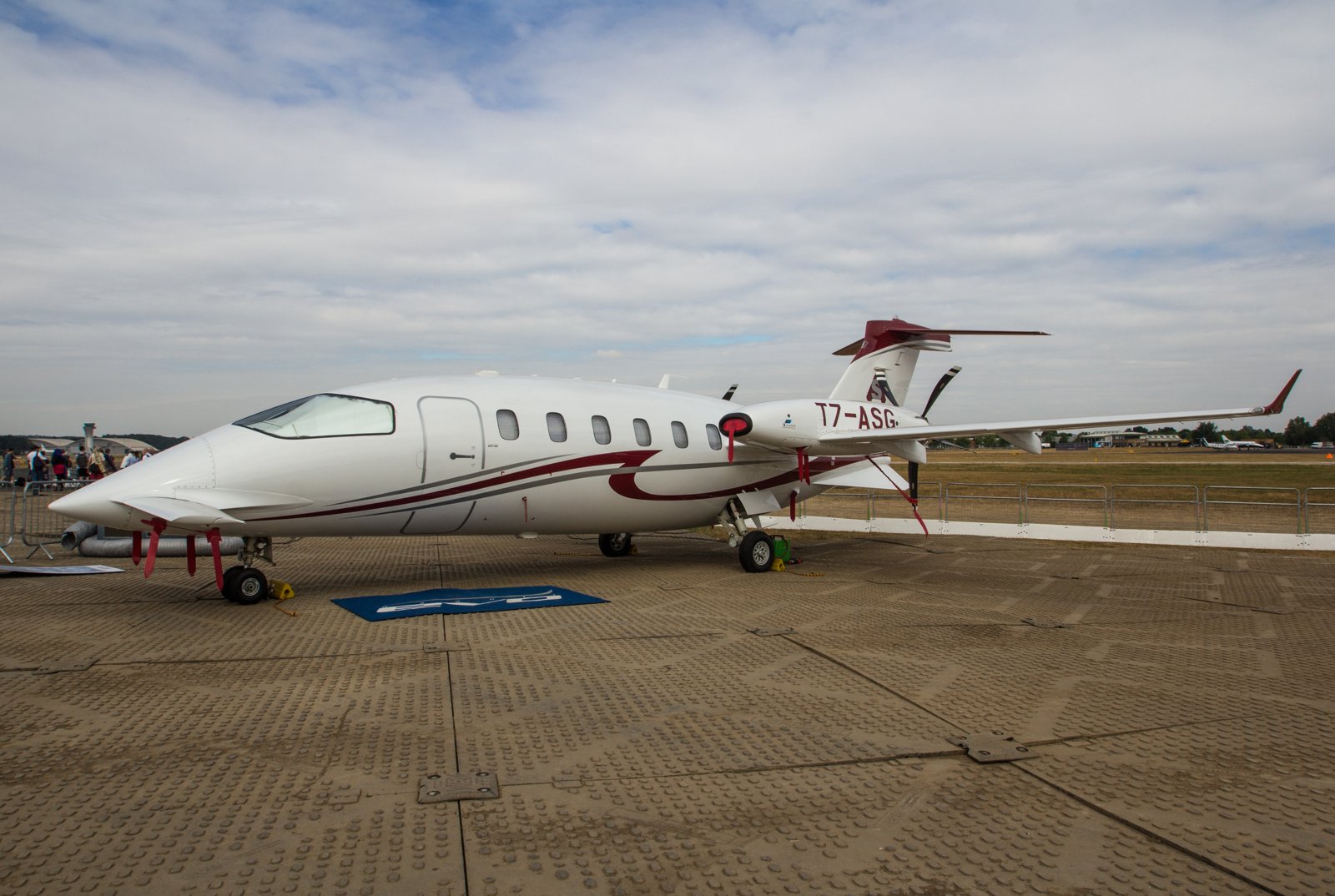
Announced 2026
Avanti NX
Next-generation Avanti announced after Baykar bought Piaggio.
What changed from the P.180 Avanti
- Collins Pro Line 21 cockpit with three large screens and a flight management system.
- PT6A-66B engines hold more power at altitude; some early aircraft kept PT6A-66 engines.
- Maximum takeoff weight rose from 11,550 lb to 12,100 lb.
- Earlier Avantis can be brought to Avanti II standard by a factory service bulletin.
Size and cabin
How big it is, inside and out
Outside
Silhouette · scaled to length
Length
Wingspan
Height
Inside the cabin
Cabin length
Width
Height
Compare
How it stacks up
This aircraft
P.180 Avanti II
- JetGrade
- 70
- Price
- $1.7M–$3.65M guide
- Cost per year
- $1.01M
- Range
- 1,470 nm
- Speed
- 400 kt
- Seats
- 7
- Cabin length
- 14′ 11″
- Pilots
- 1
- Years built
- 2005–2014
← Before
- JetGrade
- 67
- Price
- $1.74M
- Cost per year
- $1.12M
- Range
- 1,750 nm
- Speed
- 395 kt
- Seats
- 6
- Cabin length
- 14′ 11″
- Pilots
- 1
- Years built
- 1990–2005
After →
- JetGrade
- 68
- Price
- $5.88M–$5.88M guide
- Cost per year
- $1.2M
- Range
- 1,770 nm
- Speed
- 402 kt
- Seats
- 6
- Cabin length
- 14′ 11″
- Pilots
- 1
- Years built
- 2014–now
Alternative
- JetGrade
- 76
- Price
- $3.25M
- Cost per year
- $1.13M
- Range
- 1,806 nm
- Speed
- 312 kt
- Seats
- 8
- Cabin length
- 19′ 6″
- Pilots
- 1
- Years built
- 1990–2009
Alternative
- JetGrade
- Not yet graded
- Price
- $3.9M
- Range
- 1,613 nm
- Speed
- 418 kt
- Seats
- 5
- Years built
- 2006–2016
- Beechcraft King Air 350 instead: Carries far more with full tanks and has Textron's service network behind it; you give up roughly 90 kt and the taller cabin.
- Piaggio P.180 Avanti EVO instead: Same cabin with winglets, quieter propellers and newer airframes; choose it for lower noise and age, at a higher price.
- Cessna Citation CJ2+ instead: A light jet of similar speed with Textron support; the cabin is a foot lower and Piaggio's figures show higher fuel burn.
Gold marks the best figure in each row.
Owning one
What to know before you buy
Engines & inspections
2 × Pratt & Whitney Canada PT6A-66B · 850 shp each
No APUEngine hours until overhaul
- 200-hour check · 200 hr
- 600-hour check · 600 hr
- C check · 1,800 hr
- Hot section inspection · 1,800 hr
- D check · 3,600 hr
- Engine overhaul · 3,600 hr
- Propeller overhaul · 3,600 hr
- Landing gear overhaul every 144 months
Hourly programs spread hot section and overhaul costs; confirm enrollment, coverage level and transfer terms before buying, since rates are not published.
Known issues
Tail corrosion inspections
FAA directives require repeat tail corrosion inspections; the FAA estimates a replacement horizontal stabilizer at about $150,850.
Factory support rebuilding
Piaggio was insolvent from 2018 until Baykar bought it in 2025; a US parts warehouse was appointed in October 2026.
Control-surface bonding checks
Tap tests repeat every 600 hours on most Avanti IIs; a replacement aileron, elevator or flap costs $23,000 to $87,000.
Pre-buy checklist
0 of 10 checked
Baykar Piaggio Aerospace supports the fleet from Genoa, with Intercontinental Jet Service in Tulsa as an authorized US center, a new Sarasota parts warehouse and independent specialists such as SimsAir in Texas.
Review
The full review
Strengths
- Cruises at 400 kt at 31,000 ft, about 90 kt faster than a King Air 350.
- Cabin is 5 ft 9 in tall and 6 ft 1 in wide, roomier than light jets of the same era.
- Burns about 105 gal an hour, so trips cost much less fuel than in slower turboprops.
Limitations
- With full tanks and two pilots only about 848 lb remains; seats-full range falls to about 752 nm.
- Repeat tail and control-surface inspections are mandatory; replacing a horizontal stabilizer is estimated near $151,000.
- About 120 in service and few authorized shops; Piaggio's US parts warehouse only opened in October 2026.
The P.180 Avanti II is the 2005–2014 version of Piaggio's three-surface twin turboprop, built in Genoa, Italy. It replaced the original Avanti and was followed in 2014 by the Avanti EVO, which added winglets and quieter propellers. The Avanti II brought a Collins Pro Line 21 cockpit, PT6A-66B engines that hold more power at altitude, and a maximum takeoff weight raised from 11,550 to 12,100 lb. Piaggio built 129, and about 120 remain in service, according to the JETNET data shown on AvBuyer.
Pilot's take
From the cockpit, the Avanti II feels closer to a light jet than a turboprop. It climbs at about 2,770 ft a minute, settles at 400 kt in the low thirties, and the Pro Line 21 suite gives a single pilot capable automation. The pushers keep propeller noise behind the cabin, and passengers notice. It asks for discipline in return: a careful walkaround of the tail and control surfaces, clean fuselage drains in freezing weather, and close attention to emergency gear procedures. Payload planning matters on every full-cabin leg. Flown within its limits, it is fast and rewarding.
Who this is for
Owner-operators and small companies who mostly carry two to four people on regional trips, want jet-like speed and a tall cabin at turboprop running costs, and are willing to work with specialist shops.

Ask about this aircraft
Answers come only from our research file on the P.180 Avanti II.
Your earlier questionsOwners
Private to verified ownersOwn a Piaggio P.180 Avanti II? Verify with its FAA registration to join the owners' thread and the real-cost poll.