
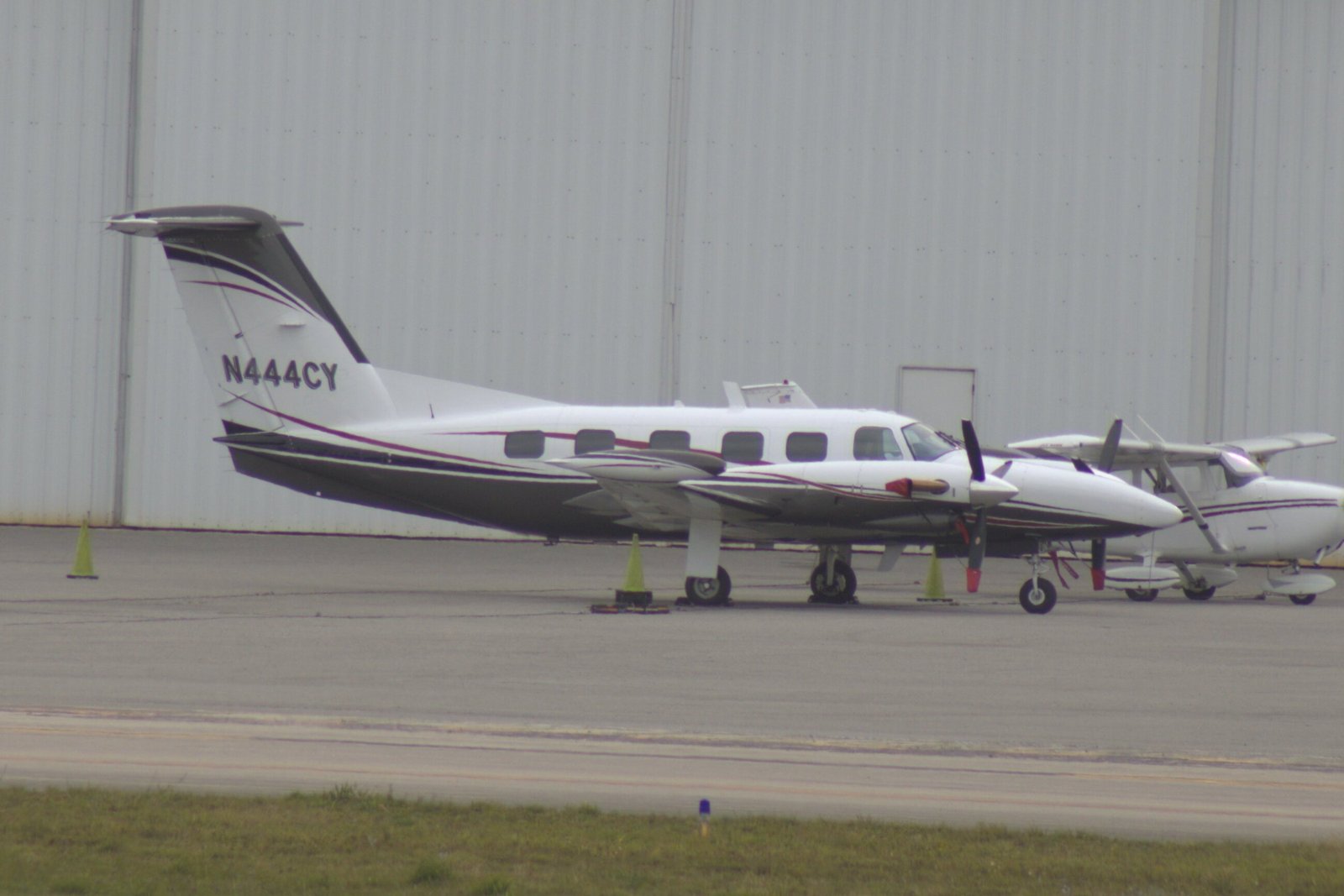
Piper Cheyenne IIIA N444CY at Daytona Beach International Airport, Florida, in 2024. · ZLEA, CC BY-SA 4.0, via Wikimedia Commons
Piper · Turboprop
Cheyenne IIIA (PA-42-720)
Middle model of Piper's PA-42 Cheyenne line, between the original Cheyenne III and the Garrett-powered 400LS.
One of the fastest older twin turboprops you can buy for about $1 million. The trade-offs are a cramped cabin and almost no payload with full tanks. Only 60 were built, so parts and expert shops take effort to find.
Buy it if
You want King Air-class trips at higher speed for much less money, usually fly two to four people on legs up to about 1,200 nm, and have a shop that knows Cheyennes.
Skip it if
You often fill every seat and the baggage area, need stand-up headroom or a closed lavatory, or want the easy parts support and resale of a King Air.
Biggest compromise
Range and payload pull against each other. With four aboard it can fly about 1,300 nm.
The numbers that matter
Purchase price
$700K–$1.09M
guide value (GlobalAir, Planephd, Conklin & de Decker and Aircraft Cost Calculator)
What it costs per year
$737K
at 300 hrs · one professional pilot
How far it flies
1,763 nm
867–1,300 nm with passengers
How fast
305 kt
high-speed cruise
Seats
6
6 typical (up to 9 by interior)
Pilots needed
1
Certified for one pilot; some operators fly it with two.
Price
What one costs to buy
Guide value
$700K–$1.09M
Other sites
16.7% of the fleet
Priced vs call
with a price / call for price
None of the three listed IIIAs shows a price. Published guide values run from about $700,000 to $1.09 million; a 1981 original Cheyenne III asks $549,000.
Price vs its family and alternatives
Scroll to explore · select a jet for details
Cheyenne IIIA (PA-42-720) · This aircraft
$700K–$1.09M guide
Guide value, not a listed asking price.
Sits between the Cheyenne II (PA-31T) and the Conquest II (441).
For sale now
None listed right now
Cost to own
What it costs per year to run
300hours / year
Per year
Per flight hour
Estimate — your operator will quote actual numbers.
Fuel, airframe maintenance, engine overhaul reserve and propeller reserve and trip costs rise as you fly more. One professional pilot, recurrent training, hangar, insurance and subscriptions and databases stay the same however much you fly.
Where the money goes
- One professional pilot$160,00022%
- Recurrent training$15,0002%
- Hangar$36,0005%
- Insurance$30,0004%
- Subscriptions and databases$11,5002%
- Fuel$241,96533%
- Airframe maintenance$120,00016%
- Engine overhaul reserve$108,00015%
- Propeller reserve and trip costs$15,0002%
Fuel is the biggest single cost at 33% of the total.
The JetGrade
66 out of 100 — Below its class average
Peer group: Beechcraft King Air B200, Cessna Conquest II (441), Mitsubishi MU-2 Marquise, Gulfstream Commander 1000
Seven categories at a glance
- - - 70 = typical— This aircraft
Strongest on speed & trip time, weakest on reliability & support.
Grades are editorial opinions about the model, not any specific aircraft. Sponsors and affiliates have no input. Reviewed 2026-10-08.
Where it flies
Sample trips and reach
Typical trips on a map
Nonstop
Depends on weight or weather
Fuel stop likely
3 of 6 sample trips are comfortable nonstops.
Sample flight times
- 1.2 hr
Carlsbad → Las Vegas
205 nm · Short hop, well within range
- 2.6 hr
Carlsbad → Aspen
625 nm · Mountain airport; summer heat may limit weight
- 3.1 hr
Santa Ana → San José del Cabo
765 nm · Nonstop with four aboard
- 3.6 hr
Teterboro → West Palm Beach
900 nm · Nonstop with four; strong headwinds cut margin
- 4.9 hr
Dallas → Teterboro
1,190 nm · Nonstop with four in calm winds; little margin
- 8.2 hr
Carlsbad → Teterboro
2,100 nm · One stop, typically mid-continent
Lineage
What came before and after


1984–1993
Piper Cheyenne IIIA (PA-42-720)
PT6A-61 engines, 35,000 ft ceiling and upgraded systems.
What changed from the Piper Cheyenne III (PA-42)
- PT6A-61 engines replace the PT6A-41; still 720 horsepower, but stronger at altitude.
- Certified ceiling rises to 35,000 ft from 33,000 ft.
- Maximum takeoff weight rises to 11,200 lb from 11,000 lb.
- Upgraded electrical, air-conditioning and engine fuel-control systems.
- AOPA's figures show range growing to 1,370 nm from 1,300 nm.
- Revised interior layout.
Size and cabin
How big it is, inside and out
Outside
Silhouette · scaled to length
Length
Wingspan
Height
Inside the cabin
Cabin length
Width
Height
Compare
How it stacks up
This aircraft
Cheyenne IIIA (PA-42-720)
- JetGrade
- 66
- Price
- $700K–$1.09M guide
- Cost per year
- $737K
- Range
- 1,763 nm
- Speed
- 305 kt
- Seats
- 6
- Cabin length
- 18′ 1″
- Pilots
- 1
- Years built
- 1984–1993
← Before
- JetGrade
- 65
- Price
- $450K
- Cost per year
- $551K
- Range
- 2,200 nm
- Speed
- 288 kt
- Seats
- 6
- Cabin length
- 18′ 1″
- Pilots
- 1
- Years built
- 1980–1983
Alternative
- JetGrade
- 74
- Price
- $1.85M
- Cost per year
- $827K
- Range
- 1,580 nm
- Speed
- 291 kt
- Seats
- 7
- Cabin length
- 16′ 8″
- Pilots
- 1
- Years built
- 1981–2009
Alternative
- JetGrade
- 72
- Price
- $1.36M
- Cost per year
- $671K
- Range
- 2,000 nm
- Speed
- 314 kt
- Seats
- 7
- Cabin length
- 12′ 10″
- Pilots
- 1
- Years built
- 1977–1986
Alternative
- JetGrade
- 66
- Price
- $1.47M–$1.53M guide
- Cost per year
- $851K
- Range
- 1,640 nm
- Speed
- 340 kt
- Seats
- 6
- Cabin length
- 18′ 1″
- Pilots
- 1
- Years built
- 1984–1992
- Beechcraft King Air B200 instead: Taller cabin, much better parts support and easier resale, at roughly twice the asking price and a little slower.
- Cessna Conquest II (441) instead: A Garrett-powered twin from the same era with a longer published range; compare cabin space and engine overhaul costs.
- Piper Cheyenne 400LS (PA-42-1000) instead: The Garrett-powered sibling with 1,000-horsepower engines: much faster, but even rarer, with 43 built.
Gold marks the best figure in each row.
Owning one
What to know before you buy
Engines & inspections
2 × Pratt & Whitney Canada PT6A-61 · 720 shp each
No APUEngine hours until overhaul
- Nose baggage door directive · 100 hr
- Engine overhaul · 3,600 hr
No listed aircraft advertises an engine program; ask the seller whether either engine is enrolled and what the hot section history shows.
Known issues
Scarce parts and specialists
Only 60 were built and production ended in 1993; some parts are slow to source and few shops know the type.
Engine overhaul cost exposure
No published flat overhaul price for these engines; similar Pratt & Whitney engines list above $575,000 each.
Pressurization and window wear
Pressurization leaks and cracked or delaminated windshields and side windows are common pre-buy findings.
Pre-buy checklist
0 of 10 checked
Piper still holds the type certificate, but production ended in 1993 and parts can be slow. Pratt & Whitney Canada supports the engines worldwide, and a few specialist shops know the airframe well.
Review
The full review
Strengths
- Cruises at up to 305 knots, faster than a King Air B200 at about 291 knots.
- Certified to 35,000 feet, with engines that hold power at altitude better than the original Cheyenne III's.
- Guide values of about $0.7-1.09 million, roughly half the asking price of a typical King Air B200.
Limitations
- Cabin is 4 ft 4 in tall and 4 ft 2 in wide, smaller than a King Air's.
- Only 60 were built, so Piper parts and experienced shops can be slow to find.
- With full fuel, a typical example has almost no payload left after the pilot.
The Piper Cheyenne IIIA is a pressurized twin turboprop that Piper built from 1984 to 1993. It is the middle model of the PA-42 Cheyenne line. The original Cheyenne III of 1980 introduced the long fuselage and T-tail. The IIIA kept that airframe and switched to Pratt & Whitney Canada PT6A-61 engines, which keep their 720 horsepower to higher altitudes, and it also improved the electrical, air-conditioning and fuel-control systems. Only 60 were built, and industry fleet data counts about 36 still in operation.
Pilot's take
From the cockpit, the IIIA is a fast, honest twin that rewards planning. The -61 engines keep climbing strongly into the thirties, and a cruise of around 290 knots is realistic. One pilot can manage the workload with a working autopilot, but this is a heavy, quick airplane, so recurrent training matters. Weight and balance needs more attention than in a King Air, because full tanks and a full cabin do not go together. Respect the rule against pulling the power levers below flight idle in flight, use the deice boots at the first sign of ice, and check the nose baggage door latch before every flight.
Who this is for
An owner-pilot, or a small company with a professional pilot, that wants fast regional trips for two to five people. It suits buyers who value speed over cabin size and will work around a small fleet for parts and maintenance.

Ask about this aircraft
Answers come only from our research file on the Piper Cheyenne IIIA (PA-42-720).
Your earlier questionsOwners
Private to verified ownersOwn a Piper Cheyenne IIIA (PA-42-720)? Verify with its FAA registration to join the owners' thread and the real-cost poll.