
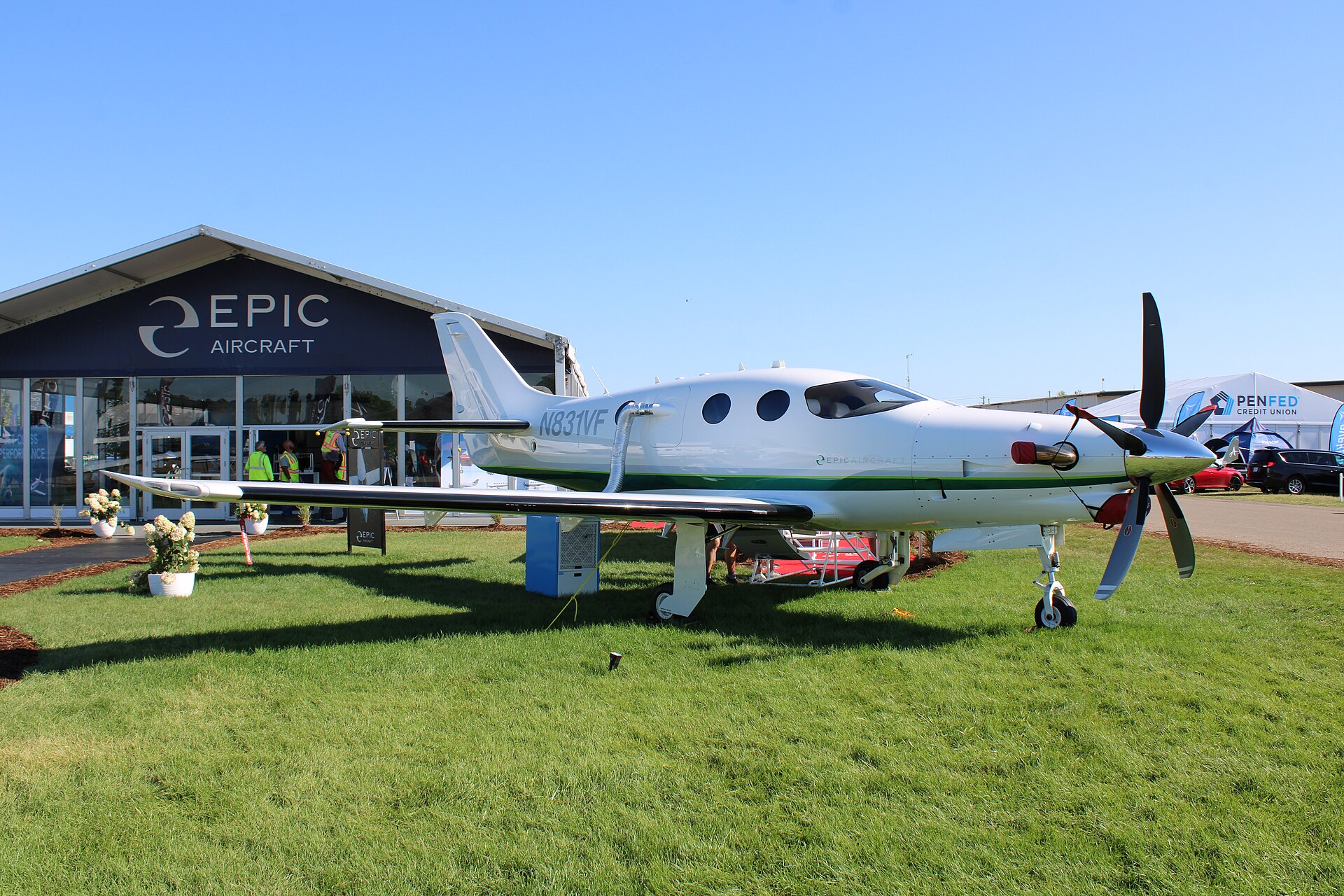
Epic E1000 N831VF, photographed in 2023. · Photo: ZLEA via Wikimedia Commons, CC BY-SA 4.0
Epic · Turboprop
Epic E1000
The first certified production version of Epic's E1000, built between the Epic LT kit and the E1000 GX.
One of the fastest-climbing, fastest-cruising single-engine turboprops, with a roomy club cabin and strong payload. The catch is rarity: eight were built, support runs through one small factory, and many buyers will prefer a later GX.
Buy it if
You fly yourself on 300 to 1,200 nm trips with up to four passengers, want 300-plus knots and a 4,000 fpm climb for about $3.3M, and are comfortable with a small, factory-centered support network.
Skip it if
You need a toilet, room for big bags, a large nationwide service network or an easy resale. A Pilatus PC-12 or Daher TBM suits you better, and a later E1000 GX costs more but sells more easily.
Biggest compromise
Only eight original E1000s exist, delivered between 2020 and early 2021 with an older S-TEC autopilot and without approval for flying into known ice. Epic offers factory upgrades to the later GX standard, but each airplane's records must be checked, and the tiny fleet makes resale pricing hard to judge.
The numbers that matter
Purchase price
$2.95M–$2.95M
guide value (PlanePhD)
What it costs per year
$610K
at 300 hrs · one professional pilot
How far it flies
1,558 nm
1,100–1,250 nm with passengers
How fast
333 kt
high-speed cruise
Seats
5
Pilot plus five passengers in six seats
Pilots needed
1
Certified for one pilot with no type rating; Epic trains one pilot free whenever the airplane changes hands.
Price
What one costs to buy
Guide value
$2.95M–$2.95M
Other sites
12.5% of the fleet
Priced vs call
with a price / call for price
Only one of the eight originals is listed, a 2020 example asking $3.325M; PlanePhD's guide value is about $2.95M.
Price vs its family and alternatives
Scroll to explore · select a jet for details
Epic E1000 · This aircraft
$2.95M–$2.95M guide
Guide value, not a listed asking price.
The least expensive here; next up is the PC-12 NGX.
For sale now
None listed right now
Cost to own
What it costs per year to run
300hours / year
Per year
Per flight hour
Estimate — your operator will quote actual numbers.
Fuel, airframe and propeller maintenance, engine program or reserve and trip fees rise as you fly more. One professional pilot, recurrent training, hangar, insurance and subscriptions and tracking stay the same however much you fly.
Where the money goes
- One professional pilot$173,40028%
- Recurrent training$9,0751%
- Hangar$27,0004%
- Insurance$26,5504%
- Subscriptions and tracking$8,5251%
- Fuel$124,90520%
- Airframe and propeller maintenance$145,20024%
- Engine program or reserve$72,90012%
- Trip fees$22,5004%
One professional pilot is the biggest single cost at 28% of the total.
The JetGrade
71 out of 100 — Slightly above its class
Peer group: Daher TBM 940, Daher TBM 930, Piper M600 SLS, Pilatus PC-12 NGX
Seven categories at a glance
- - - 70 = typical— This aircraft
Strongest on speed & trip time, weakest on reliability & support.
Grades are editorial opinions about the model, not any specific aircraft. Sponsors and affiliates have no input. Reviewed 2026-10-02.
Where it flies
Sample trips and reach
Typical trips on a map
Nonstop
Depends on weight or weather
Fuel stop likely
4 of 6 sample trips are comfortable nonstops.
Sample flight times
- 1.1 hr
Carlsbad → Las Vegas
205 nm · Short hop; seats and bags can all be full
- 2.5 hr
Carlsbad → Aspen
625 nm · High-altitude airport; winter trips need known-ice approval
- 2.9 hr
Santa Ana → San José del Cabo
765 nm · Comfortable nonstop with four passengers
- 3.4 hr
Teterboro → West Palm Beach
900 nm · Nonstop with four passengers and light bags
- 4.9 hr
Dallas → Teterboro
1,190 nm · Nonstop only at economy cruise; winds decide
- 7.7 hr
Carlsbad → Teterboro
2,100 nm · Needs one stop, typically mid-continent
Lineage
What came before and after
2006–2018
Epic LT
Kit-built experimental version; about 50 were flying by 2020.

2020–2021
Epic E1000
First FAA-certified version; eight delivered.

What changed from the Epic LT
- Factory-built and FAA type certificated in November 2019, unlike the experimental LT kit.
- Larger engine inlet helps the 1,200 shp PT6A-67A at high-altitude airports.
- Three-screen Garmin G1000 NXi panel paired with a Genesys S-TEC IntelliFlight 2100 autopilot.
- Emergency exit added opposite the airstair door.
- Empty weight runs about 500 lb heavier than a typical LT.
Size and cabin
How big it is, inside and out
Outside
Silhouette · scaled to length
Length
Wingspan
Height
Inside the cabin
Cabin length
Width
Height
Compare
How it stacks up
This aircraft
Epic E1000
- JetGrade
- 71
- Cost per year
- $610K
- Range
- 1,558 nm
- Speed
- 333 kt
- Seats
- 5
- Cabin length
- 15′ 0″
- Pilots
- 1
- Years built
- 2020–2021
← Before
Epic LT
Not yet graded
After →
- JetGrade
- 72
- Cost per year
- $579K
- Range
- 1,560 nm
- Speed
- 333 kt
- Seats
- 4
- Cabin length
- 15′ 0″
- Pilots
- 1
- Years built
- 2021–2025
Alternative
- JetGrade
- 71
- Cost per year
- $574K
- Range
- 1,730 nm
- Speed
- 330 kt
- Seats
- 4
- Cabin length
- 13′ 3″
- Pilots
- 1
- Years built
- 2019–2022
Alternative
- JetGrade
- 80
- Cost per year
- $608K
- Range
- 1,889 nm
- Speed
- 290 kt
- Seats
- 6
- Cabin length
- 16′ 11″
- Pilots
- 1
- Years built
- 2020–2025
- Epic E1000 GX instead: Same airframe with Garmin's integrated GFC 700 autopilot and a five-blade propeller; used examples ask about $375,000 more but resell more easily.
- Daher TBM 940 instead: A similarly fast pressurized single from a long-established manufacturer with a much larger fleet and service network, in a tighter cabin.
- Pilatus PC-12 NGX instead: Slower, but with a much bigger cabin, an enclosed toilet on executive interiors, a cargo door and a far deeper resale market.
Gold marks the best figure in each row.
Owning one
What to know before you buy
Engines & inspections
1 × Pratt & Whitney Canada PT6A-67A · 1,200 shp each
No APUEngine hours until overhaul
- Engine hot section inspection · 1,750 hr
- Engine overhaul · 3,500 hr
- Propeller overhaul · 4,000 hr
- Annual inspection every 12 months
Pratt & Whitney Canada's Eagle Service Plan covers PT6A engines by the hour; confirm whether a listed airplane is enrolled and what transfers.
Known issues
No known-ice approval as delivered
Originals were not approved for flight into known ice; Epic offers a factory retrofit, so confirm it was done before winter flying.
Older non-Garmin autopilot
Originals came with an S-TEC IntelliFlight 2100 autopilot and four-blade propeller; Epic's factory upgrade brings them to GX standard.
Small fleet, single-factory support
Eight originals and about 125 E1000s registered in the US; airframe parts and expertise come from Epic and its service centers.
Pre-buy checklist
0 of 8 checked
Epic supports the fleet from its factory in Bend, Oregon, and 16 authorized service centers covering every US time zone. Only eight originals exist, so parts and expertise come from the wider E1000 family.
Review
The full review
Strengths
- Cruises at up to 333 knots and climbs at up to 4,000 fpm to a 34,000 ft ceiling.
- Carries up to 2,238 lb of payload, or 1,070 lb with all 264 gallons of fuel aboard.
- A 15 ft cabin with four club seats, pressurized to 6.6 psi for about a 9,700 ft cabin.
Limitations
- No toilet, and bags share the cabin in an 18 cu ft area limited to 200 lb.
- Delivered with an S-TEC autopilot and no known-ice approval; upgrades require Epic factory work.
- Only eight built and about 125 E1000s registered in the US, so support depends on Epic.
The Epic E1000 is a six-seat, single-engine turboprop built in Bend, Oregon, with a carbon-fiber airframe and a 1,200 shp Pratt & Whitney Canada PT6A-67A engine. It grew out of the Epic LT, a kit airplane of which about 50 were flying by 2020, and earned its FAA type certificate in November 2019. This page covers the first certified version. Just eight were delivered, from February 2020 to January 2021, before Epic moved production to the E1000 GX in July 2021 and then to the E1000 AX in 2025.
Pilot's take
From the left seat, the E1000's appeal is performance that feels closer to a light jet than a turboprop: a climb into the mid-30s in under 20 minutes and cruise speeds above 300 knots on about 50 gallons an hour up high. A stick shaker and pusher add a margin against stalls. The original's S-TEC autopilot works, but it sits beside the Garmin panel rather than inside it, which means more button-pushing on busy arrivals. We would want a recurrent training habit, careful winter planning unless the icing retrofit is done, and a close relationship with an Epic service center.
Who this is for
Owner-pilots stepping up from a piston single or an older turboprop who want near-jet speed, usually fly with family or colleagues, and value a big cabin over a toilet. Best for buyers willing to dig into one airplane's upgrade history.

Ask about this aircraft
Answers come only from our research file on the Epic E1000.
Your earlier questionsOwners
Private to verified ownersOwn a Epic Epic E1000? Verify with its FAA registration to join the owners' thread and the real-cost poll.