
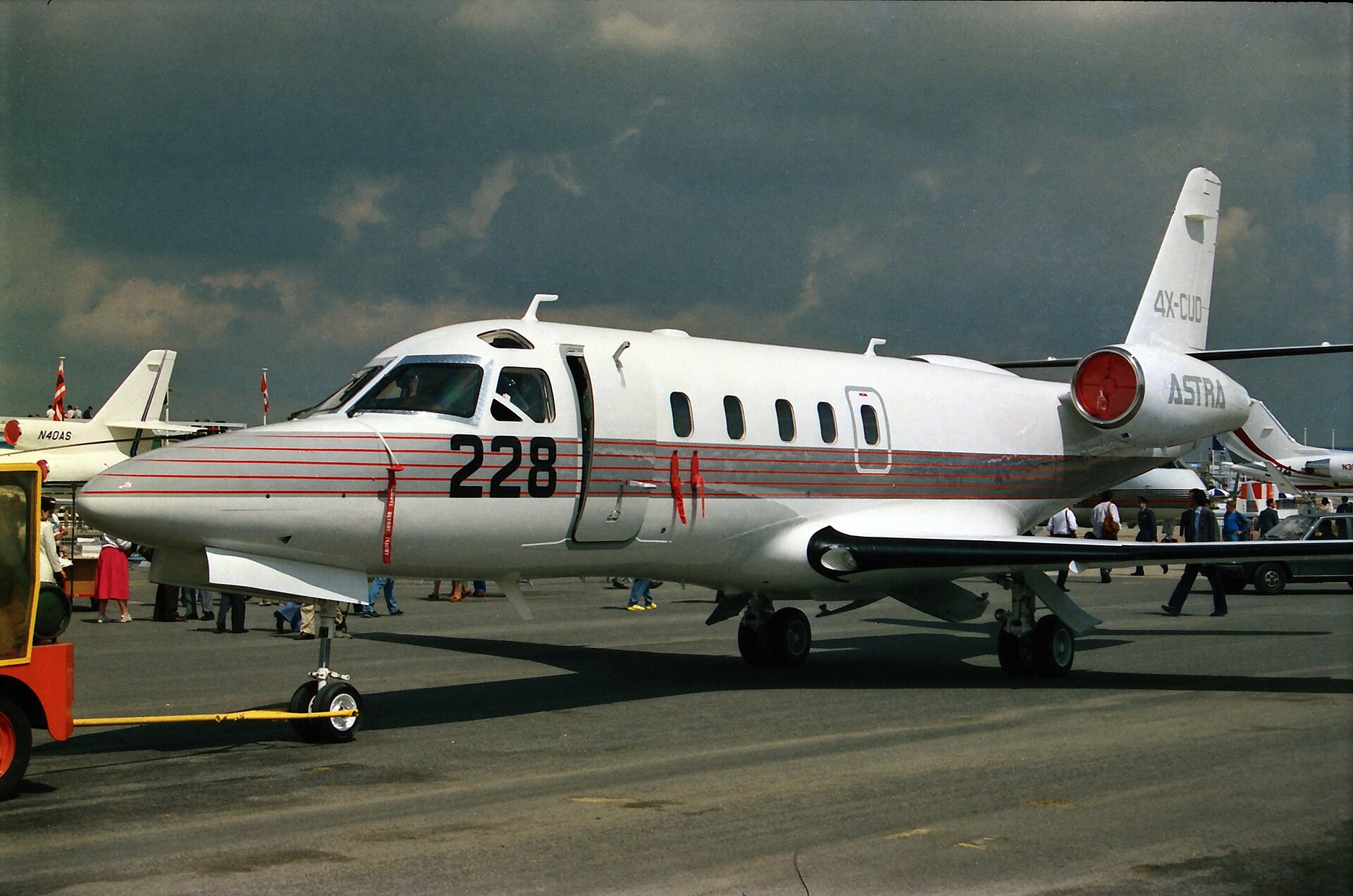
An original Astra 1125 at the 1988 Paris Air Show. · Photo: Dignam Martin, CC BY-SA 4.0 (creativecommons.org/licenses/by-sa/4.0), via Wikimedia Commons
IAI · Midsize Jet
Astra 1125
The first Astra, built from 1985 to 1989 before the Astra SP took over the line.
A lot of speed and range for well under $1 million, in a narrow but quiet cabin. Only about 15 originals are still active, so engine status, parts and records decide whether a cheap Astra stays cheap.
Buy it if
You want legs of about 2,200 nm at up to 465 knots for the lowest purchase price in the class, you fly with two experienced pilots, and you can budget for engine inspections and a small-fleet parts supply.
Skip it if
Passengers need to stand or move around, you carry a lot of luggage, you need full fuel from runways under about 5,300 feet, or you want a jet that is easy to resell.
Biggest compromise
Running costs do not shrink with the price. 32 million a year at 300 hours is larger than the purchase price, and with only about 15 originals still active, parts, experienced mechanics and resale buyers are all harder to find than for mainstream midsize jets.
The numbers that matter
Purchase price
$853K–$853K
guide value (PlanePhD model estimate)
What it costs per year
$1.32M
at 300 hrs · two professional pilots
How far it flies
2,755 nm
2,200–2,200 nm with passengers
How fast
465 kt
high-speed cruise
Seats
6
6 typical; up to 9 by interior
Pilots needed
2
Certified for two pilots; there is no single-pilot option.
Price
What one costs to buy
Guide value
$853K–$853K
Other sites
6.7% of the fleet
Priced vs call
with a price / call for price
One original Astra is listed, price on request after a $899,999 ask; another asked $675,000 before selling in September 2026.
Price vs its family and alternatives
Scroll to explore · select a jet for details
Astra 1125 · This aircraft
$853K–$853K guide
Guide value, not a listed asking price.
Sits between the Westwind II (1124A) and the IAI Astra SP.
For sale now
None listed right now
Cost to own
What it costs per year to run
300hours / year
Per year
Per flight hour
Estimate — your operator will quote actual numbers.
Fuel, airframe maintenance, engine reserve and crew travel, landing, handling and sundries rise as you fly more. Two pilots, recurrent training, hangar, insurance, management and subscriptions, charts and other fixed stay the same however much you fly.
Where the money goes
- Two pilots$235,00018%
- Recurrent training$41,4293%
- Hangar$38,7893%
- Insurance$7,0091%
- Management$48,0004%
- Subscriptions, charts and other fixed$13,9671%
- Fuel$534,20440%
- Airframe maintenance$198,00915%
- Engine reserve$135,63010%
- Crew travel, landing, handling and sundries$67,5005%
Fuel is the biggest single cost at 40% of the total.
The JetGrade
68 out of 100 — Below its class average
Peer group: IAI Westwind II (1124A), Learjet 55, Cessna Citation III (650), BAe Hawker 800, IAI Astra SP
Seven categories at a glance
- - - 70 = typical— This aircraft
Strongest on speed & trip time, weakest on reliability & support.
Grades are editorial opinions about the model, not any specific aircraft. Sponsors and affiliates have no input. Reviewed 2026-10-28.
Where it flies
Sample trips and reach
Typical trips on a map
Nonstop
Depends on weight or weather
Fuel stop likely
Out of reach
5 of 8 sample trips are comfortable nonstops.
Sample flight times
- 0.9 hr
Carlsbad → Las Vegas
205 nm · Short hop at any practical weight
- 1.8 hr
Carlsbad → Aspen
625 nm · Hot-and-high Aspen; depends on weight and weather
- 2.2 hr
Santa Ana → San José del Cabo
765 nm · Comfortable nonstop with a full cabin
- 2.5 hr
Teterboro → West Palm Beach
900 nm · Easy nonstop with full seats
- 3.2 hr
Dallas → Teterboro
1,190 nm · Nonstop with good fuel margin
- 3.7 hr
Teterboro → San Juan
1,410 nm · Over-water leg with ample fuel margin
- 5.7 hr
Carlsbad → Teterboro
2,100 nm · Carlsbad's short runway limits fuel; plan one stop
Los Angeles → Honolulu
2,215 nm · Beyond still-air range; no fuel stop en route
Lineage
What came before and after


1985–1989
IAI Astra 1125
New swept low wing under the Westwind fuselage; the first Astra.


What changed from the IAI Westwind II (1124A)
- New swept wing mounted low, replacing the Westwind's straight wing with tip tanks.
- Wing spar moved below the floor, adding about 8 inches of cabin headroom.
- Longer nose for avionics and more composite parts on the control surfaces.
- About 2,200 nm with full seats versus roughly 2,100 nm for the Westwind II.
- Keeps the Westwind's 3,700 lbf TFE731-3 engines, later convertible to the -3C version.
Size and cabin
How big it is, inside and out
Outside
Silhouette · scaled to length
Length
Wingspan
Height
Inside the cabin
Cabin length
Width
Height
Compare
How it stacks up
This aircraft
Astra 1125
- JetGrade
- 68
- Price
- $853K–$853K guide
- Cost per year
- $1.32M
- Range
- 2,755 nm
- Speed
- 465 kt
- Seats
- 6
- Cabin length
- 17′ 1″
- Pilots
- 2
- Years built
- 1985–1989
← Before
- JetGrade
- 65
- Price
- $375K–$523K guide
- Cost per year
- $1.47M
- Range
- 2,530 nm
- Speed
- 436 kt
- Seats
- 7
- Cabin length
- 15′ 7″
- Pilots
- 2
- Years built
- 1980–1987
After →
- JetGrade
- 65
- Price
- $550K–$1.3M guide
- Cost per year
- $1.47M
- Range
- 2,780 nm
- Speed
- 462 kt
- Seats
- 7
- Cabin length
- 17′ 1″
- Pilots
- 2
- Years built
- 1990–1995
Alternative
- JetGrade
- 68
- Cost per year
- $1.5M
- Range
- 2,950 nm
- Speed
- 470 kt
- Seats
- 7
- Cabin length
- 17′ 1″
- Pilots
- 2
- Years built
- 1996–2001
Alternative
- JetGrade
- 74
- Price
- $1.27M
- Cost per year
- $1.65M
- Range
- 2,555 nm
- Speed
- 442 kt
- Seats
- 8
- Cabin length
- 21′ 4″
- Pilots
- 2
- Years built
- 1984–1995
- IAI Astra SP instead: The same airplane with zero-flap takeoffs, better hot-day climb, a newer Collins panel and a larger surviving fleet, with asks from about $750,000.
- IAI Astra SPX instead: More thrust, winglets and longer engine intervals; asks around $2 million to $2.5 million, but it is the Astra buyers favor.
- BAe Hawker 800 instead: A much wider cabin and a far larger fleet and service network, in exchange for slower cruise.
Gold marks the best figure in each row.
Owning one
What to know before you buy
Engines & inspections
2 × Honeywell TFE731-3A-200G (many converted to -3C-200G) · 3,700 lbf each
Engine hours until overhaul
- Hot-section inspection (MPI) · 2,100 hr
- Core zone inspection (CZI) · 4,200 hr
- Airframe C-check every 48 months
Pay-per-hour engine coverage is the biggest value lever; some listed Astras are enrolled and others carry no program, so price each engine's next inspection.
Known issues
Engine inspection exposure
Off-program engines face hot-section and core inspections that can reach six figures each, a large share of airframe value.
Slat drive history
The leading-edge slat drive has a service-bulletin and directive history; maintenance practice decides how troublesome it is.
Main entry door latching
After doors opened in flight, directives added door-check procedures, warning wiring changes and switch rigging.
Pre-buy checklist
0 of 10 checked
Gulfstream still supports the type, Duncan Aviation is a factory-authorized service center and FlightSafety in Dallas trains crews on a full-motion Astra/G100 simulator. Parts pricing draws complaints and European support is thin.
Review
The full review
Strengths
- Fast: a 465-knot top cruise and 45,000 ft ceiling on a swept wing that later carried the Gulfstream G200.
- Long legs for the money: about 2,200 nm with passengers and reserves, enough for Dallas to New York with margin.
- Cheap to buy: recent asks for original Astras were $675,000 and $899,999, far below most midsize jets.
Limitations
- Narrow cabin: about 4 ft 9 in wide and 5 ft 7 in tall in the dropped aisle, so nobody stands.
- Baggage lives in a 64 cu ft tail hold, out of reach in flight; the long-range tank cuts it to 370 lb.
- Small fleet: roughly 30 built and about 15 still active, which thins parts, mechanics and resale buyers.
The Astra 1125 is the original version of the Israeli midsize jet that later became the Gulfstream G100. Israel Aircraft Industries kept the fuselage, tail and engines of its Westwind II, added a new swept wing mounted below the cabin floor, and won certification in 1985. Deliveries began in 1986, and roughly 30 were built before the improved Astra SP took over the line around 1990. About 15 originals are still listed as active.
Pilot's take
From the front, the Astra feels newer than its age. The swept wing delivers a solid Mach 0.80-plus cruise and a comfortable ride in chop, and the slats help it slow down for approaches. The trade-offs are flaps-required takeoffs, modest hot-day climb on TFE731-3 power, and pneumatic boots instead of heated wing leading edges. Crews tend to like the airplane more than passengers do. Treat it as a two-pilot jet with type-specific habits: physically check the door latch pin, respect the reverse-thrust limits, and train in the Dallas simulator.
Who this is for
A cost-conscious owner, small charter or cargo operator, or flight department that values speed and range over cabin comfort, flies with two professional pilots and has a trusted Astra shop to manage engine and airframe history.

Ask about this aircraft
Answers come only from our research file on the IAI Astra 1125.
Your earlier questionsOwners
Private to verified ownersOwn a IAI Astra 1125? Verify with its FAA registration to join the owners' thread and the real-cost poll.