
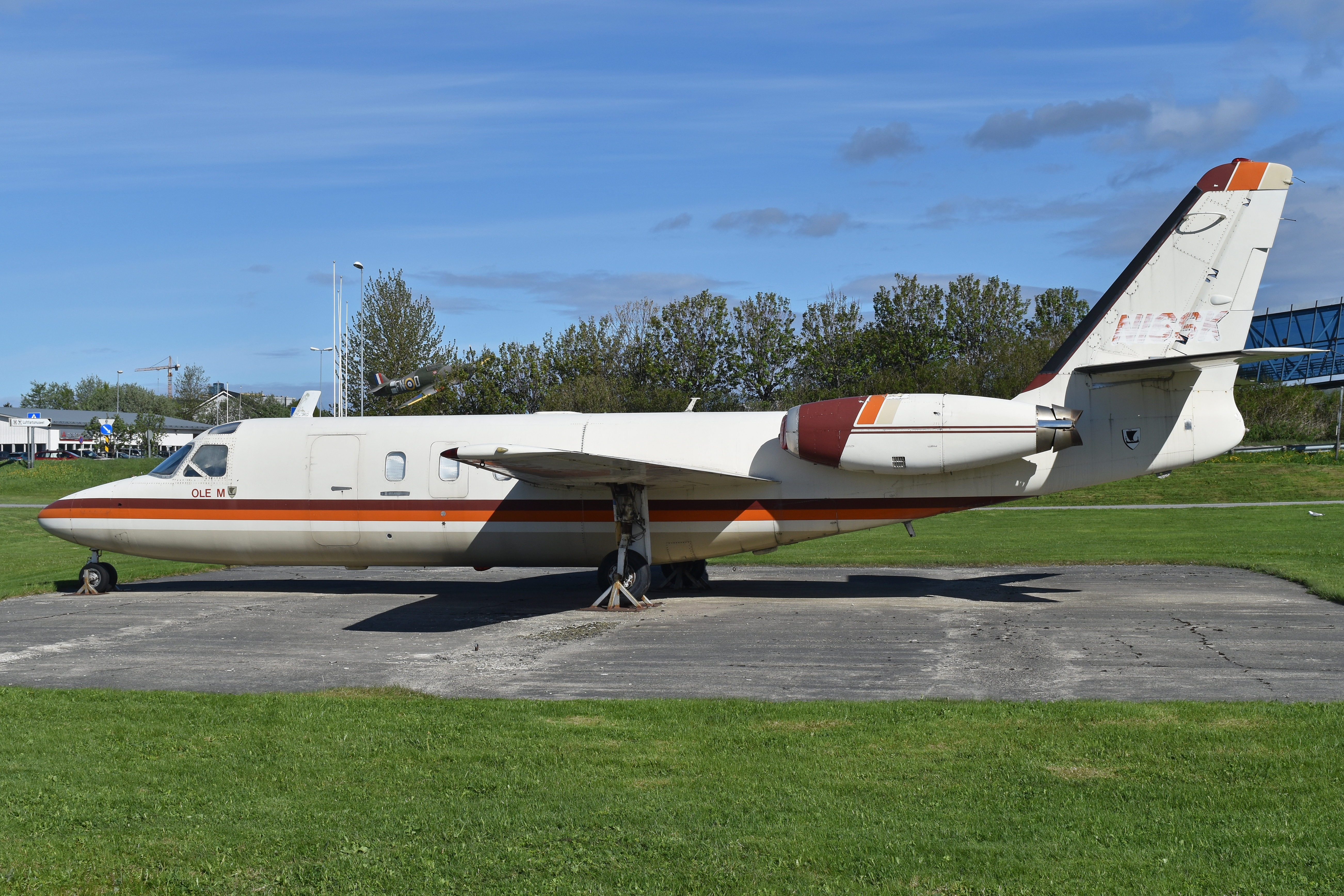
Jet Commander 1121 N16SK on display at the Norwegian Aviation Museum in Bodø. · Alan Wilson, CC BY-SA 2.0, via Wikimedia Commons
Rockwell / IAI · Light Jet
Jet Commander 1121 / 1121A / 1121B
The first jet in the family that became the Westwind, Astra and Gulfstream G100 and G150.
A collector's piece rather than a practical jet. No noise kit exists to meet US Stage 3 rules, so it cannot use airports in the lower 48 states. Only two remain on the US register, and none is offered for sale.
Buy it if
You are a collector or museum that wants the first of the Westwind line, you will base and fly it outside the lower 48 states, and you already have a shop and a parts source lined up.
Skip it if
You need a jet to carry passengers around the United States. Noise rules keep it out of lower-48 airports, and parts for so rare a type increasingly come from salvaged airframes.
Biggest compromise
Legal access. Since January 2016, jets of 75,000 lb or less that do not meet Stage 3 noise standards may not use airports in the 48 contiguous states, except for limited trips such as ferrying for maintenance or export.
The numbers that matter
What it costs per year
$1.19M
at 300 hrs · two professional pilots
How far it flies
1,288 nm
About 800–1,000 nm with four passengers (our estimate)
How fast
434 kt
high-speed cruise
Pilots needed
2
Requires two pilots; the captain needs an IA-JET type rating.
Price
What one costs to buy
Typical asking price
$0
Other sites
Priced vs call
with a price / call for price
No airworthy Jet Commander is listed and no current price guide covers it. Before the 2016 noise ban, the FAA estimated retail value near $235,000.
Price vs its family and alternatives
Scroll to explore · select a jet for details
Learjet 24 (24, 24A–24F)
$235K–$308K guide
Guide value, not a listed asking price.
See the Learjet 24 (24, 24A–24F)For sale now
None listed right now
Cost to own
What it costs per year to run
300hours / year
Per year
Per flight hour
Estimate — your operator will quote actual numbers.
Fuel, airframe maintenance, engine overhaul reserve and landing, handling, crew travel and databases rise as you fly more. Two professional pilots, hangar and management stay the same however much you fly.
Where the money goes
Partial estimate- Two professional pilots$285,00024%
- Hangar$27,5002%
- Management$24,0002%
- Fuel$518,88044%
- Airframe maintenance$157,50013%
- Engine overhaul reserve$82,5007%
- Landing, handling, crew travel and databases$90,0008%
Fuel is the biggest single cost at 44% of the total.
The JetGrade
43 out of 100 — Well below its class
Peer group: Learjet 23, Learjet 24 / 24A–F, Learjet 25, Cessna Citation I (500), IAI 1123 Westwind
Seven categories at a glance
- - - 70 = typical— This aircraft
Strongest on speed & trip time, weakest on airport access.
Grades are editorial opinions about the model, not any specific aircraft. Sponsors and affiliates have no input. Reviewed 2026-09-29.
Where it flies
Sample trips and reach
Typical trips on a map
Nonstop
Depends on weight or weather
Fuel stop likely
2 of 6 sample trips are comfortable nonstops.
Sample flight times
- 0.9 hr
Carlsbad → Las Vegas
205 nm · Easy range; US noise rules bar lower-48 airports
- 1.9 hr
Carlsbad → Aspen
625 nm · Hot-and-high; noise rules also bar lower-48 airports
- 2.3 hr
Santa Ana → San José del Cabo
765 nm · Within range with four; noise rules bar Santa Ana
- 2.6 hr
Teterboro → West Palm Beach
900 nm · Nonstop only if light; noise rules bar both airports
- 3.7 hr
Dallas → Teterboro
1,190 nm · Needs one stop; noise rules bar both airports
- 6.3 hr
Carlsbad → Teterboro
2,100 nm · Needs two stops; noise rules bar both airports
Lineage
What came before and after

1965–1969
Jet Commander 1121 / 1121A / 1121B
Aero Commander's original straight-wing jet with CJ610 turbojets.


Size and cabin
How big it is, inside and out
Outside
Silhouette · scaled to length
Length
Wingspan
Height
Inside the cabin
Width
Height
Compare
How it stacks up
This aircraft
Jet Commander 1121 / 1121A / 1121B
- JetGrade
- 43
- Cost per year
- $1.19M
- Range
- 1,288 nm
- Speed
- 434 kt
- Seats
- 6
- Pilots
- 2
- Years built
- 1965–1969
After →
- JetGrade
- 48
- Cost per year
- $1.35M
- Range
- 1,840 nm
- Speed
- 470 kt
- Seats
- 7
- Cabin length
- 15′ 5″
- Pilots
- 2
- Years built
- 1972–1976
Alternative
- JetGrade
- 62
- Price
- $473K
- Cost per year
- $841K
- Range
- 900 nm
- Speed
- 335 kt
- Seats
- 5
- Cabin length
- 12′ 8″
- Pilots
- 2
- Years built
- 1971–1985
Alternative
- JetGrade
- 57
- Price
- $328K–$450K guide
- Cost per year
- $1.5M
- Range
- 2,030 nm
- Speed
- 455 kt
- Seats
- 7
- Cabin length
- 15′ 6″
- Pilots
- 2
- Years built
- 1976–1980
Alternative
- JetGrade
- 51
- Price
- $235K–$308K guide
- Cost per year
- $1.3M
- Range
- 1,200 nm
- Speed
- 439 kt
- Seats
- 5
- Cabin length
- 9′ 0″
- Pilots
- 2
- Years built
- 1966–1977
- Cessna Citation I (500) instead: Quieter fan engines, broad parts support and many more examples on the market. Slower, but far easier to own and fly in the US.
- IAI Westwind 1124 instead: The same family grown up: longer cabin, more range and efficient Garrett TFE731 fan engines, with a much larger fleet still flying.
- Learjet 24 instead: Another 1960s CJ610 jet, but noise-kitted examples can still use US airports. Smaller cabin, faster climb.
Gold marks the best figure in each row.
Owning one
What to know before you buy
Engines & inspections
2 × GE CJ610-1 (CJ610-5 on the 1121B) · 2,850 lbf each
No APUEngine hours until overhaul
- Stabilizer trim actuator check · 300 hr
No pay-per-hour engine program is offered for these turbojets, so owners fund overhauls themselves.
Known issues
Barred by US noise rules
No Stage 3 noise kit exists, so it cannot use airports in the 48 contiguous states without special FAA permission.
Scarce parts
Most spares now come from dismantled airframes; a missing part can ground the aircraft for a long time.
Stabilizer trim actuator directives
FAA directives require trim actuator checks every 300 hours until a modified actuator is fitted.
Pre-buy checklist
0 of 8 checked
The type certificate sits with Israel Aircraft Industries, now Israel Aerospace Industries. With only a handful left, many parts come from salvaged airframes.
Review
The full review
Strengths
- The whole cabin sits ahead of the wing and is approved for up to eight passengers, generous for a 1960s light jet.
- Cruises at roughly 410–435 knots and climbs about 5,200 feet per minute at sea level on two GE CJ610 turbojets.
- A real piece of history: first flown in 1963, it started the line that became the Westwind, Astra and Gulfstream G100.
Limitations
- Barred from airports in the 48 contiguous states since 2016 because no Stage 3 noise kit exists for it.
- Thirsty turbojets burn about 225 gallons an hour, and full tanks leave little weight for passengers.
- Only two remain on the US register and none is listed for sale, so parts and resale are very limited.
The Jet Commander was Aero Commander's first jet: a straight-wing business jet with room for up to eight passengers that first flew in January 1963 and reached its first customer in January 1965. About 150 were built in three versions. The original 1121 was followed by the 1121A, with more fuel and better wheels and brakes, and the 1121B, with CJ610-5 engines and a stronger landing gear. When Aero Commander's parent company merged with North American Aviation, maker of the Sabreliner, antitrust concerns forced a sale, and Israel Aircraft Industries bought the program in 1968. It grew into the Westwind, then the Astra, and finally the Gulfstream G100 and G150.
Pilot's take
On paper the Jet Commander flies like an honest, heavy straight-wing jet. Plane & Pilot noted that its flight controls are not hydraulically boosted and that in a deliberate stall it does not drop a wing. Aero Commander's 1964 flight-test accounts describe final approaches around 110 knots and touchdowns near 95 knots, gentle numbers for an early jet. The catch is everything around the flying: the CJ610 turbojets are loud and thirsty, parts are scarce, and US noise rules sharply limit where you can take it.
Who this is for
Collectors, museums and enthusiasts who want a piece of business-jet history and can base and fly it outside the lower 48 states, or who plan to display it rather than carry passengers.

Ask about this aircraft
Answers come only from our research file on the Jet Commander 1121 / 1121A / 1121B.
Your earlier questionsOwners
Private to verified ownersOwn a Rockwell / IAI Jet Commander 1121 / 1121A / 1121B? Verify with its FAA registration to join the owners' thread and the real-cost poll.