
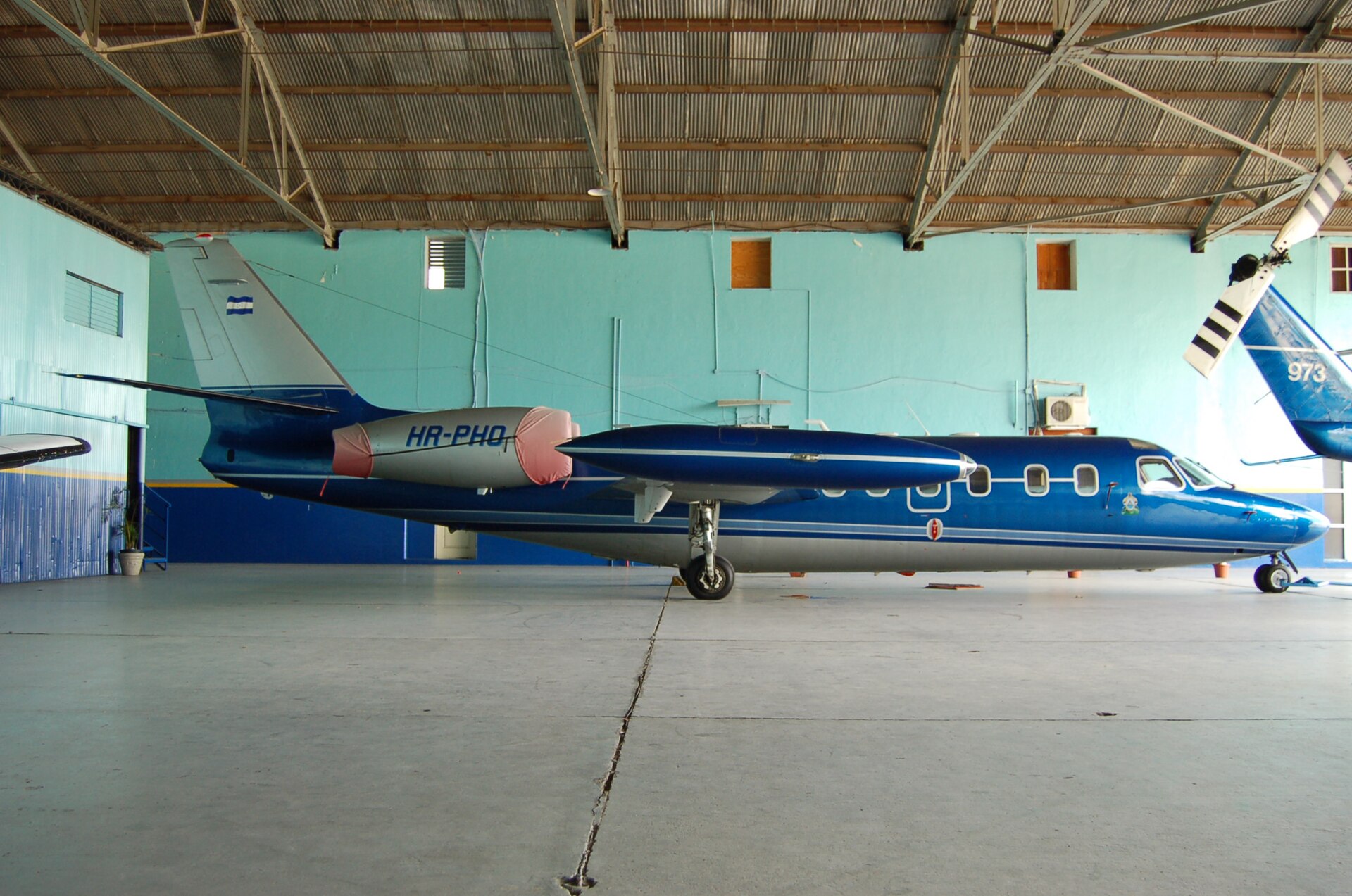
A Westwind 1124 of the Honduran Air Force presidential flight in its hangar at Tegucigalpa, 2011. · Alec Wilson from Khon Kaen, Thailand, via Wikimedia Commons, CC BY-SA 2.0
IAI · Midsize Jet
IAI Westwind 1124
The third model in the Jet Commander and Westwind line, and the first with fuel-efficient turbofan engines.
The cheapest way into a jet that can cross much of the US nonstop, but the cabin is small for a midsize, support depends on a few specialist shops, and one big engine or fuel-cell bill can rival the purchase price.
Buy it if
You need 1,500 to 1,800 nm legs with four passengers on a tight purchase budget, will fly it regularly with an experienced two-pilot crew, and can hold cash in reserve for engine and fuel-system work.
Skip it if
You want a stand-up cabin, factory support, strong hot-and-high performance or predictable costs; a Citation III or a Westwind II answers some of those, usually for more money.
Biggest compromise
Range comes at the cost of payload. With the tanks full, an estimated 470 lb is left for people and bags, so long legs with more than two passengers mean leaving fuel behind.
The numbers that matter
Purchase price
$328K–$450K
guide value (Conklin & de Decker and PlanePhD)
What it costs per year
$1.5M
at 300 hrs · two professional pilots
How far it flies
2,030 nm
1,450–1,750 nm with passengers
How fast
455 kt
high-speed cruise
Seats
7
7 typical, up to 10
Pilots needed
2
Two pilots required; the captain needs the IA-JET type rating that covers every Westwind.
Price
What one costs to buy
Guide value
$328K–$450K
Other sites
Priced vs call
with a price / call for price
No Westwind 1124 is listed with a price right now. Published guide values run about $330,000 to $450,000; a 1977 example asked $499,000 before it sold.
Price vs its family and alternatives
Scroll to explore · select a jet for details
IAI Westwind 1124 · This aircraft
$328K–$450K guide
Guide value, not a listed asking price.
The least expensive here; next up is the Westwind II (1124A).
For sale now
None listed right now
Cost to own
What it costs per year to run
300hours / year
Per year
Per flight hour
Estimate — your operator will quote actual numbers.
Fuel, airframe maintenance, engine program or reserve and landing, handling and crew travel rise as you fly more. Two professional pilots, recurrent training, two pilots, hangar, insurance, management and subscriptions and databases stay the same however much you fly.
Where the money goes
- Two professional pilots$259,77117%
- Recurrent training, two pilots$38,6103%
- Hangar$39,5803%
- Insurance$17,3901%
- Management$24,0002%
- Subscriptions and databases$12,4801%
- Fuel$515,46034%
- Airframe maintenance$338,25623%
- Engine program or reserve$189,09013%
- Landing, handling and crew travel$67,5004%
Fuel is the biggest single cost at 34% of the total.
The JetGrade
57 out of 100 — Well below its class
Peer group: Cessna Citation III (650), BAe / HS 125-700 (Hawker 700), Learjet 55, IAI Westwind II (1124A)
Seven categories at a glance
- - - 70 = typical— This aircraft
Strongest on running costs, weakest on reliability & support.
Grades are editorial opinions about the model, not any specific aircraft. Sponsors and affiliates have no input. Reviewed 2026-10-28.
Where it flies
Sample trips and reach
Typical trips on a map
Nonstop
Depends on weight or weather
Fuel stop likely
Out of reach
5 of 8 sample trips are comfortable nonstops.
Sample flight times
- 0.8 hr
Carlsbad → Las Vegas
205 nm · Short hop, well within range
- 1.7 hr
Carlsbad → Aspen
625 nm · Hot-and-high; depends on weight and weather
- 2.0 hr
Santa Ana → San José del Cabo
765 nm · Within range; check Santa Ana noise and runway rules
- 2.3 hr
Teterboro → West Palm Beach
900 nm · Comfortably within range with four passengers
- 3.0 hr
Dallas → Teterboro
1,190 nm · Within range with four; winter headwinds cut margin
- 3.6 hr
Teterboro → San Juan
1,410 nm · Within range with four; overwater, plan reserves carefully
- 5.5 hr
Carlsbad → Teterboro
2,100 nm · Needs one stop, typically mid-continent
Los Angeles → Honolulu
2,215 nm · Beyond range over open ocean
Lineage
What came before and after


1976–1980
IAI Westwind 1124
Garrett TFE731 fan engines brought range past 2,000 nm.


What changed from the IAI 1123 Westwind
- Garrett TFE731-3 turbofans of 3,700 lb thrust replaced the thirsty CJ610 turbojets.
- Usable fuel rose to about 1,400 US gallons, pushing published range past 2,000 nm.
- Maximum takeoff weight rose to 22,850 lb from 20,700 lb.
- Added dorsal fin, reshaped engine pods and pylons, and a new wheel-well fairing.
- Improved drooped leading edge on the wing.
- The 1123's tail-mounted auxiliary power unit was deleted.
Size and cabin
How big it is, inside and out
Outside
Silhouette · scaled to length
Length
Wingspan
Height
Inside the cabin
Cabin length
Width
Height
Compare
How it stacks up
This aircraft
IAI Westwind 1124
- JetGrade
- 57
- Price
- $328K–$450K guide
- Cost per year
- $1.5M
- Range
- 2,030 nm
- Speed
- 455 kt
- Seats
- 7
- Cabin length
- 15′ 6″
- Pilots
- 2
- Years built
- 1976–1980
← Before
- JetGrade
- 48
- Cost per year
- $1.35M
- Range
- 1,840 nm
- Speed
- 470 kt
- Seats
- 7
- Cabin length
- 15′ 5″
- Pilots
- 2
- Years built
- 1972–1976
After →
- JetGrade
- 65
- Price
- $375K–$523K guide
- Cost per year
- $1.47M
- Range
- 2,530 nm
- Speed
- 436 kt
- Seats
- 7
- Cabin length
- 15′ 7″
- Pilots
- 2
- Years built
- 1980–1987
Alternative
- JetGrade
- Not yet graded
- Range
- 1,900 nm
- Speed
- 450 kt
- Seats
- 8
- Years built
- 1983–1992
Alternative
- JetGrade
- 67
- Price
- $581K–$920K guide
- Cost per year
- $1.31M
- Range
- 2,196 nm
- Speed
- 451 kt
- Seats
- 6
- Cabin length
- 12′ 11″
- Pilots
- 2
- Years built
- 1974–1993
- IAI Westwind II (1124A) instead: Same engines and cabin, with winglets and a revised wing that improve hot-day climb and range; fewer were built, so good examples are scarcer.
- Cessna Citation III (650) instead: A stand-up 5 ft 9 in cabin and much broader Textron support with similar range, at a higher purchase price.
- Learjet 35 / 35A instead: Faster, better on short or hot runways and far easier to support, but with a much smaller cabin.
Gold marks the best figure in each row.
Owning one
What to know before you buy
Engines & inspections
2 × Honeywell (Garrett) TFE731-3-1G · 3,700 lbf each
No APUEngine hours until overhaul
- Stabilizer trim actuator check · 400 hr
- Aileron push-pull tube check · 600 hr
- Brake hydraulic fuse test · 1,200 hr
- Engine mid-life inspection (MPI) · 1,400 hr
- Engine core inspection (CZI) · 4,200 hr
Honeywell's MSP pay-per-hour plan covers these engines and several listed Westwinds advertise it. Without it, core inspections cost six figures per engine.
Known issues
Fuel cell leaks
Four fuel cells cost about $50,000 each in 2010; heavy landings and age cause leaks, and a full re-cell approaches half the jet's value.
Engine inspection costs
Each TFE731 needs a core inspection every 4,200 hours; without an hourly program that is a six-figure bill per engine.
Corrosion under de-ice boots
Corrosion between the wing de-ice boots and leading edges, and along the belly, especially on jets stored outside.
Pre-buy checklist
0 of 10 checked
1124 production ended in 1980. Worthington Aviation has served as IAI's designated Westwind support center, specialist shops still work on the type, and Honeywell's network supports the engines. IA-JET simulator training is still offered.
Review
The full review
Strengths
- Roughly 2,030 nm published range from about 1,400 gallons in wing, tip and fuselage tanks, long for its price.
- Published guide values of about $330,000 to $450,000 make it one of the cheapest ways into a 455-knot jet.
- Not among the jets barred from lower-48 airports by the 2016 noise rule, unlike the turbojet 1123 before it.
Limitations
- The cabin is 4 ft 11 in tall and 4 ft 10 in wide, smaller than stand-up rivals like the Citation III.
- Full tanks leave an estimated 470 lb for passengers and bags at the 22,850 lb maximum takeoff weight.
- The US fleet of Westwind I and II jets fell from about 200 in 2003 to 76 by 2025, thinning support.
The Westwind 1124, later sold as the Westwind I, is the model that turned Israel Aircraft Industries' Westwind into a practical long-range business jet. It kept the stretched cabin and wingtip fuel tanks of the 1123 but replaced its thirsty General Electric turbojets with two Garrett (now Honeywell) TFE731-3 turbofans of 3,700 lb thrust each. Deliveries began in 1976, and from 1980 IAI built the winglet-equipped Westwind II (1124A) instead. The same basic airframe later grew into the Astra and the Gulfstream G100 and G150.
Pilot's take
Pilots describe the Westwind as honest and heavy rather than nimble: the flight controls are manual, with no hydraulic boost, so it takes muscle in the flare. In exchange, the mid-mounted wing rides through chop well, and the TFE731s climb it into the low 40s, where it settles near 430 knots. It wants runway, though, and on a hot day at a high airport the numbers get tight quickly, which is the gap the Westwind II's revised wing set out to close. Most of the planning is about weight: full tanks or a full cabin, rarely both.
Who this is for
Small charter, cargo and air-ambulance operators, and hands-on owners with access to a Westwind specialist shop, who need long legs and a low door more than headroom and can budget for aging-jet maintenance.

Ask about this aircraft
Answers come only from our research file on the Westwind 1124.
Your earlier questionsOwners
Private to verified ownersOwn a IAI IAI Westwind 1124? Verify with its FAA registration to join the owners' thread and the real-cost poll.