
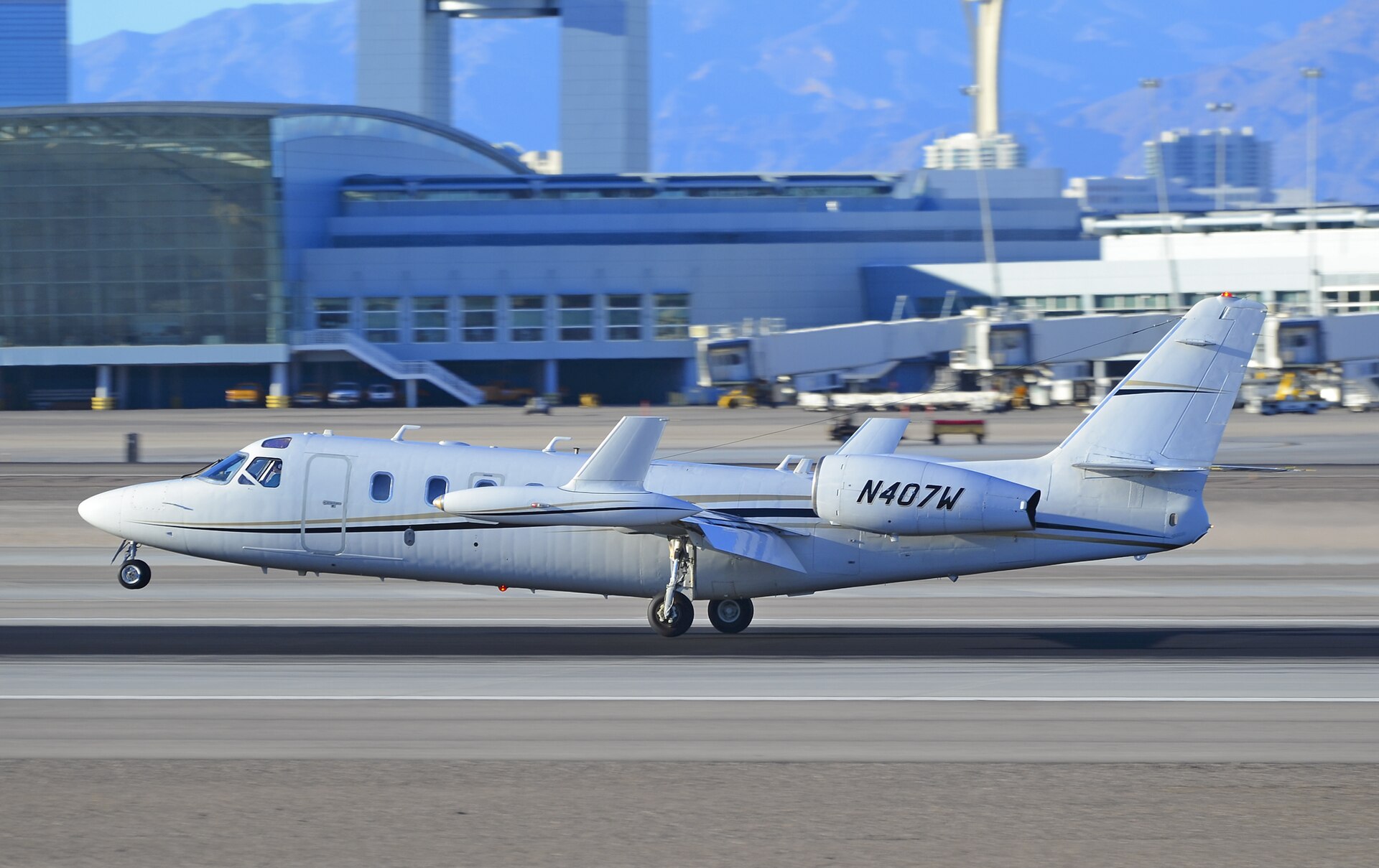
Westwind II N407W, built in 1984, at Las Vegas in September 2013. · Tomás Del Coro, CC BY-SA 2.0, via Wikimedia Commons
IAI · Midsize Jet
Westwind II (1124A)
The final Westwind: fourth version of the Jet Commander design, replaced by the swept-wing Astra.
The Westwind II still out-ranges most jets its age and costs very little to buy. Its low, narrow cabin, small fleet and ageing systems mean it suits practical missions like medevac or cargo better than first-time private flyers.
Buy it if
You need real range on a small budget, fly with four or fewer people, want a low door for stretchers or cargo, and have a Westwind-experienced shop and two pilots lined up.
Skip it if
Passengers expect to stand up, you want modern avionics without a big upgrade bill, you plan to sell within a few years, or you need easy parts and service everywhere.
Biggest compromise
You get range that newer light and midsize jets charge millions for, but you live with a cabin under 5 ft tall, a fleet of only about 90 built, and parts and skills that are getting harder to find. 6M a year at 300 hours.
The numbers that matter
Purchase price
$375K–$523K
guide value (Aircraft Cost Calculator, PlanePhD and evoJets)
What it costs per year
$1.47M
at 300 hrs · two professional pilots
How far it flies
2,530 nm
2,125–2,500 nm with passengers
How fast
436 kt
high-speed cruise
Seats
7
7 typical (up to 10)
Pilots needed
2
Flown by two pilots; there is no single-pilot version.
Price
What one costs to buy
Guide value
$375K–$523K
Other sites
Priced vs call
with a price / call for price
Only one of five Westwind IIs for sale shows a price: $350,000 for a high-time 1981 jet. Published estimates run about $375,000–$523,000.
Price vs its family and alternatives
Scroll to explore · select a jet for details
Westwind II (1124A) · This aircraft
$375K–$523K guide
Guide value, not a listed asking price.
Sits between the IAI Westwind 1124 and the Learjet 55.
For sale now
None listed right now
Cost to own
What it costs per year to run
300hours / year
Per year
Per flight hour
Estimate — your operator will quote actual numbers.
Fuel, airframe maintenance, engine program or reserve and trip costs (crew travel, fees, catering) rise as you fly more. Two professional pilots, recurrent training, hangar, insurance, management and subscriptions and other fixed costs stay the same however much you fly.
Where the money goes
- Two professional pilots$263,84718%
- Recurrent training$27,7382%
- Hangar$31,5202%
- Insurance$13,8901%
- Management$48,0003%
- Subscriptions and other fixed costs$9,9801%
- Fuel$534,20436%
- Airframe maintenance$292,50020%
- Engine program or reserve$182,25012%
- Trip costs (crew travel, fees, catering)$63,3004%
Fuel is the biggest single cost at 36% of the total.
The JetGrade
65 out of 100 — Below its class average
Peer group: Learjet 55, Cessna Citation III, Hawker 700, Sabreliner 65, Cessna Citation VI
Seven categories at a glance
- - - 70 = typical— This aircraft
Strongest on range & payload, weakest on cabin & passenger comfort.
Grades are editorial opinions about the model, not any specific aircraft. Sponsors and affiliates have no input. Reviewed 2026-10-28.
Where it flies
Sample trips and reach
Typical trips on a map
Nonstop
Depends on weight or weather
5 of 8 sample trips are comfortable nonstops.
Sample flight times
- 0.9 hr
Carlsbad → Las Vegas
205 nm · Short hop, well within range
- 2.0 hr
Carlsbad → Aspen
625 nm · Hot-and-high; depends on weight and weather
- 2.4 hr
Santa Ana → San José del Cabo
765 nm · Comfortable nonstop with a full cabin
- 2.7 hr
Teterboro → West Palm Beach
900 nm · Easy nonstop with a full cabin
- 3.4 hr
Dallas → Teterboro
1,190 nm · Comfortable nonstop with four passengers
- 3.9 hr
Teterboro → San Juan
1,410 nm · Nonstop with four passengers and bags
- 5.8 hr
Carlsbad → Teterboro
2,100 nm · In range, but Carlsbad's short runway limits fuel
- 6.1 hr
Los Angeles → Honolulu
2,215 nm · Near maximum range; winds and reserves decide
Lineage
What came before and after


1980–1987
Westwind II (1124A)
Winglets on the tip tanks and a reshaped wing.

What changed from the Westwind 1124
- Winglets added on top of the wingtip fuel tanks for better efficiency.
- Reshaped leading edge, new center section and vortex generators.
- Maximum takeoff weight rose by 500 lb to 23,500 lb.
- About 5% more range and a higher initial cruise altitude.
- Refreshed interior with a refreshment center and flatter floor.
- Same TFE731-3-1G engines as the 1124, 3,700 lb thrust each.
Size and cabin
How big it is, inside and out
Outside
Silhouette · scaled to length
Length
Wingspan
Height
Inside the cabin
Cabin length
Width
Height
Compare
How it stacks up
This aircraft
Westwind II (1124A)
- JetGrade
- 65
- Price
- $375K–$523K guide
- Cost per year
- $1.47M
- Range
- 2,530 nm
- Speed
- 436 kt
- Seats
- 7
- Cabin length
- 15′ 7″
- Pilots
- 2
- Years built
- 1980–1987
← Before
- JetGrade
- 57
- Price
- $328K–$450K guide
- Cost per year
- $1.5M
- Range
- 2,030 nm
- Speed
- 455 kt
- Seats
- 7
- Cabin length
- 15′ 6″
- Pilots
- 2
- Years built
- 1976–1980
After →
- JetGrade
- 68
- Price
- $853K–$853K guide
- Cost per year
- $1.32M
- Range
- 2,755 nm
- Speed
- 465 kt
- Seats
- 6
- Cabin length
- 17′ 1″
- Pilots
- 2
- Years built
- 1985–1989
Alternative
- JetGrade
- Not yet graded
- Range
- 1,900 nm
- Speed
- 450 kt
- Seats
- 8
- Years built
- 1983–1992
Alternative
- JetGrade
- 65
- Price
- $649K
- Cost per year
- $1.93M
- Range
- 2,244 nm
- Speed
- 458 kt
- Seats
- 7
- Cabin length
- 13′ 7″
- Pilots
- 2
- Years built
- 1981–1986
- IAI Astra 1125 instead: The Westwind's successor: new swept wing, more speed and a roomier cabin, at a higher price.
- Cessna Citation III instead: Near stand-up cabin, wider service network and faster cruise, with somewhat less range.
- Learjet 55 instead: Faster and with a taller cabin, but shorter range and higher fuel burn for similar money.
Gold marks the best figure in each row.
Owning one
What to know before you buy
Engines & inspections
2 × Honeywell (Garrett) TFE731-3-1G · 3,700 lbf each
Engine hours until overhaul
- Aileron push-pull tube check · 600 hr
- Hydraulic fuse functional test · 1,200 hr
- Engine mid-life inspection · 1,400 hr
- Engine core zone inspection · 4,200 hr
- Thrust reverser inspection · 5,000 hr
Engines on an hourly program make an aircraft worth much more; confirm the contract transfers and whether a buy-in payment is owed.
Known issues
Corrosion under de-ice boots
Corrosion can form between the wing de-ice boots and leading edge, and along the belly. Repairs can be costly.
Fuel-cell leaks
Heavy or firm landings can start fuel-cell leaks; each of the four cells cost about $50,000 in 2010.
Thrust-reverser procedures revised
A 2025 FAA directive added new flight manual limits and procedures for the thrust reversers.
Pre-buy checklist
0 of 10 checked
Israel Aircraft Industries still holds the type certificate. Support relies on a small group of Westwind-experienced shops, specialist parts dealers and Honeywell's TFE731 network for the engines.
Review
The full review
Strengths
- About 2,500 nm with four passengers and standard reserves, enough for Dallas to New York with plenty in hand.
- Purchase prices around $375,000–$523,000 in published guides, a fraction of newer midsize jets.
- Ground-level door and 49 cu ft of baggage space, prized by medevac and cargo operators.
Limitations
- Cabin about 4 ft 10 in tall and 4 ft 9 in wide; nobody stands up.
- Only about 90 built, so parts, shops and experienced pilots are scarce.
- Full fuel leaves only about 890 lb for people and bags.
The Westwind II, certified as the IAI 1124A, is the last version of a design that began as the American Aero Commander Jet Commander in the 1960s. Israel Aircraft Industries bought the program in 1968, stretched it into the 1123, put Garrett TFE731 turbofans on it to make the 1124, and in 1980 added winglets on top of the wingtip fuel tanks, a reshaped wing and a refreshed interior to create the Westwind II. About 90 were built before production ended in 1987 in favour of the swept-wing Astra.
Pilot's take
Pilots describe the Westwind II as honest and capable rather than glamorous. The mid-mounted wing gives a smoother ride in turbulence than most jets its size, climb to the mid-30s takes about 25 minutes, and it cruises around Mach 0.77. Its long legs mean fewer fuel stops than its peers. Expect an older, busier cockpit unless avionics have been upgraded, and treat landings with care: heavy, firm arrivals can start fuel-cell leaks. A crew that knows the type matters more here than in more common jets.
Who this is for
Air-ambulance, cargo and special-mission operators, and budget-minded owners who need 2,000-nm legs with a few passengers, have a maintenance shop that knows the type, and accept an older, plainer cabin.

Ask about this aircraft
Answers come only from our research file on the Westwind II (1124A).
Your earlier questionsOwners
Private to verified ownersOwn a IAI Westwind II (1124A)? Verify with its FAA registration to join the owners' thread and the real-cost poll.