
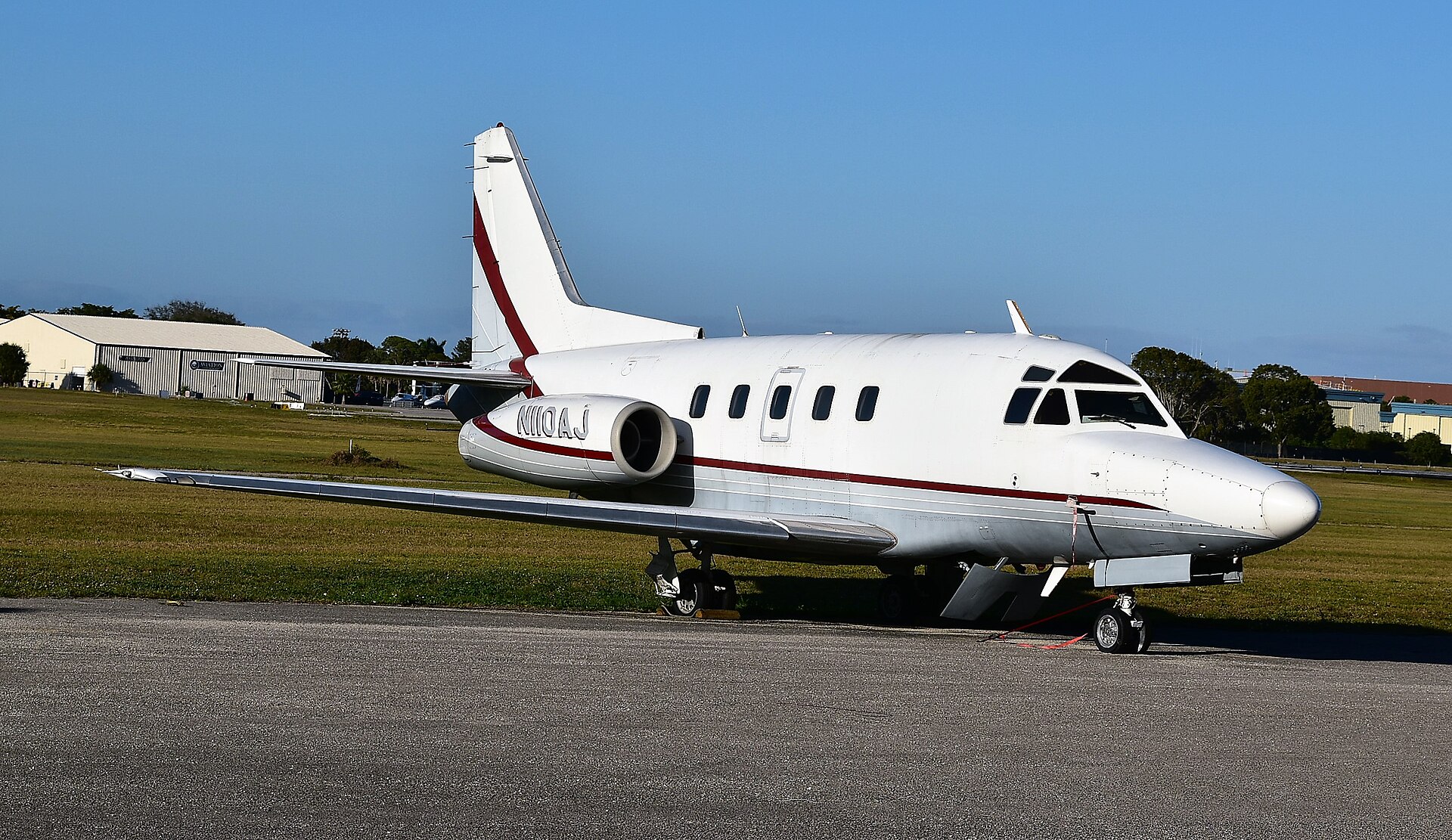
A Sabreliner 75A parked at Fort Lauderdale Executive Airport, Florida, in February 2017. · Photo: Alec Wilson / Wikimedia Commons, CC BY-SA 2.0
Sabreliner · Midsize Jet
Sabreliner 75A / 80
The last and roomiest original-engine Sabreliner: the raised-cabin Sabre 75 airframe fitted with General Electric turbofans.
The 75A/80 offers more headroom and speed than most jets of its era, but Stage 2 noise status bars it from airports in the 48 contiguous states, and support and resale have all but vanished.
Buy it if
You will base and fly it outside the 48 contiguous states, want a fast classic with a tall cabin, and have reliable access to CF700 engine and Sabreliner airframe specialists.
Skip it if
You need to fly into US mainland airports, want a pay-per-hour engine plan, or need more than about 1,280 nm of range with four passengers.
Biggest compromise
Every 75A and 80 is rated Stage 2 for noise, and no approved fix was found. Since 31 December 2015 that rules out airports in the 48 contiguous states except on special one-off permits, which shrinks both its usefulness and its resale market.
The numbers that matter
What it costs per year
$1.72M
at 300 hrs · two professional pilots
How far it flies
1,897 nm
1,180–1,280 nm with passengers
How fast
482 kt
high-speed cruise
Seats
7
7 typical, up to 10
Pilots needed
2
Two pilots are required.
Price
What one costs to buy
Typical asking price
$0
Other sites
Priced vs call
with a price / call for price
No airworthy 75A or 80 is advertised. Recent offers are parts airframes, such as one fuselage at $25,000; published model estimates are not based on sales.
Price vs its family and alternatives
Scroll to explore · select a jet for details
Sabreliner 60 (NA-265-60)
$235K–$363K guide
Guide value, not a listed asking price.
See the Sabreliner 60 (NA-265-60)For sale now
None listed right now
Cost to own
What it costs per year to run
300hours / year
Per year
Per flight hour
Estimate — your operator will quote actual numbers.
Fuel, airframe maintenance, engine overhaul reserve and landing, handling and other costs rise as you fly more. Two pilots, recurrent training, hangar and insurance stay the same however much you fly.
Where the money goes
- Two pilots$294,84317%
- Recurrent training$41,4312%
- Hangar$46,0133%
- Insurance$35,9192%
- Fuel$667,58739%
- Airframe maintenance$330,93019%
- Engine overhaul reserve$210,75912%
- Landing, handling and other costs$96,8656%
Fuel is the biggest single cost at 39% of the total.
The JetGrade
46 out of 100 — Well below its class
Peer group: Dassault Falcon 20 (20C / 20D / 20E / 20F), Hawker Siddeley HS-125-600, Hawker Siddeley HS-125-400, Sabreliner 60, Sabreliner 65
Seven categories at a glance
- - - 70 = typical— This aircraft
Strongest on speed & trip time, weakest on airport access.
Grades are editorial opinions about the model, not any specific aircraft. Sponsors and affiliates have no input. Reviewed 2026-10-29.
Where it flies
Sample trips and reach
Typical trips on a map
Nonstop
Depends on weight or weather
Fuel stop likely
Out of reach
3 of 8 sample trips are comfortable nonstops.
Sample flight times
- 0.9 hr
Carlsbad → Las Vegas
205 nm · Needs Stage 3 noise approval for US airports
- 1.9 hr
Carlsbad → Aspen
625 nm · Hot-and-high; Stage 3 aircraft only
- 2.2 hr
Santa Ana → San José del Cabo
765 nm · Stage 3 approval needed; Santa Ana noise rules strict
- 2.5 hr
Teterboro → West Palm Beach
900 nm · Needs Stage 3 noise approval for US airports
- 3.3 hr
Dallas → Teterboro
1,190 nm · Near four-passenger range limit; headwinds may force stop
- 3.8 hr
Teterboro → San Juan
1,410 nm · Needs one stop, typically in Florida
- 5.4 hr
Carlsbad → Teterboro
2,100 nm · Needs one stop, typically mid-continent
Los Angeles → Honolulu
2,215 nm · Beyond range; no fuel stop possible over water
Lineage
What came before and after

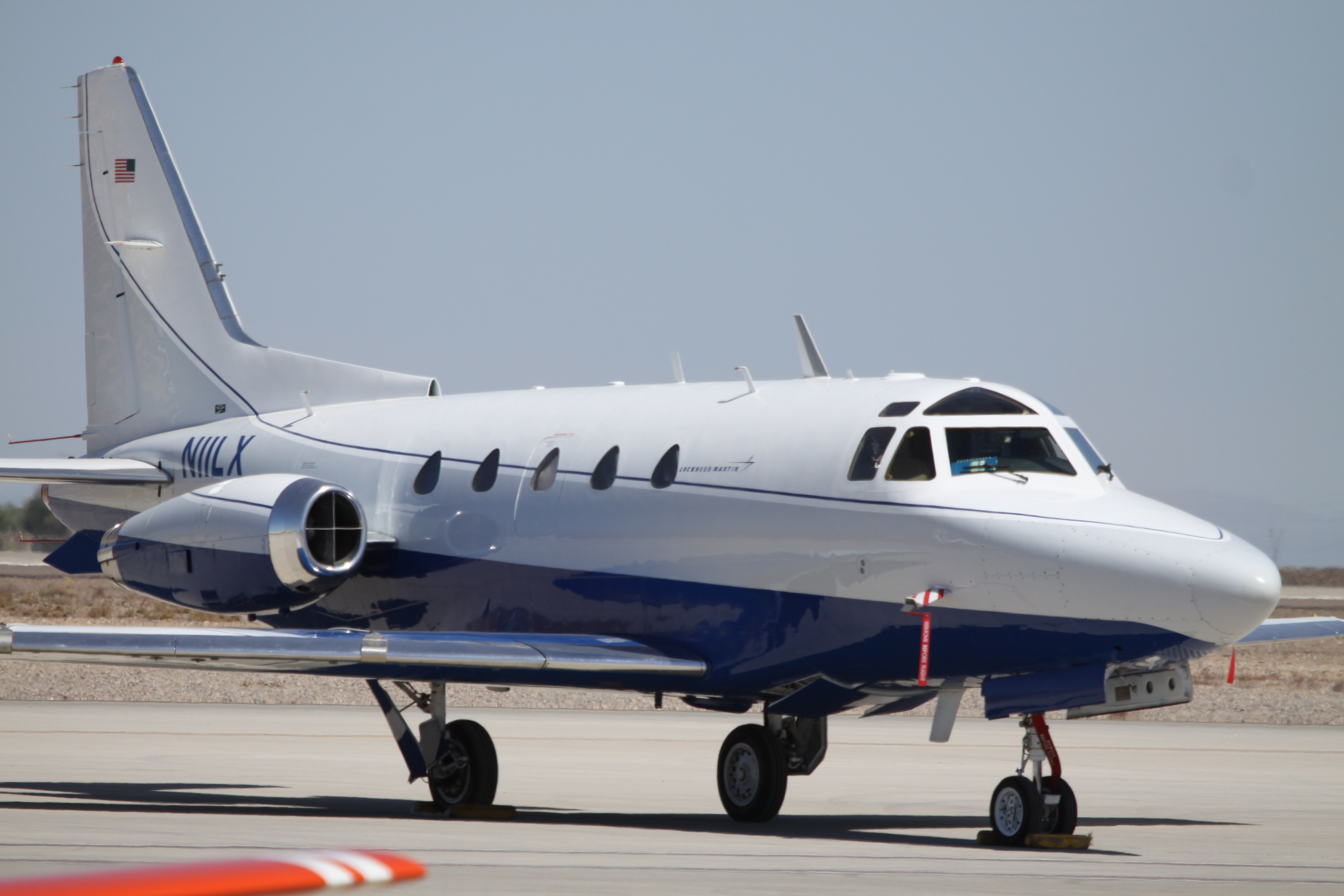
About 1970–1973
Sabreliner 75
Taller cabin and square windows, still on turbojets.
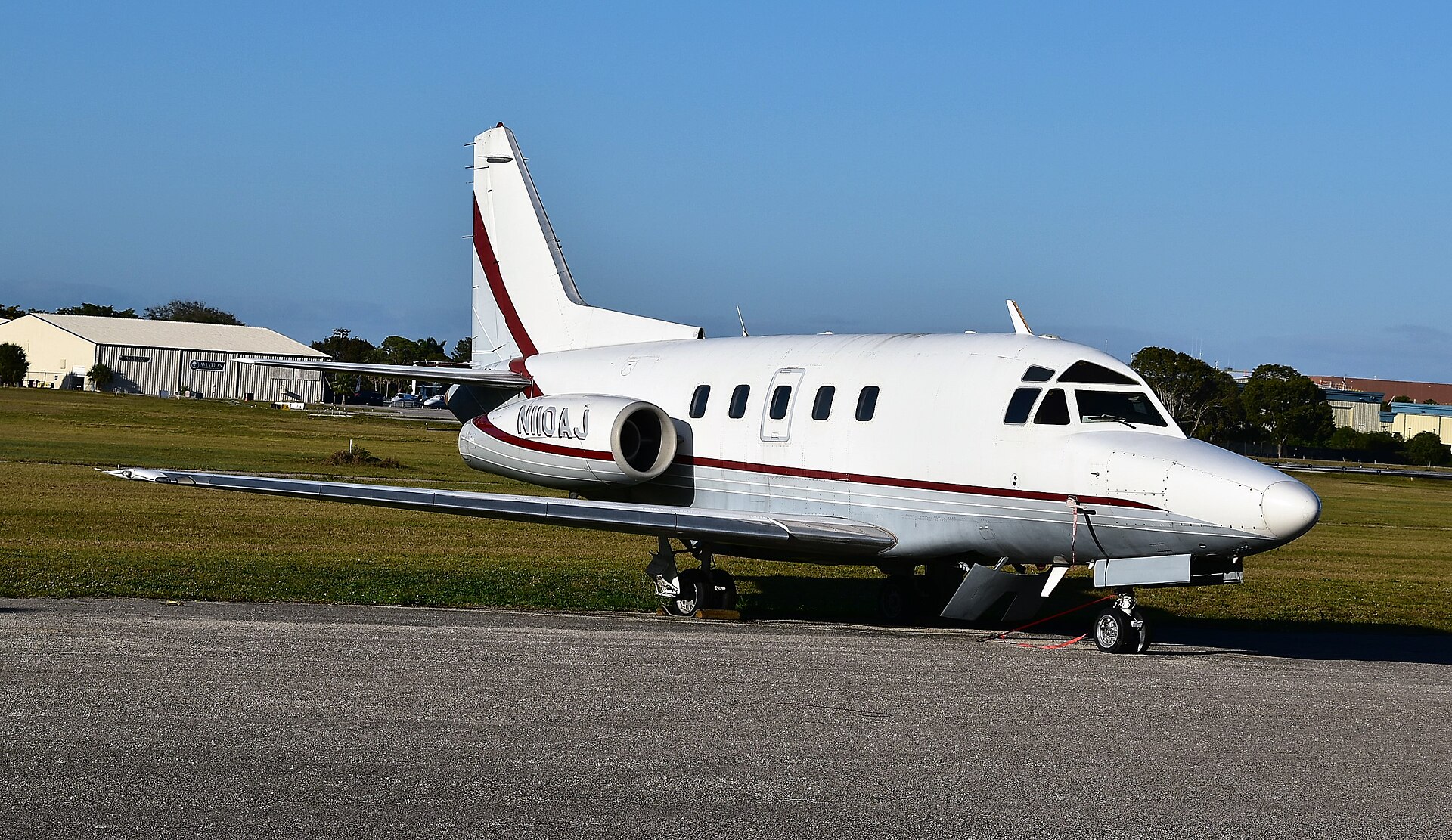
1973–1979
Sabreliner 75A / 80
Raised cabin with GE CF700 turbofans and higher weights.
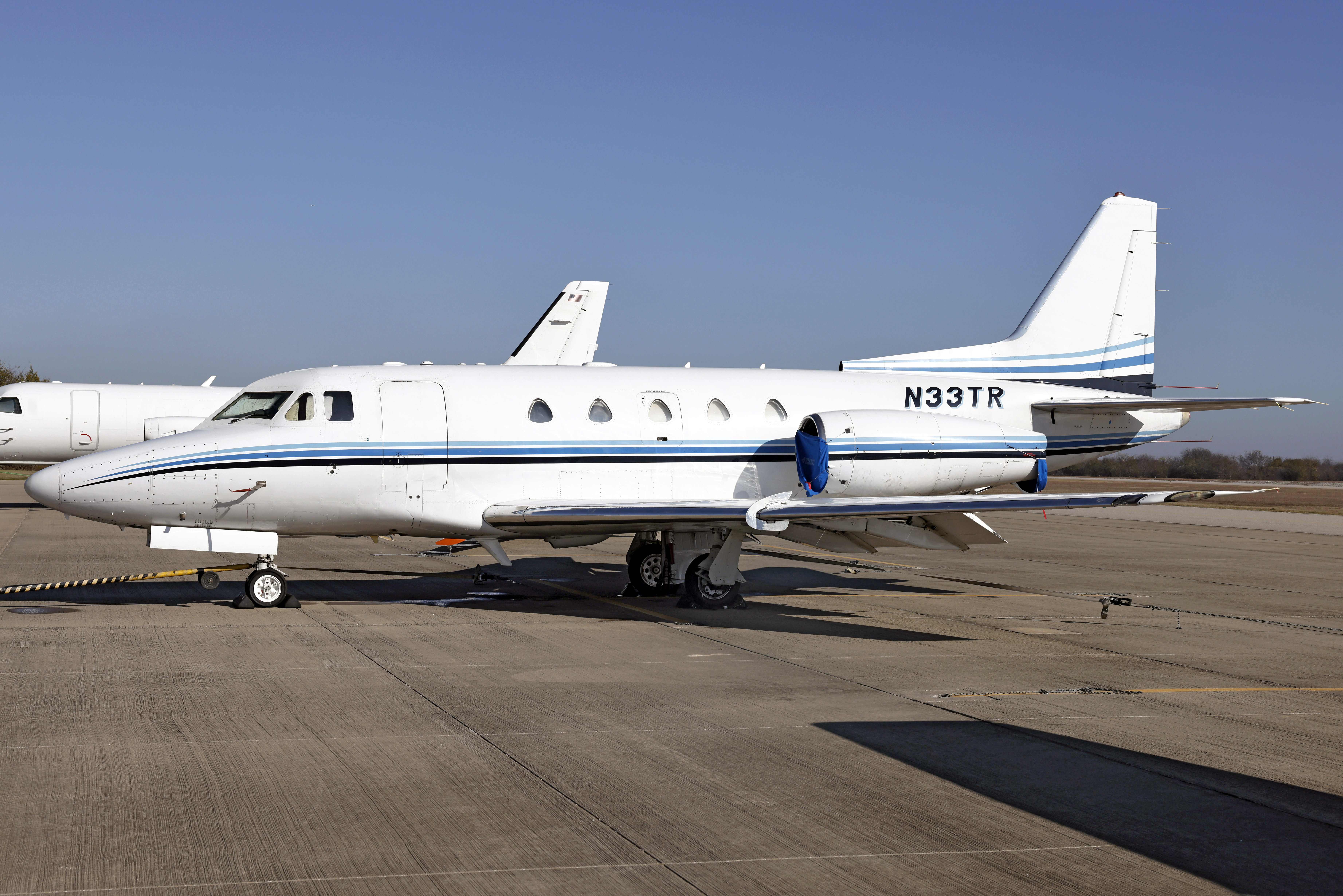
What changed from the Sabreliner 75
- GE CF700 turbofans replaced the Sabre 75's Pratt & Whitney JT12 turbojets.
- Maximum takeoff weight rose by about 2,000 lb to roughly 23,000 lb.
- Rockwell listed aerodynamic, equipment and systems improvements alongside the new engines.
- Kept the Sabre 75's raised roof, square windows and stand-up lavatory.
- An optional later supercritical wing retrofit created the 80A, also sold as 80SC.
Size and cabin
How big it is, inside and out
Outside
Silhouette · scaled to length
Length
Wingspan
Height
Inside the cabin
Cabin length
Width
Compare
How it stacks up
This aircraft
Sabreliner 75A / 80
- JetGrade
- 46
- Cost per year
- $1.72M
- Range
- 1,897 nm
- Speed
- 482 kt
- Seats
- 7
- Cabin length
- 19′ 0″
- Pilots
- 2
- Years built
- 1973–1979
← Before
Sabreliner 75
Not yet graded
Alternative
- JetGrade
- 59
- Price
- $350K–$505K guide
- Cost per year
- $2M
- Range
- 2,460 nm
- Speed
- 465 kt
- Seats
- 8
- Cabin length
- 19′ 0″
- Pilots
- 2
- Years built
- 1979–1981
Alternative
- JetGrade
- 68
- Price
- $897K–$1.25M guide
- Cost per year
- $1.58M
- Range
- 2,460 nm
- Speed
- 455 kt
- Seats
- 8
- Cabin length
- 24′ 2″
- Pilots
- 2
- Years built
- 1989–2005
Alternative
- JetGrade
- 68
- Price
- $400K–$642K guide
- Cost per year
- $1.82M
- Range
- 2,170 nm
- Speed
- 430 kt
- Seats
- 8
- Cabin length
- 21′ 4″
- Pilots
- 2
- Years built
- 1977–1984
- Sabreliner 65 instead: Same family on the Sabre 60 body, with Garrett TFE731 turbofans and considerably longer range; check each aircraft's noise status.
- Dassault Falcon 20-5 instead: A Falcon 20 re-engined with quieter Garrett TFE731s, with a wider cabin and broader engine support.
- BAe / HS 125-700 (Hawker 700) instead: A 1970s-80s midsize with a wider cabin, TFE731 engines and a deeper parts and service network.
Gold marks the best figure in each row.
Owning one
What to know before you buy
Engines & inspections
2 × GE CF700-2D2 · 4,500 lbf each
- Wing spar borescope inspection every 24 months
No pay-per-hour engine plan exists. Owners reserve by the hour and use independent CF700 shops for overhauls and parts.
Known issues
Stage 2 noise ban
Barred from airports in the 48 contiguous states since 31 December 2015, except on special one-off permits; no approved noise fix found.
Very small remaining fleet
Only two remain on the US register in October 2026, so parts, expertise and buyers are scarce.
Wing spar cracking inspections
An FAA directive requires fuel-leak and borescope checks of the wing spars every 24 months.
Pre-buy checklist
0 of 8 checked
Rockwell ended production in 1981 and the follow-on Sabreliner company closed its Missouri base in 2017. AVMATS in St. Louis is the authorized parts and service center; CF700 engines go to independent shops.
Review
The full review
Strengths
- A raised roof gives 444 cu ft of cabin, about 30 percent more than the Sabreliner 60.
- Fast for its age, with maximum cruise around 475 to 489 kt and a 4,500 fpm climb.
- Private stand-up lavatory, a galley and baggage reachable in flight, according to Rockwell's own advertising.
Limitations
- Stage 2 noise status bars it from airports in the 48 contiguous states since 31 December 2015.
- Range of about 1,280 nm with four passengers means stops on most trips beyond 1,200 nm.
- Only two remain on the US register, with one authorized service center and few CF700 engine shops.
The Sabreliner 75A, later sold as the Sabre 80, is the roomiest and last original-engine version of the jet North American Aviation first built for the US Air Force as the T-39. Rockwell took the Sabre 60, raised its roof for more headroom, squared off the windows and, from 1973, swapped the old turbojets for General Electric CF700 turbofans, the same engines used on the Falcon 20. About 66 were built through 1979. A small number were later fitted with a Raisbeck supercritical wing and called the 80A or 80SC.
Pilot's take
The 75A/80 flies like the Sabreliners that came before it: solid, stable and built to military standards, with a strong climb and a fast cruise for its age. The CF700 fans are thirsty, though, and planning should assume about 1,280 nm with four aboard before reserves start to bite. We would treat the 8,000 ft takeoff and landing pressure-altitude limit and the icing procedures added by directive as firm planning items. With no simulator course, recurrent training depends on finding an instructor who knows the type.
Who this is for
A buyer based outside the contiguous United States who wants an inexpensive classic midsize jet with a tall cabin and has CF700 expertise nearby, or a collector or training organization.

Ask about this aircraft
Answers come only from our research file on the Sabreliner 75A / 80.
Your earlier questionsOwners
Private to verified ownersOwn a Sabreliner Sabreliner 75A / 80? Verify with its FAA registration to join the owners' thread and the real-cost poll.