
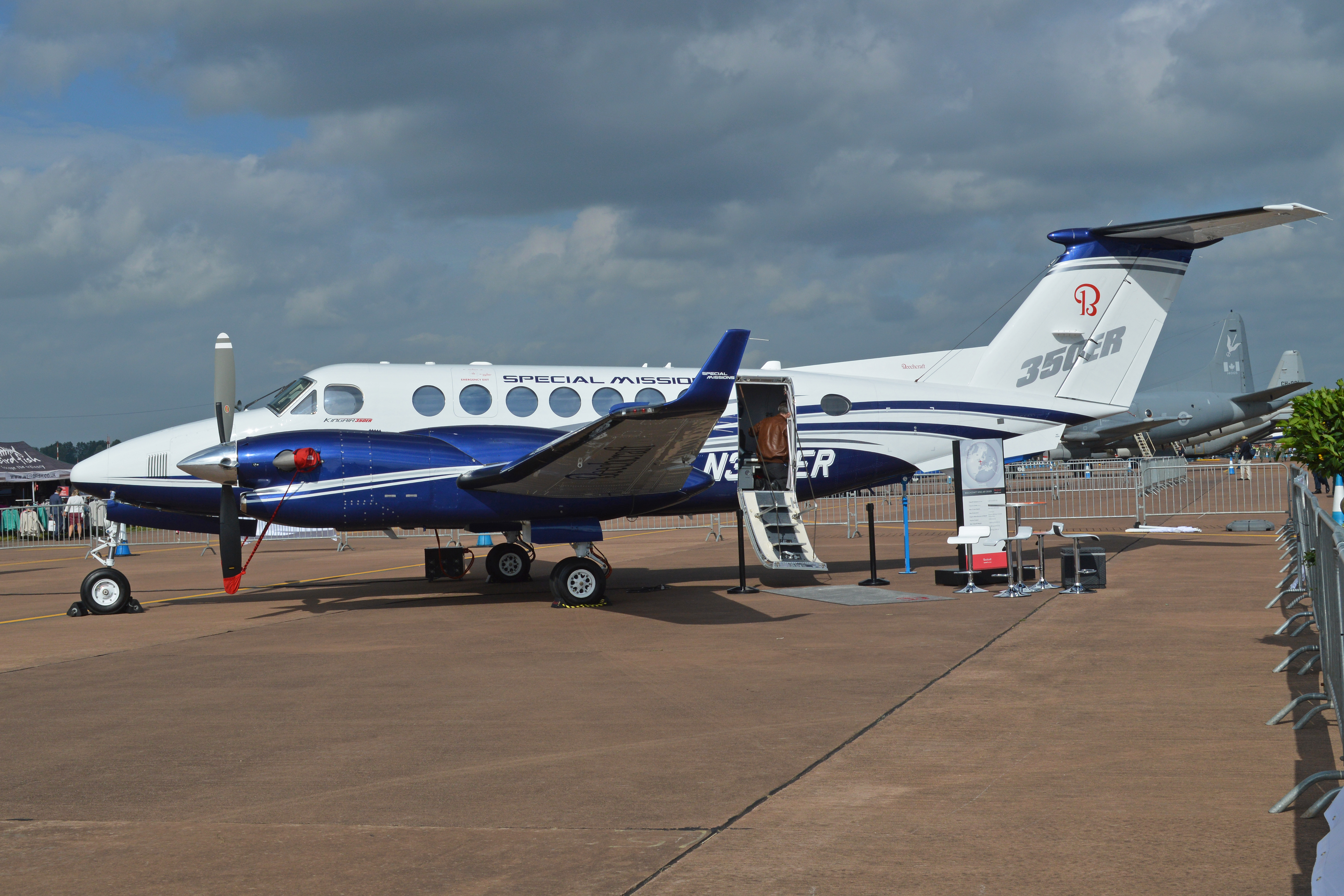
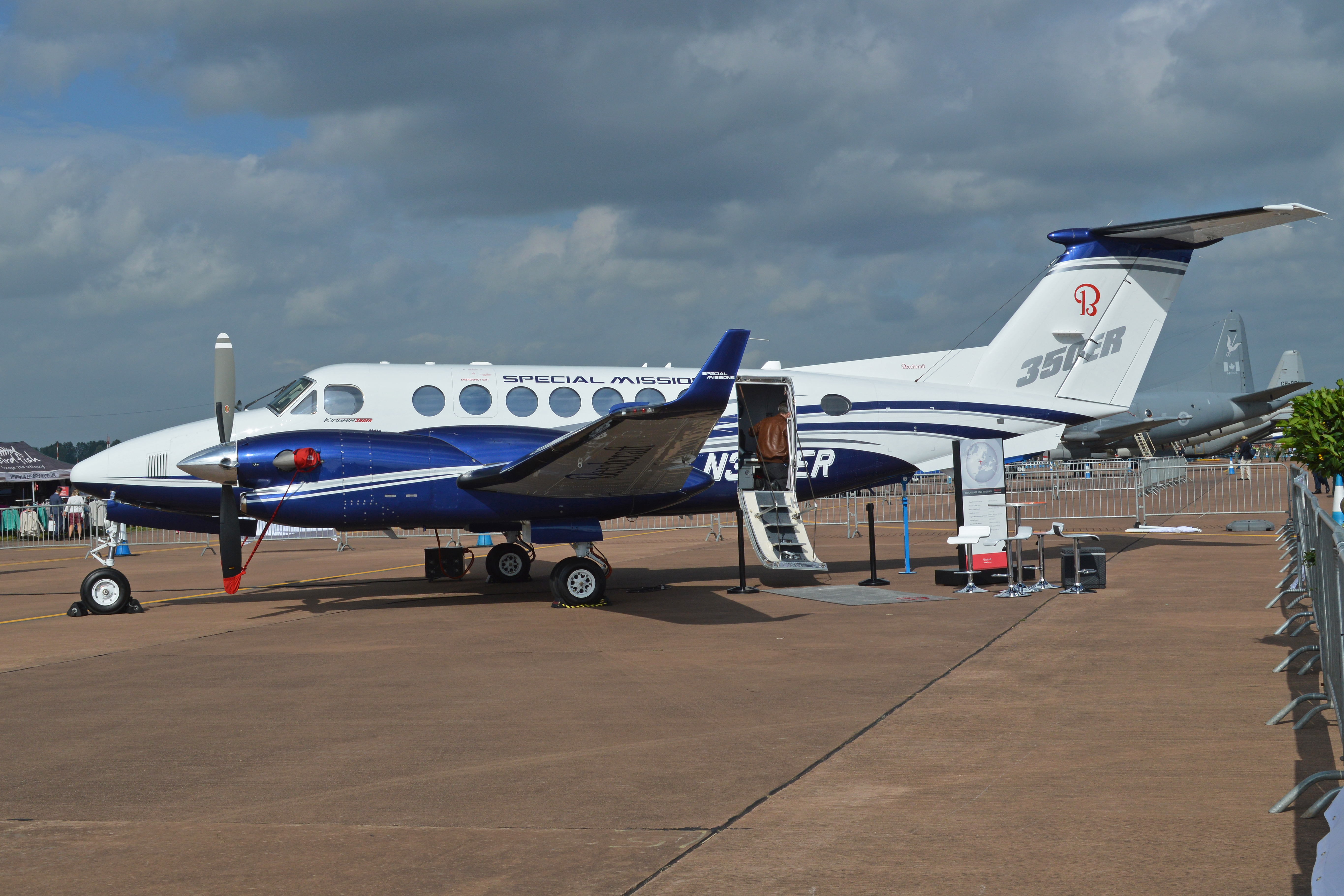
King Air 350ER demonstrator N350ER on display, airstair open. · Alan Wilson, CC BY-SA 2.0, via Wikimedia Commons
Beechcraft · Turboprop
King Air 350ER / 350iER
The extended-range member of the King Air 350 family, between the standard 350 and the 360ER.
The 350ER flies farther than any other King Air of its era, about 2,690 nm on maximum fuel, and lifts more. You pay with a slightly slower airplane, less baggage space, a thin resale market and new wing-inspection rules.
Buy it if
You need two-engine range for long legs, overwater crossings or remote strips, often fly heavy, and value nonstop reach more than a few knots of speed or extra baggage room.
Skip it if
Your trips are mostly under 1,000 nm, you want the lowest running cost, you carry skis and golf bags that a standard 350 stows in its nacelles, or you may sell within a few years.
Biggest compromise
The extra fuel lives where a standard King Air 350 carries luggage. The nacelle lockers become tanks, so the 55 cubic-foot hold inside the cabin is the main baggage space, and the heavier airframe is about 9 knots slower and needs roughly 750 ft more runway than a 350i at maximum weight.
The numbers that matter
Purchase price
$5.25M–$5.25M
guide value (AvBuyer's JETNET market panel (advertised prices))
What it costs per year
$909K
at 300 hrs · two professional pilots
How far it flies
2,690 nm
How fast
303 kt
high-speed cruise
Seats
8
8 typical (up to 11 by interior)
Pilots needed
1
Certified for one pilot with a type rating; professional operators often fly it with two.
Price
What one costs to buy
Guide value
$5.25M–$5.25M
Other sites
8.9% of the fleet
Priced vs call
with a price / call for price
The one public listing asks for offers; AvBuyer's JETNET panel shows ER-family aircraft advertised around $5.25M. New, a 350iER listed near $8.8M in 2019.
Price vs its family and alternatives
Scroll to explore · select a jet for details
King Air 350ER / 350iER · This aircraft
$5.25M–$5.25M guide
Guide value, not a listed asking price.
Sits between the King Air 350 (B300) and the PC-12 NGX.
For sale now
None listed right now
Cost to own
What it costs per year to run
300hours / year
Per year
Per flight hour
Estimate — your operator will quote actual numbers.
Fuel, airframe maintenance, engine program or reserve and landing, handling and crew trip fees rise as you fly more. Two pilots (salary and benefits), recurrent training, hangar, insurance, management and charts, software and subscriptions stay the same however much you fly.
Where the money goes
- Two pilots (salary and benefits)$230,00025%
- Recurrent training$30,9003%
- Hangar$30,1003%
- Insurance$36,7504%
- Management$60,0007%
- Charts, software and subscriptions$30,0003%
- Fuel$272,58030%
- Airframe maintenance$83,8509%
- Engine program or reserve$92,40010%
- Landing, handling and crew trip fees$42,0005%
Fuel is the biggest single cost at 30% of the total.
The JetGrade
72 out of 100 — Slightly above its class
Peer group: King Air 350i, King Air 250, P.180 Avanti II, PC-12 NG (/47E), King Air 360 / 360ER
Seven categories at a glance
- - - 70 = typical— This aircraft
Strongest on range & payload, weakest on running costs.
Grades are editorial opinions about the model, not any specific aircraft. Sponsors and affiliates have no input. Reviewed 2026-10-04.
Where it flies
Sample trips and reach
Typical trips on a map
Nonstop
Depends on weight or weather
6 of 8 sample trips are comfortable nonstops.
Sample flight times
- 1.1 hr
Carlsbad → Las Vegas
205 nm
- 2.6 hr
Carlsbad → Aspen
625 nm · High-altitude airport; summer departures weight-limited
- 3.0 hr
Santa Ana → San José del Cabo
765 nm
- 3.5 hr
Teterboro → West Palm Beach
900 nm
- 4.5 hr
Dallas → Teterboro
1,190 nm
- 5.3 hr
Teterboro → San Juan
1,410 nm · Long overwater leg within comfortable range
- 7.6 hr
Carlsbad → Teterboro
2,100 nm · Nonstop possible eastbound; westbound usually needs a stop
- 8.0 hr
Los Angeles → Honolulu
2,215 nm · Light load and favorable winds only; often ferried
Lineage
What came before and after


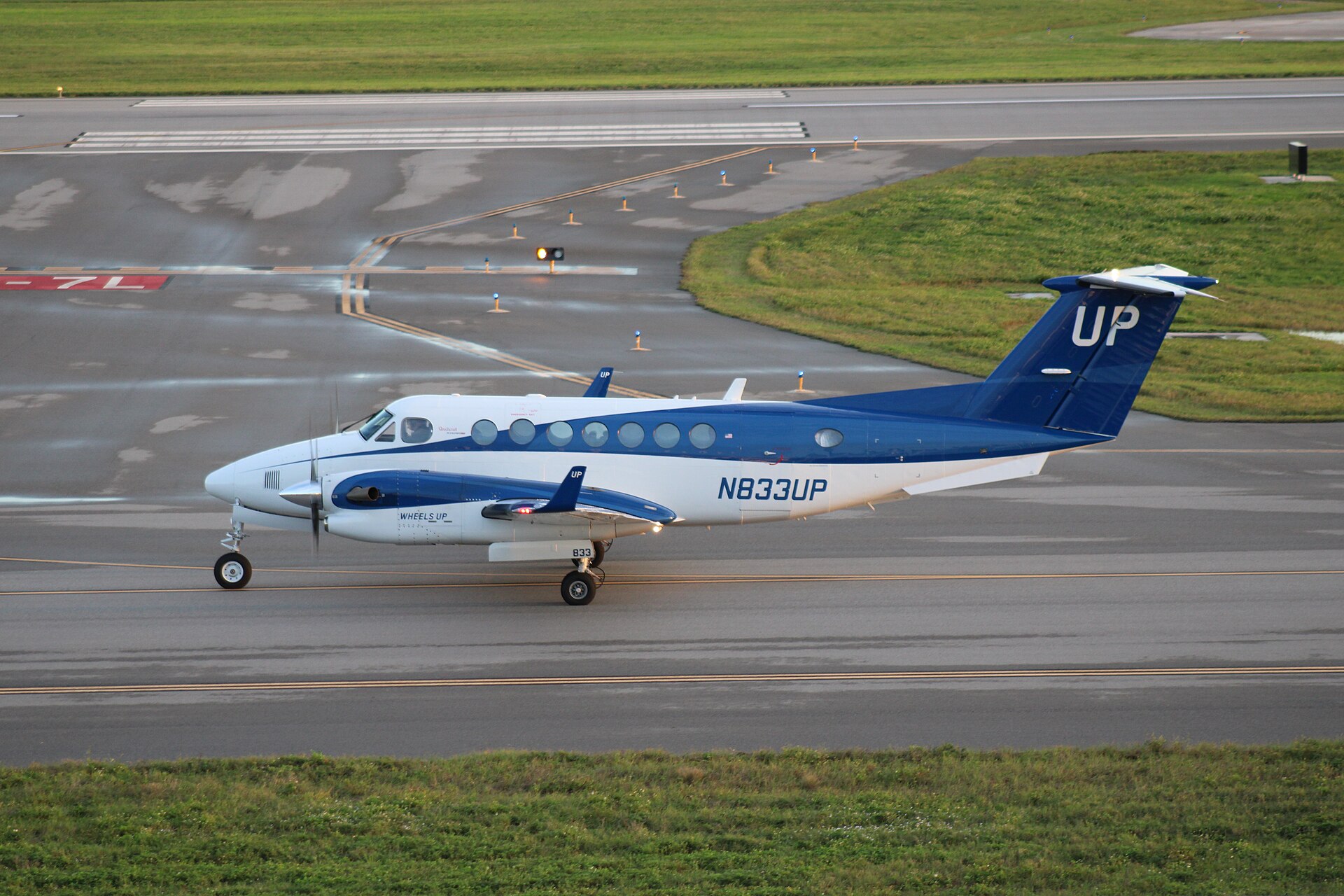
2008–2020
King Air 350ER / 350iER
Nacelle fuel tanks, 16,500 lb weight and heavy-duty gear.
What changed from the King Air 350
- Maximum takeoff weight rises to 16,500 lb from the standard 350's 15,000 lb.
- Nacelle tanks add 236 gallons, lifting usable fuel to 775 gallons from 539.
- Heavier-duty landing gear from the Beech 1900 for high weights and rough strips.
- Nacelle luggage lockers give way to fuel, leaving the cabin hold for bags.
- The 350iER adds the 350i's quieter cabin and Collins Venue entertainment system.
- Later aircraft switched from Pro Line 21 to the touchscreen Pro Line Fusion cockpit.
Size and cabin
How big it is, inside and out
Outside
Silhouette · scaled to length
Length
Wingspan
Height
Inside the cabin
Cabin length
Width
Height
Compare
How it stacks up
This aircraft
King Air 350ER / 350iER
- JetGrade
- 72
- Price
- $5.25M–$5.25M guide
- Cost per year
- $909K
- Range
- 2,690 nm
- Speed
- 303 kt
- Seats
- 8
- Cabin length
- 19′ 6″
- Pilots
- 1
- Years built
- 2008–2020
← Before
- JetGrade
- 76
- Price
- $3.25M
- Cost per year
- $1.13M
- Range
- 1,806 nm
- Speed
- 312 kt
- Seats
- 8
- Cabin length
- 19′ 6″
- Pilots
- 1
- Years built
- 1990–2009
After →
- JetGrade
- 74
- Cost per year
- $976K
- Range
- 2,690 nm
- Speed
- 303 kt
- Seats
- 8
- Cabin length
- 19′ 6″
- Pilots
- 1
- Years built
- 2020–now
Alternative
- JetGrade
- 72
- Cost per year
- $1.03M
- Range
- 1,806 nm
- Speed
- 312 kt
- Seats
- 8
- Cabin length
- 19′ 6″
- Pilots
- 1
- Years built
- 2009–2020
Alternative
- JetGrade
- 80
- Price
- $7.39M
- Cost per year
- $608K
- Range
- 1,889 nm
- Speed
- 290 kt
- Seats
- 6
- Cabin length
- 16′ 11″
- Pilots
- 1
- Years built
- 2020–2025
- Beechcraft King Air 350i instead: Same cabin with nacelle luggage lockers, about 9 knots more speed and a shorter takeoff run; the better pick if you rarely need the extra fuel.
- Beechcraft King Air 360ER instead: The same extended-range airframe with autothrottle, digital pressurization and a newer cabin, for buyers with a bigger budget.
- Pilatus PC-12 NGX instead: One engine, lower running costs, shorter runway needs and a large cargo door, but less range and only one engine over water.
Gold marks the best figure in each row.
Owning one
What to know before you buy
Engines & inspections
2 × Pratt & Whitney Canada PT6A-60A · 1,050 shp each
No APUEngine hours until overhaul
- Phase inspection · 200 hr
- Fuel nozzle flow check · 400 hr
- Starter-generator overhaul · 1,000 hr
- Engine overhaul · 3,600 hr
- Wing attach angle replacement · 29,200 hr
- Pitot-static and transponder check every 24 months
Pratt & Whitney Canada's hourly engine program covers King Air engines; check enrollment and transfer terms before buying.
Known issues
2026 wing structure directive
A 2026 FAA rule sets new wing inspections and part-replacement limits for 16,500 lb King Air 350s, including ERs; some aircraft were overdue.
Engine-out rudder forces
Low-speed engine failure demands heavy rudder; working rudder boost and recurrent training are essential, as a fatal 2019 accident showed.
Special-mission histories
About three-quarters of 350ERs went to defense-type customers; sensor installs and removals need close records review.
Pre-buy checklist
0 of 9 checked
Textron Aviation runs a worldwide company-owned service network with more than 30 mobile service units and a 24-hour AOG line, and the PT6 engine is supported almost everywhere turboprops fly.
Review
The full review
Strengths
- Published maximum range of about 2,690 nm on 775 gallons of usable fuel.
- Maximum takeoff weight of 16,500 lb and heavy-duty landing gear suit heavy, rough-strip and overwater work.
- Two Pratt & Whitney PT6A-60A engines with 3,600-hour overhaul intervals and Textron's worldwide service network.
Limitations
- Nacelle fuel tanks replace the standard 350's nacelle lockers, leaving a 55 cubic-foot, 550 lb cabin hold.
- Needs about 4,057 ft of runway at maximum weight, roughly 750 ft more than a 350i.
- A 2026 FAA rule adds wing inspection and part-replacement limits for 16,500 lb King Air 350s, including ERs.
The King Air 350ER is the extended-range version of Beechcraft's King Air 350, the largest of the classic King Air twin turboprops. Beechcraft announced it in 2005 and the FAA approved it in late 2007. It is the same 350 airframe with extra fuel tanks in the engine nacelles, a maximum takeoff weight raised to 16,500 lb from 15,000 lb, and heavier landing gear taken from the Beech 1900 airliner. From about 2010 it was sold as the 350iER, which added the 350i's quieter, updated cabin. The King Air 360ER replaced it in 2020. Most ERs went to governments and special-mission operators, so private examples are far less common than standard 350s.
Pilot's take
The 350ER flies like any King Air 350 until it is heavy. Near 16,500 lb, climb slows to about 1,500 feet per minute and takeoff runs stretch, so performance planning matters at hot or short fields. The payoff is time aloft: with full nacelle tanks, a crew can plan legs that would need a fuel stop in a standard 350. Engine-out handling deserves respect. Rudder forces at low speed are high, and rudder boost plus recurrent training are part of flying this airplane well. Watch the flight manual revision, too; early takeoff charts were corrected in 2011.
Who this is for
Owners who fly long overwater or remote legs, air-ambulance and special-mission operators, and private buyers who want King Air simplicity with more fuel and weight capacity than any standard 350.

Ask about this aircraft
Answers come only from our research file on the Beechcraft King Air 350ER / 350iER.
Your earlier questionsOwners
Private to verified ownersOwn a Beechcraft King Air 350ER / 350iER? Verify with its FAA registration to join the owners' thread and the real-cost poll.