
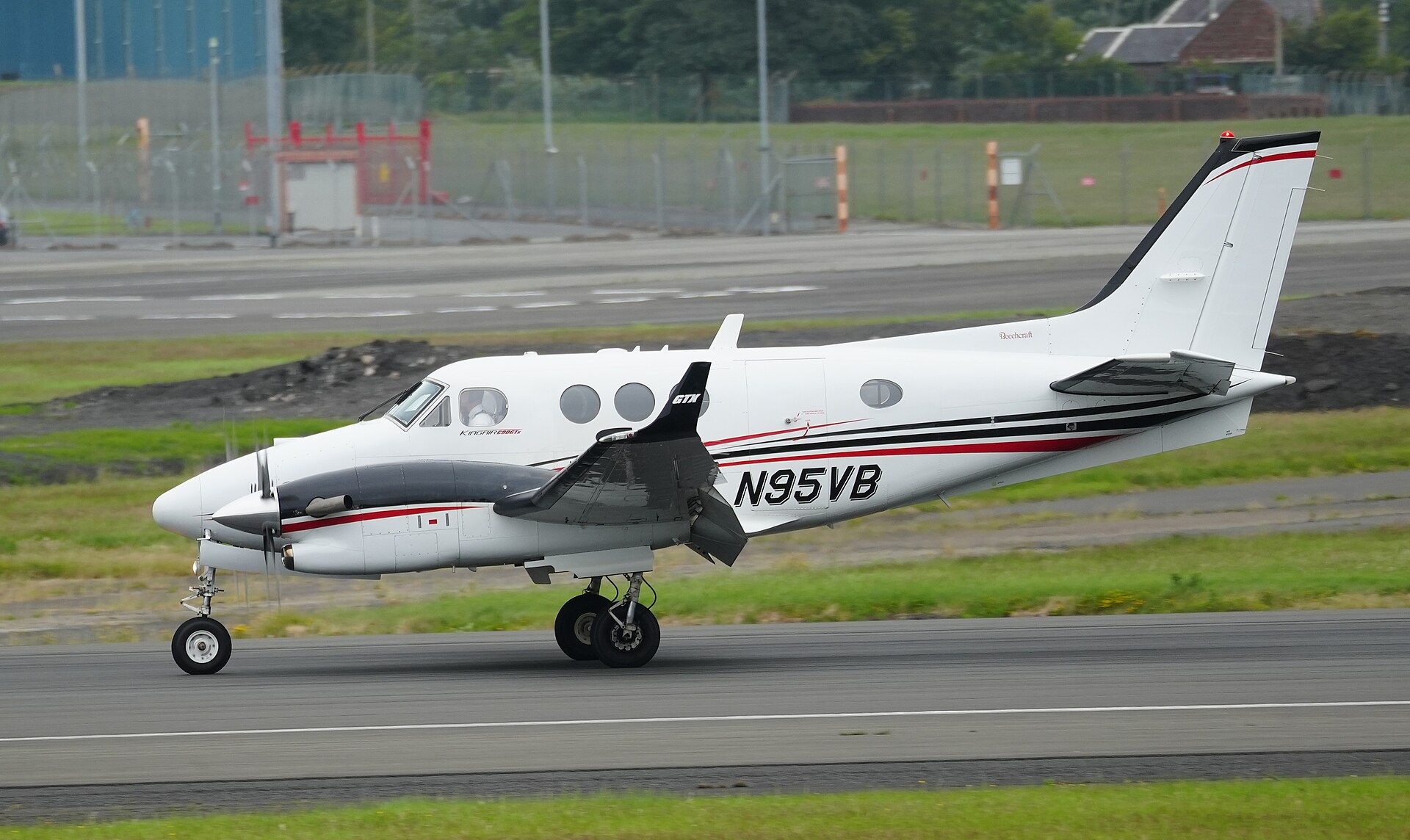
Silhouette traced from a photo of the closest sister model, the King Air C90, by Joao Carlos Medau from Campinas, Brazil · CC BY 2.0
Nextant · Turboprop
Nextant G90XT
An aftermarket rebuild of the King Air C90, offered by Nextant alongside the factory-built C90GTx.
The G90XT fixes the classic King Air 90's weak spots: engines, cockpit, cooling and noise. It should cost less to fly than a C90GTx, but none were listed for sale in October 2026 and support for the conversion is unclear.
Buy it if
You want a single-pilot twin turboprop for 200–700 nm trips, like modern Garmin avionics and simple single-lever engine handling, and can find a well-kept example with clear engine support in writing.
Skip it if
You need easy resale, a broad factory service network, or more than about 900 nm with four passengers. A factory King Air C90GTx or a Pilatus PC-12 is the safer choice.
Biggest compromise
You are buying a small-fleet conversion. Nextant's website now points to Flexjet Technical Services, which does not list the G90XT, and the GE engines go to a small specialist network for overhaul.
The numbers that matter
What it costs per year
$553K
at 300 hrs · one professional pilot
How far it flies
1,500 nm
600–900 nm with passengers
How fast
263 kt
high-speed cruise
Seats
5
5 typical; up to 7
Pilots needed
1
Certified for single-pilot operation, like other King Air 90s.
Price
What one costs to buy
Typical asking price
$0
Other sites
Priced vs call
with a price / call for price
No G90XT was for sale in October 2026. New conversions were priced around $2.6–2.8M with the airframe; King Air C90A donors list near $1.4M.
Price vs its family and alternatives
Scroll to explore · select a jet for details
For sale now
None listed right now
Cost to own
What it costs per year to run
300hours / year
Per year
Per flight hour
Estimate — your operator will quote actual numbers.
Fuel, airframe maintenance and engine overhaul reserve rise as you fly more. One professional pilot, hangar and insurance stay the same however much you fly.
Where the money goes
Partial estimate- One professional pilot$86,25016%
- Hangar$29,0005%
- Insurance$24,6884%
- Fuel$227,95541%
- Airframe maintenance$144,00026%
- Engine overhaul reserve$41,2507%
Fuel is the biggest single cost at 41% of the total.
The JetGrade
Not yet rated
Peer group: Beechcraft King Air C90GTx, Beechcraft King Air C90B / C90SE, Pilatus PC-12/47, Daher TBM 850, Piper M600
Seven categories at a glance
- - - 70 = typical
This model hasn't been graded yet.
Grades are editorial opinions about the model, not any specific aircraft. Sponsors and affiliates have no input. Reviewed 2026-10-08.
Where it flies
Sample trips and reach
Typical trips on a map
Nonstop
Depends on weight or weather
Fuel stop likely
1 of 6 sample trips are comfortable nonstops.
Sample flight times
- 1.2 hr
Carlsbad → Las Vegas
205 nm · Short hop, well within range
- 2.9 hr
Carlsbad → Aspen
625 nm · Mountain airport; weather and weight matter
- 3.5 hr
Santa Ana → San José del Cabo
765 nm · Nonstop with four aboard in light winds
- 4.5 hr
Teterboro → West Palm Beach
900 nm · Nonstop only with fewer passengers or tailwinds
- 5.6 hr
Dallas → Teterboro
1,190 nm · One stop, typically in the Ohio Valley
- 9.6 hr
Carlsbad → Teterboro
2,100 nm · Two stops crossing the country
Lineage
What came before and after


2015–2018 approvals
Nextant G90XT
Older C90 rebuilt with GE engines, Garmin G1000 and a new cabin.
What changed from the King Air C90A
- GE H75-100 engines replace PT6s: same 550 shp, held to 24,000 ft, no hot-section inspection.
- Single-lever power control with electronic engine control, autostart and exceedance protection.
- Three-screen Garmin G1000 with GFC 700 autopilot, synthetic vision and envelope protection.
- New composite shell and seats; Nextant says cabin noise fell 9.5 dB.
- Digital pressurization and new air conditioning with triple the cooling capacity.
- Landing gear overhauled, life-limited parts renewed, Raisbeck strakes and wing lockers added.
Size and cabin
How big it is, inside and out
Outside
Silhouette · scaled to length
Length
Wingspan
Height
Inside the cabin
Cabin length
Width
Height
Compare
How it stacks up
This aircraft
Nextant G90XT
- JetGrade
- Not yet graded
- Cost per year
- $553K
- Range
- 1,500 nm
- Speed
- 263 kt
- Seats
- 5
- Cabin length
- 12′ 6″
- Pilots
- 1
- Years built
- 2015–now
← Before
- JetGrade
- 71
- Price
- $1.42M
- Cost per year
- $550K
- Range
- 1,120 nm
- Speed
- 247 kt
- Seats
- 6
- Cabin length
- 12′ 4″
- Pilots
- 1
- Years built
- 1984–1992
Alternative
- JetGrade
- 65
- Price
- $2.7M–$3.13M guide
- Cost per year
- $644K
- Range
- 1,260 nm
- Speed
- 272 kt
- Seats
- 5
- Cabin length
- 12′ 7″
- Pilots
- 1
- Years built
- 2010–2021
Alternative
- JetGrade
- 70
- Price
- $2.52M
- Cost per year
- $605K
- Range
- 1,049 nm
- Speed
- 246 kt
- Seats
- 6
- Cabin length
- 12′ 8″
- Pilots
- 1
- Years built
- 1992–2005
Alternative
- JetGrade
- 79
- Price
- $3M–$4.25M guide
- Cost per year
- $524K
- Range
- 1,660 nm
- Speed
- 265 kt
- Seats
- 6
- Cabin length
- 16′ 11″
- Pilots
- 1
- Years built
- 2006–2008
- Beechcraft King Air C90GTx instead: The factory-built final King Air 90, with winglets, a 10,485 lb takeoff weight and Textron support, at roughly $2.7–3.2M.
- Beechcraft King Air C90B / C90SE instead: The same cabin with proven Pratt & Whitney PT6 engines and service at almost any turboprop shop; easy to buy and sell.
- Pilatus PC-12/47 instead: One engine instead of two, but a far larger cabin, a big cargo door and a worldwide factory service network.
Gold marks the best figure in each row.
Owning one
What to know before you buy
Engines & inspections
2 × GE H75-100 · 550 shp each
No APUEngine hours until overhaul
- Engine minor inspections · 100 hr
- Phase 1–4 inspections · 200 hr
- Starter-generator overhaul · 1,000 hr
- Engine overhaul · 4,000 hr
- Landing gear inspection every 72 months
- Wing bolt inspection every 60 months
- Fluid and brake hoses every 60 months
No hot-section inspection is required. GE has offered OnPoint hourly plans on its H-Series engines; ask whether these engines are enrolled and whether coverage transfers.
Known issues
Conversion support is unclear
Nextant's website now points to Flexjet Technical Services, which does not list the G90XT; conversion parts and manuals depend on that support.
Engine overhaul turnaround
Overhauls happen in Prague or at Prime Turbines in Dallas and take about eight weeks plus shipping.
Engine life-limit directives
FAA directives in 2023 and 2024 tightened life limits on H75 engine parts; ask for a current parts-life statement.
Pre-buy checklist
0 of 10 checked
GE in Prague and Prime Turbines in Dallas overhaul the H75 engines. Nextant's former website now points to Flexjet Technical Services; confirm who supports the conversion before buying.
Review
The full review
Strengths
- GE H75-100 engines carry a 4,000-hour overhaul interval and need no mid-life hot-section inspection, cutting a major King Air expense.
- Nextant quotes 10–12% better fuel efficiency; a magazine flight test measured 263 kt at 24,000 ft on 616 lb per hour.
- Three-screen Garmin G1000 with GFC 700 autopilot, single-lever power, autofeather and a cabin Nextant says is 9.5 dB quieter.
Limitations
- Independent figures suggest about 1,000 nm with three passengers, dropping roughly 100 nm for each extra passenger.
- None were listed for sale in October 2026, and no published value guide covers the G90XT, so resale is hard to judge.
- The King Air 90 cabin is about 4 ft 10 in tall and 4 ft 6 in wide; nobody stands inside.
The Nextant G90XT is not a new airplane. It is a Beechcraft King Air C90, a family of pressurized twin turboprops built from 1971, stripped down by Nextant Aerospace in Cleveland and rebuilt with new engines, a new cockpit and a new cabin. The FAA approved the conversion in November 2015 and signed off its single-lever power controls in February 2018. It sits alongside the factory King Air C90GTx as a cheaper way into a modern King Air 90, and it is certified as a C90A.
Pilot's take
From the left seat the G90XT still feels like a King Air: solid, predictable and a little heavy in roll, which helps on an instrument approach. The difference is the workload. One power lever per engine, autostart, exceedance protection and a GFC 700 autopilot with envelope protection take a lot off a single pilot. AOPA's test pilot noted the takeoff came without the usual torque surge and that the airplane wants a fair amount of nose-up trim in the flare. We would want type-specific training on the electronic engine controls, including the manual reversion mode, before flying one alone.
Who this is for
An owner-pilot or single-pilot operator carrying two to four people 200–700 nm, often from short or high airports, who wants twin-engine redundancy and low engine costs and plans to keep the aircraft for many years.

Ask about this aircraft
Answers come only from our research file on the Nextant G90XT (remanufactured C90).
Your earlier questionsOwners
Private to verified ownersOwn a Nextant Nextant G90XT? Verify with its FAA registration to join the owners' thread and the real-cost poll.