
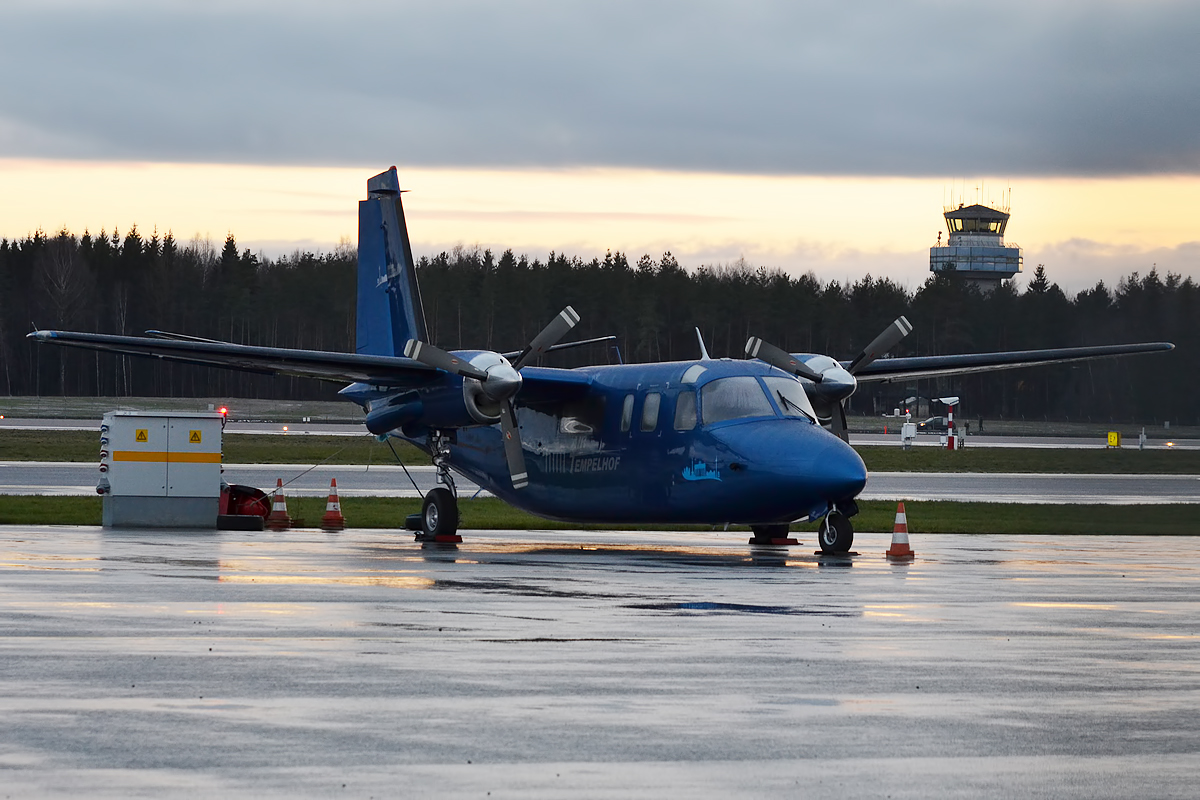
A Model 681 Hawk Commander at Tallinn, Estonia, in 2014. · Anna Zvereva, CC BY-SA 2.0, via Wikimedia Commons
Aero Commander · Turboprop
Turbo Commander 680T / 680V / 680W / 681 (1965–1972)
The first turbine-powered Commanders, ahead of the 690 and every later Jetprop Commander.
A roomy cabin on an honest high-wing airframe, held back by 575 shp engines that need overhaul every 2,000 hours and have few shops behind them. Buy one only with converted engines or a specialist on call, and budget for wing-spar inspections.
Buy it if
You want an inexpensive way into a pressurized twin turboprop, fly mostly from long runways in cooler, lower regions, and have a mechanic who knows Commanders and Garrett engines.
Skip it if
You fly from high or hot airports, need easy resale, or want predictable engine costs. The Commander 690 and King Air 90 offer more power, wider support and an active used market.
Biggest compromise
The original Garrett TPE331-43 engines. At 575 shp they leave the aircraft short of power on hot days and at altitude, they need overhaul every 2,000 hours, and few shops support them.
The numbers that matter
What it costs per year
$573K
at 300 hrs · one professional pilot
How far it flies
1,081 nm
About 600–700 nm with four passengers, depending on equipped weight
How fast
242 kt
high-speed cruise
Seats
6
6 typical (10 certified maximum)
Pilots needed
1
Certified for one pilot; insurers will expect Commander-specific training and turbine experience.
Price
What one costs to buy
Typical asking price
$0
Other sites
Priced vs call
with a price / call for price
No flyable examples were advertised in October 2026. The last asking price seen was $305,000 for a converted 1967 680V, around 2024.
Price vs its family and alternatives
Scroll to explore · select a jet for details
For sale now
None listed right now
Cost to own
What it costs per year to run
300hours / year
Per year
Per flight hour
Estimate — your operator will quote actual numbers.
Fuel, airframe and propeller maintenance, engine overhaul set-aside and trip fees rise as you fly more. One professional pilot, recurrent training, hangar, insurance and databases and tracking stay the same however much you fly.
Where the money goes
- One professional pilot$145,00025%
- Recurrent training$12,0002%
- Hangar$30,0005%
- Insurance$25,0004%
- Databases and tracking$6,7501%
- Fuel$150,93026%
- Airframe and propeller maintenance$95,00117%
- Engine overhaul set-aside$90,00016%
- Trip fees$18,7503%
Fuel is the biggest single cost at 26% of the total.
The JetGrade
56 out of 100 — Well below its class
Peer group: King Air 90 / A90, MU-2 short body, Merlin IIA / IIB, Commander 690 / 690A
Seven categories at a glance
- - - 70 = typical— This aircraft
Strongest on cabin & passenger comfort, weakest on reliability & support.
Grades are editorial opinions about the model, not any specific aircraft. Sponsors and affiliates have no input. Reviewed 2026-10-08.
Where it flies
Sample trips and reach
Typical trips on a map
Nonstop
Depends on weight or weather
Fuel stop likely
1 of 6 sample trips are comfortable nonstops.
Sample flight times
- 1.4 hr
Carlsbad → Las Vegas
205 nm · Short hop; well within range
- 3.4 hr
Carlsbad → Aspen
625 nm · Hot-and-high; original engines limit weight
- 4.6 hr
Santa Ana → San José del Cabo
765 nm · Beyond four-passenger range with full reserves
- 5.2 hr
Teterboro → West Palm Beach
900 nm · One stop, typically in the Carolinas
- 6.6 hr
Dallas → Teterboro
1,190 nm · One stop, typically mid-route
- 11.5 hr
Carlsbad → Teterboro
2,100 nm · Two stops minimum; three with headwinds
Lineage
What came before and after
1964–1967
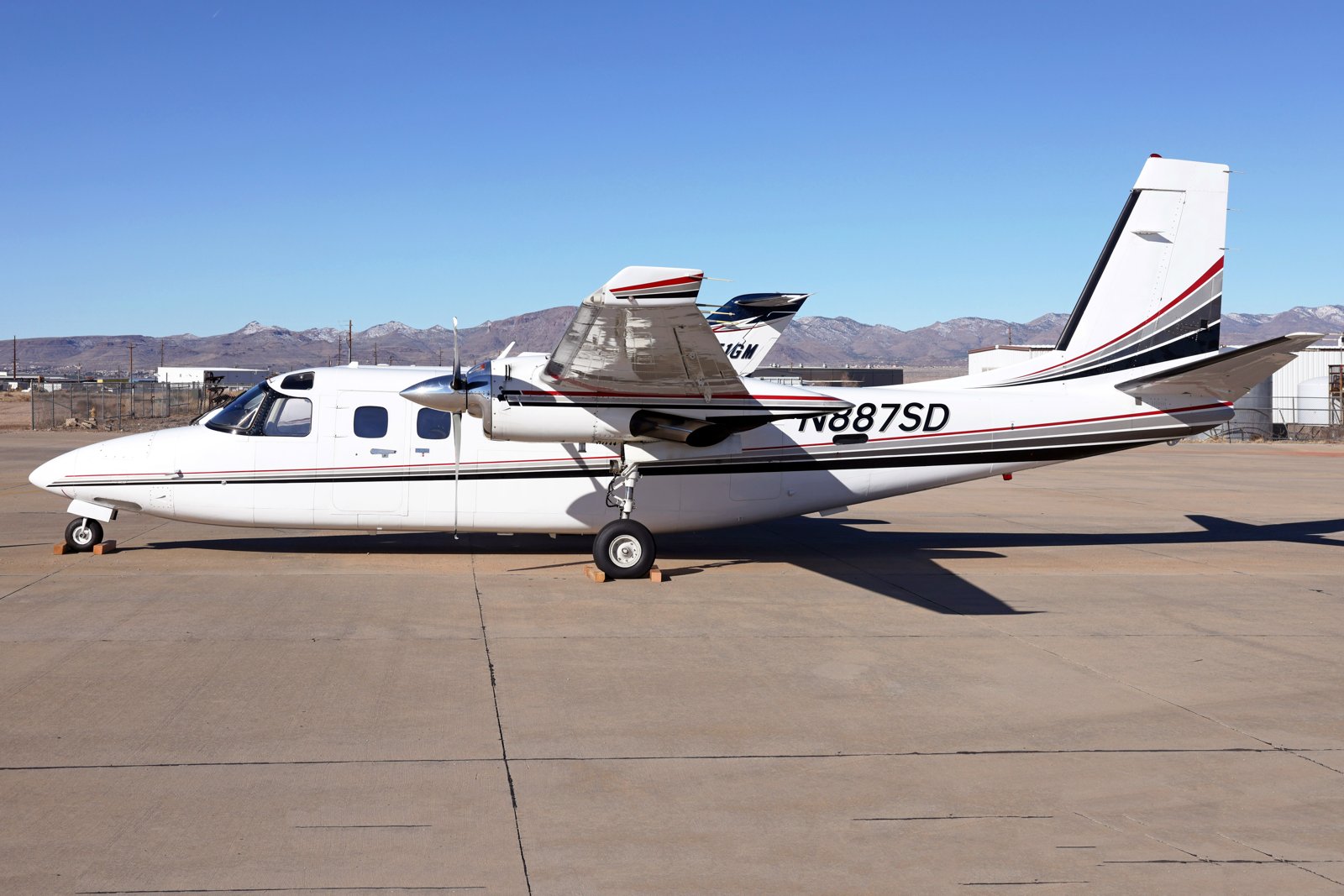
Commander 680FL(P) Pressurized Grand Commander
Piston-engine pressurized Commander that became the 680T airframe.

1965–1972
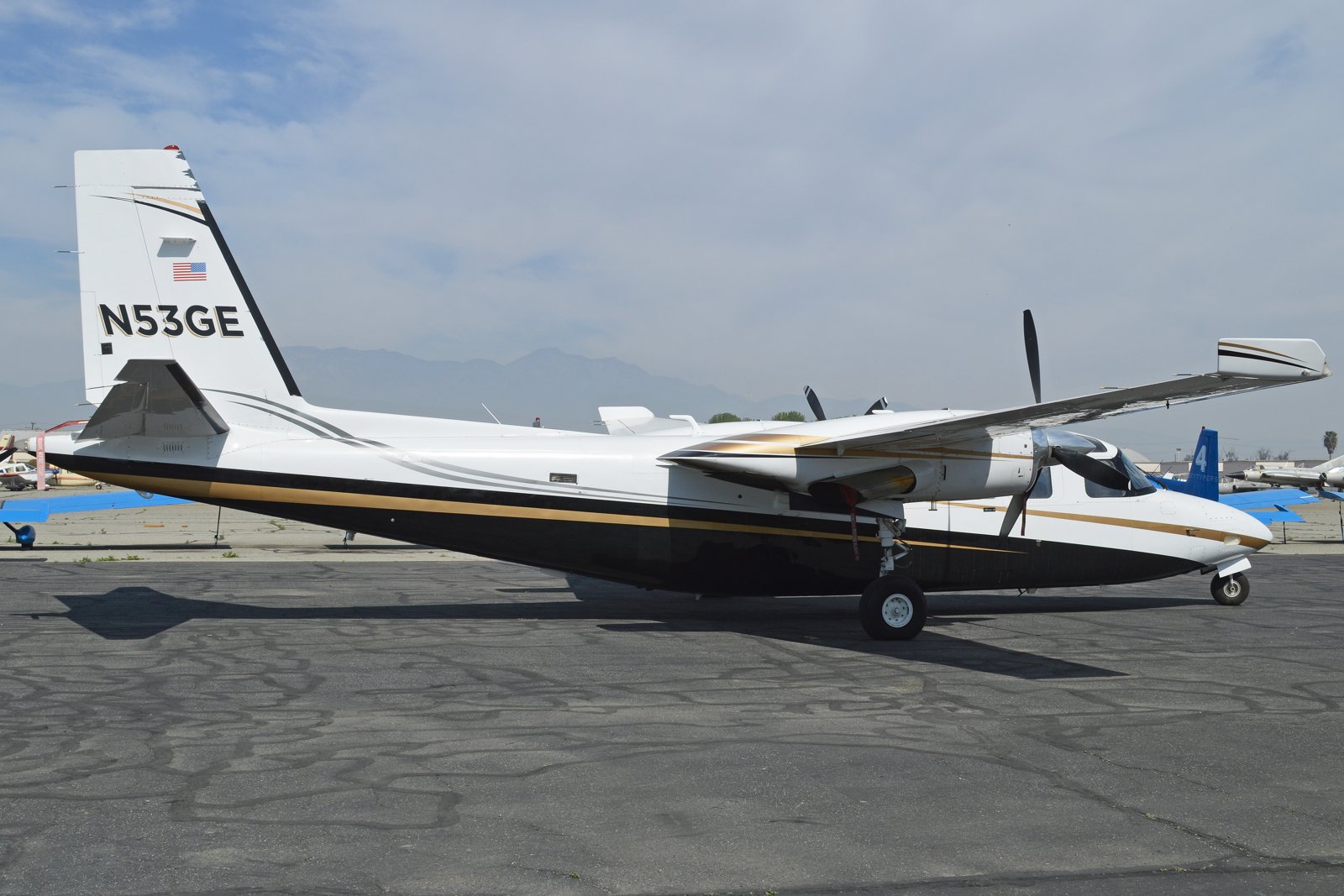
Turbo Commander 680T / 680V / 680W / 681
First turbine Commanders, with 575 shp Garrett engines.



What changed from the Commander 680FL(P) Pressurized Grand Commander
- Two 575 shp Garrett TPE331 turboprops replace the 680FLP's 380 hp supercharged Lycoming piston engines.
- Usable fuel rises from 223 to 286.5 gallons, with optional tanks adding 51 more.
- Maximum takeoff weight climbs from 8,500 lb to 8,950 lb, then 9,400 lb from the 680V.
- Wingtip extensions removed in 1966, cutting the span from about 49 ft to 44 ft.
- The 680W moves to the improved TPE331-43BL engine, also used on the 681.
- The 681 pressurizes with engine bleed air instead of a hydraulically driven compressor.
Size and cabin
How big it is, inside and out
Outside
Silhouette · scaled to length
Length
Wingspan
Height
Inside the cabin
Cabin length
Width
Height
Compare
How it stacks up
This aircraft
Turbo Commander 680T / 680V / 680W / 681 (1965–1972)
- JetGrade
- 56
- Cost per year
- $573K
- Range
- 1,081 nm
- Speed
- 242 kt
- Seats
- 6
- Cabin length
- 14′ 2″
- Pilots
- 1
- Years built
- 1965–1972
← Before
Commander 680FL(P) Pressurized Grand Commander
Not yet graded
After →
- JetGrade
- 67
- Cost per year
- $595K
- Range
- 1,471 nm
- Speed
- 285 kt
- Seats
- 6
- Cabin length
- 14′ 3″
- Pilots
- 1
- Years built
- 1971–1976
Alternative
- JetGrade
- 63
- Cost per year
- $415K
- Range
- 1,160 nm
- Speed
- 216 kt
- Seats
- 5
- Cabin length
- 12′ 4″
- Pilots
- 1
- Years built
- 1964–1968
Alternative
MU-2 short body (B, D, F, K, M, P)
- JetGrade
- 70
- Cost per year
- $461K
- Range
- 1,461 nm
- Speed
- 317 kt
- Seats
- 6
- Cabin length
- 8′ 0″
- Pilots
- 1
- Years built
- 1966–1978
- Commander 690 / 690A instead: The direct successor: 717 shp engines with 5,400-hour overhauls, more fuel, higher weights and much wider shop support.
- King Air 90 / A90 instead: Similar age and price, with Pratt & Whitney PT6A engines and Beechcraft's large service network behind it.
- MU-2 short body instead: Garrett-powered and faster, but its cabin is smaller and FAA rules require MU-2-specific pilot training.
Gold marks the best figure in each row.
Owning one
What to know before you buy
Engines & inspections
2 × Garrett (Honeywell) TPE331-43, -43A or -43BL · 575 shp each
No APUEngine hours until overhaul
- Phase inspection program · 100 hr
- Wing spar cap inspection · 500 hr
- Wing attach bracket inspection · 1,000 hr
- Original engine overhaul · 2,000 hr
- Hartzell propeller overhaul · 3,000 hr
- Converted engine overhaul · 5,400 hr
- Spar cap corrosion scan every 36 months
No hourly engine plan exists for the original engines. Many aircraft now have TPE331-1 conversions with 5,400-hour overhauls.
Known issues
Wing spar cracking history
Commander spar failures led to 1990s directives; a cracked lower spar cap must be replaced, which the FAA put near $100,000 in 1994.
Orphaned original engines
The TPE331-43 series needs overhaul every 2,000 hours and owners report very few shops still support it.
Hydraulic pressurization pump
On the 680T, 680V and 680W a hydraulic pump drives pressurization; owners describe replacement pumps as rare.
Pre-buy checklist
0 of 10 checked
Twin Commander Aircraft, part of Ontic, holds the type certificate in Creedmoor, North Carolina, and supplies airframe parts. Support for the original engines and pressurization parts is thin.
Review
The full review
Strengths
- A cabin about 14 ft 3 in long, certified for up to 10 passengers behind a single pilot.
- Owners report fuel flows of 420 to 480 lb an hour, roughly 63 to 72 gallons, low for a twin turboprop.
- High wing and reversing propellers suit short strips; the original Hamilton Standard propellers have no fixed overhaul time.
Limitations
- Original engines need overhaul every 2,000 hours, against 5,400 hours for later TPE331s, and few shops support them.
- Owners report 190 to 215 kt in the high teens, well below the 242 kt book figure, and weak hot-day climb.
- Wing spar inspections repeat every 500 hours; the FAA put a cracked spar cap replacement near $100,000 in 1994.
The Turbo Commander was Aero Commander's first turbine twin. The 680T, certified in 1965, put two 575 shp Garrett TPE331 turboprops on the pressurized 680FLP Grand Commander airframe. The 680V raised maximum takeoff weight to 9,400 lb in 1967, the 680W of 1968 switched to the improved TPE331-43BL engine, and the 681 Hawk Commander of 1969 added a longer nose and pressurization from engine bleed air. Some late 681s were sold as the lower-priced 681B Propjet. Production ended in 1972, after roughly 200 aircraft counting conversions, and the line continued as the more powerful Commander 690.
Pilot's take
The Turbo Commander shares its airframe with the piston Grand Commander, so pilots who know that aircraft will find the handling familiar, and reversing propellers make short runways comfortable. The original Garrett engines are responsive but run out of breath in the high teens, and on a hot day the climb is slow, so plan departures from high airports carefully. Learn the pressurization system and its limits, especially on the hydraulically driven 680 models. A converted 681 is the pick for pilots who want performance closer to the later 690.
Who this is for
A hands-on owner or small operator in the flatter, cooler parts of the US who wants a pressurized twin turboprop for less than a later Commander and accepts aging engines, scarce parts and a thin resale market.

Ask about this aircraft
Answers come only from our research file on the Turbo Commander 680T / 680V / 680W / 681.
Your earlier questionsOwners
Private to verified ownersOwn a Aero Commander Turbo Commander 680T / 680V / 680W / 681 (1965–1972)? Verify with its FAA registration to join the owners' thread and the real-cost poll.