
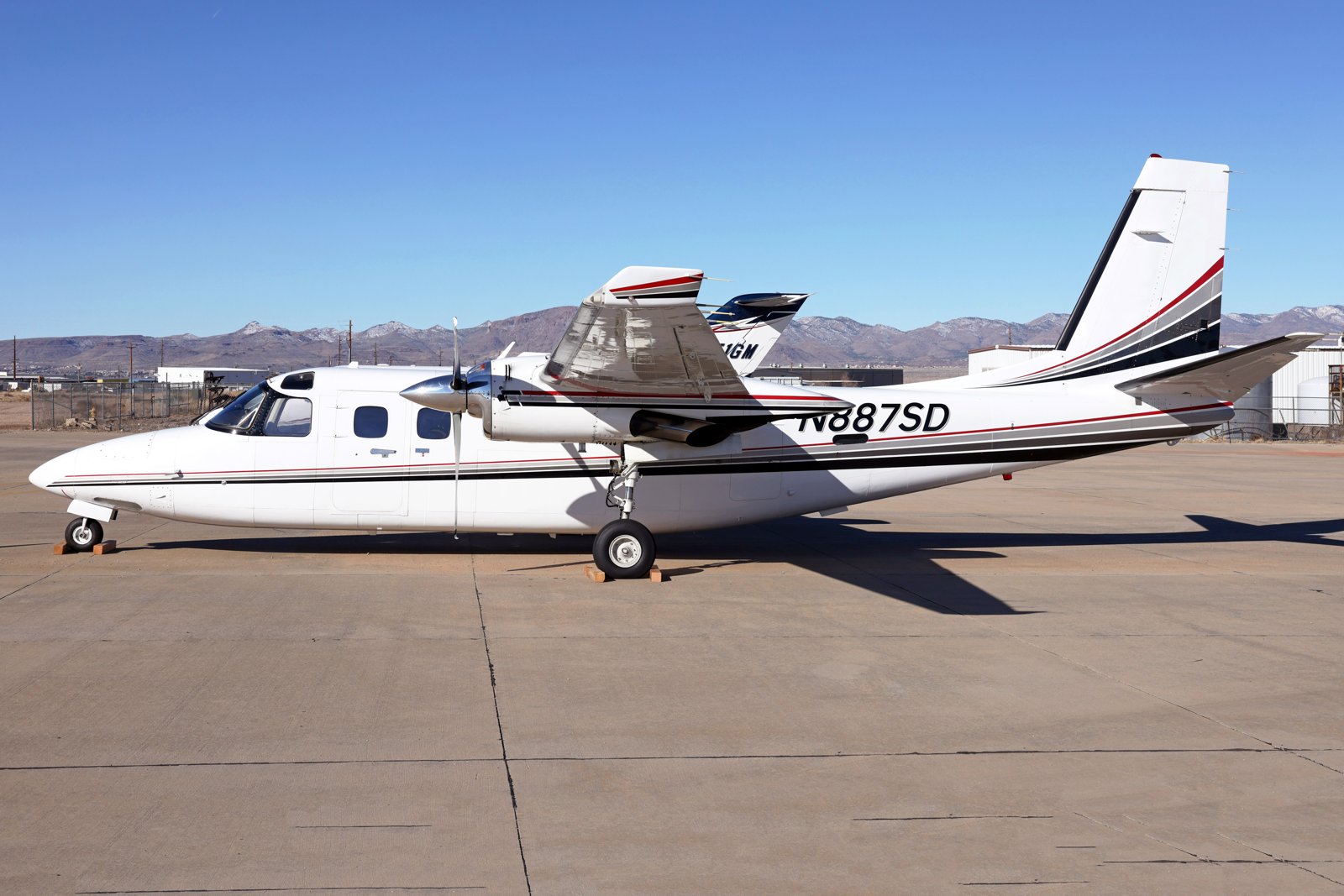
A Commander 1000 (695B) at Kingman, Arizona, in February 2024. · Duncan Kirk, CC BY 4.0, via Wikimedia Commons
Gulfstream American · Turboprop
Commander 1000 (695A/695B)
The final and largest-cabin model of the Twin Commander turboprop family, built 1981 to 1985.
The Commander 1000 pairs near-300-knot speed and 2,000 nm legs with a price under $1.6M. The trade-off is age: structural inspections, rising engine overhaul costs and a tiny market reward patient, well-advised buyers and punish rushed ones.
Buy it if
You want turboprop speed and range for two to four people on 300 to 1,200 nm trips, you or your pilot will train formally on type, and you will budget for engine time and structural inspections up front.
Skip it if
You regularly carry six or more people, want a stand-up cabin or a fully enclosed lavatory, or need an aircraft that will be quick and easy to resell.
Biggest compromise
Every Commander 1000 is now more than 40 years old. Structural fatigue inspections, an open FAA proposal on tail and fuselage cracks, and engine overhauls averaging about $487,000 each mean the condition of the individual airframe and its engines matters far more than the asking price.
The numbers that matter
Purchase price
$1.15M–$1.53M
guide value (Conklin & de Decker and AircraftCostCalculator)
What it costs per year
$380K
at 300 hrs · one professional pilot
How far it flies
2,080 nm
1,210–1,400 nm with passengers
How fast
308 kt
high-speed cruise
Seats
5
5 typical (up to 10 by interior)
Pilots needed
1
Certified for one pilot; insurers expect formal initial and recurrent training on type.
Price
What one costs to buy
Guide value
$1.15M–$1.53M
Other sites
Priced vs call
with a price / call for price
Only one of four listings shows a price, $1.25M. Published guide values run about $1.15M to $1.53M.
Price vs its family and alternatives
Scroll to explore · select a jet for details
Commander 1000 (695A/695B) · This aircraft
$1.15M–$1.53M guide
Guide value, not a listed asking price.
Sits between the Commander 840 (690C) and the Conquest II (441).
For sale now
None listed right now
Cost to own
What it costs per year to run
300hours / year
Per year
Per flight hour
Estimate — your operator will quote actual numbers.
Fuel and engine reserves rise as you fly more. One professional pilot stays the same however much you fly.
Where the money goes
Partial estimate- One professional pilot$112,65030%
- Fuel$199,44052%
- Engine reserves$67,83018%
Fuel is the biggest single cost at 52% of the total.
The JetGrade
70 out of 100 — Typical for its class
Peer group: Beechcraft King Air B200, Beechcraft King Air 200, Cessna Conquest II, Piper Cheyenne IIIA, Mitsubishi MU-2 Marquise
Seven categories at a glance
- - - 70 = typical— This aircraft
Strongest on speed & trip time, weakest on cabin & passenger comfort.
Grades are editorial opinions about the model, not any specific aircraft. Sponsors and affiliates have no input. Reviewed 2026-10-08.
Where it flies
Sample trips and reach
Typical trips on a map
Nonstop
Depends on weight or weather
Fuel stop likely
Out of reach
4 of 8 sample trips are comfortable nonstops.
Sample flight times
- 1.1 hr
Carlsbad → Las Vegas
205 nm · Short hop, well within range
- 2.6 hr
Carlsbad → Aspen
625 nm · Mountain airport; summer heat limits takeoff weight
- 3.2 hr
Santa Ana → San José del Cabo
765 nm · Nonstop with four aboard
- 3.7 hr
Teterboro → West Palm Beach
900 nm · Nonstop with four aboard
- 4.7 hr
Dallas → Teterboro
1,190 nm · Nonstop with four; strong headwinds trim margin
- 6.1 hr
Teterboro → San Juan
1,410 nm · Economy cruise and light load; many crews stop
- 8.3 hr
Carlsbad → Teterboro
2,100 nm · Needs one stop, typically mid-continent
Los Angeles → Honolulu
2,215 nm · Beyond range; no stop possible over water
Lineage
What came before and after


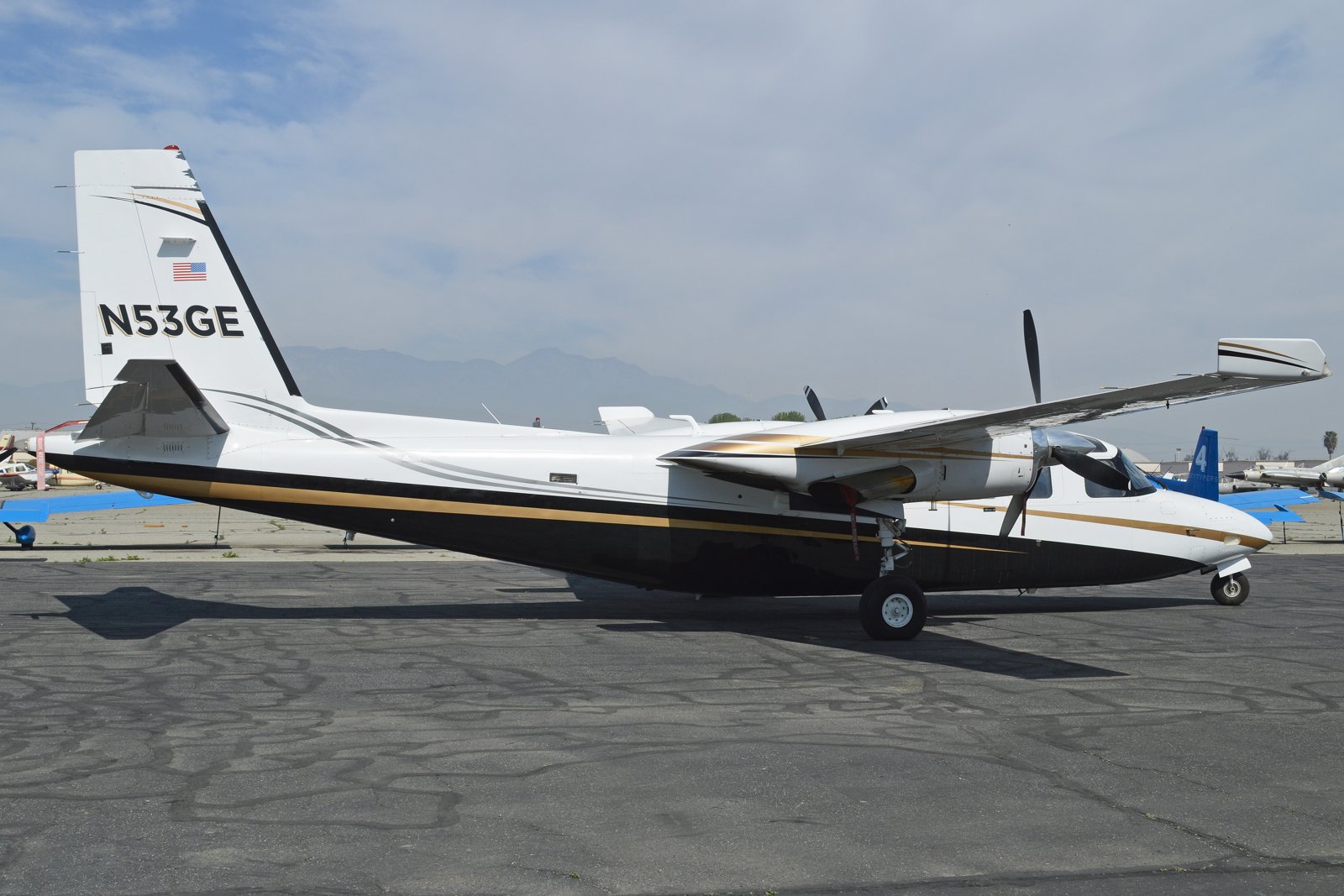


1981–1985
Commander 1000
The longer cabin with Dash 10 engines and the highest weights.
What changed from the Commander 980
- Cabin stretched 3 ft to 17 ft 3 in inside the same fuselage.
- Rear baggage area shortened; a small pressurized baggage area added.
- Same Dash 10 engines, rated 820 shp each instead of 733 hp.
- Maximum takeoff weight up 875 lb to 11,200 lb; the 695B reached 11,750 lb.
- Certified ceiling raised from 31,000 ft to 35,000 ft.
Size and cabin
How big it is, inside and out
Outside
Silhouette · scaled to length
Length
Wingspan
Height
Inside the cabin
Cabin length
Width
Height
Compare
How it stacks up
This aircraft
Commander 1000 (695A/695B)
- JetGrade
- 70
- Price
- $1.15M–$1.53M guide
- Cost per year
- $380K
- Range
- 2,080 nm
- Speed
- 308 kt
- Seats
- 5
- Cabin length
- 17′ 3″
- Pilots
- 1
- Years built
- 1981–1985
← Before
- JetGrade
- 69
- Price
- $825K–$825K guide
- Cost per year
- $915K
- Range
- 1,800 nm
- Speed
- 315 kt
- Seats
- 6
- Cabin length
- 14′ 3″
- Pilots
- 1
- Years built
- 1979–1981
Alternative
- JetGrade
- 74
- Price
- $1.85M
- Cost per year
- $827K
- Range
- 1,580 nm
- Speed
- 291 kt
- Seats
- 7
- Cabin length
- 16′ 8″
- Pilots
- 1
- Years built
- 1981–2009
Alternative
- JetGrade
- 72
- Price
- $1.36M
- Cost per year
- $671K
- Range
- 2,000 nm
- Speed
- 314 kt
- Seats
- 7
- Cabin length
- 12′ 10″
- Pilots
- 1
- Years built
- 1977–1986
Alternative
- JetGrade
- 66
- Price
- $1.47M–$1.53M guide
- Cost per year
- $851K
- Range
- 1,640 nm
- Speed
- 340 kt
- Seats
- 6
- Cabin length
- 18′ 1″
- Pilots
- 1
- Years built
- 1984–1992
- Beechcraft King Air B200 instead: A wider cabin, the largest support network in turboprops and easier resale, at the cost of more fuel and less speed.
- Cessna Conquest II instead: Garrett-powered with similar speed and range, from a larger fleet with broader shop familiarity.
- Piper Cheyenne 400LS instead: More power and more speed in a pressurized cabin, but with an equally small fleet to lean on.
Gold marks the best figure in each row.
Owning one
What to know before you buy
Engines & inspections
2 × Honeywell TPE331-10-501K / -511K · 820 shp each
No APUEngine hours until overhaul
- 150-hour and annual inspection · 150 hr
- Fuel nozzle and combustion check · 450 hr
- Vertical tail crack check · 500 hr
- Wing attachment fitting check · 1,000 hr
- Engine overhaul · 5,000 hr
- Lower wing skin inspection every 12 months
Overhauls now average about $487,000 per engine, so engine time remaining shapes value more than almost anything else. Ask whether either engine is on an hourly plan.
Known issues
Airframe fatigue inspections
A mandatory factory fatigue program covers the wing and fuselage; repairs found during it ran up to about $233,000 in 2003 estimates.
Tail and fuselage cracks
A November 2025 FAA proposal would require new crack inspections of the rear fuselage and tail on 695A airplanes.
Engine overhaul costs climbing
A TPE331-10 overhaul averaged about $487,000 per engine in 2025, up from $294,000 in 2018.
Pre-buy checklist
0 of 10 checked
Twin Commander Aircraft in Creedmoor, North Carolina, still holds the type certificate, keeps the original production tooling and supports the fleet through authorized service centers in the US, South America and Australia.
Review
The full review
Strengths
- A factory range of 2,080 nm at economy cruise is unusually long for a twin turboprop at this price.
- Cruises at up to 308 knots, faster than a King Air 200's roughly 289 knots.
- Burns roughly 75 to 80 gallons an hour, about a quarter less fuel than a King Air 200.
Limitations
- The cabin is 4 ft 1 in wide and 4 ft 9 in tall, narrower than a King Air 200's.
- With full fuel, a lightly equipped example carries only about 785 lb of pilot, people and bags.
- Only 25 remain on the US register, so shops, parts specialists and buyers form a small community.
The Commander 1000 is the last and most capable of the Twin Commander turboprops, a family that began with the Turbo Commander in 1965. Gulfstream built it from 1981 to about 1985, selling it as the Commander 1000 and Jetprop 1000; the FAA calls it the Model 695A, and a heavier 695B followed in 1984. It shares the Commander 980's wing and twin Honeywell TPE331-10 engines but stretches the cabin by 3 ft, to 17 ft 3 in, without lengthening the fuselage, mostly by shrinking the rear baggage area. Roughly 100 to 110 were built, and 25 were on the US register in October 2026.
Pilot's take
We rate the Commander 1000 as a pilot's airplane built around its cruise numbers: close to 300 knots on roughly 75 gallons an hour, with legs long enough to skip stops other turboprops make. The Garrett engines respond quickly but punish careless starts, and engine shops recommend ground-power starts and a close watch on the start sequence. A single red line temperature computer helps hold engine limits in flight. The factory lists a single-engine best climb speed of 120 knots and a minimum control speed of 81 knots. Treat simulator training as the price of entry.
Who this is for
An owner-pilot or small company moving up from a piston twin or older turboprop, flying two to four people 300 to 1,200 nm at a time, who values speed and range over cabin size and has a shop that knows Commanders.

Ask about this aircraft
Answers come only from our research file on the Commander 1000.
Your earlier questionsOwners
Private to verified ownersOwn a Gulfstream American Commander 1000 (695A/695B)? Verify with its FAA registration to join the owners' thread and the real-cost poll.